Welcome to another edition ofChina Insights Weekly. Here are some of the main events of this week:
Chinese shipyards secured 90 percent of global orders for container ships, including all 83 of the giant vessels.
YMTC's share of global NAND memory supply reached 17 percent. The company is also preparing to enter the DRAM segment.
China's exports rose by 36.3 percent and the trade surplus for the first nine months reached $938.1 billion.
Pharmaceutical research is expanding in Shanghai. Boehringer Ingelheim wants to increase China's involvement in the early stages of drug development.
Main News
Visa gets preliminary approval to set up China's first wholly foreign-owned card clearing company (link)
Visa has received preliminary approval from the People's Bank of China to set up the first institution for clearing payments by bank cards in China that will be wholly foreign-owned. This is a step towards being able to independently process domestic transactions without using the China UnionPay network once final approval is obtained.
The payment company, based in San Francisco, must complete preparations within one year and then apply for final approval from the People's Bank of China and the Chinese National Financial Regulatory Administration. Visa is preparing to enter the domestic clearing market as the third international card network, following American Express, which obtained a license in 2020, and Mastercard, which received it in 2023.
Unlike these competitors, which operate through joint ventures with Chinese partners, Visa wants to operate a wholly-owned company. UnionPay had a monopoly on clearing card payments from its founding in 2002 until 2015, when China began opening the sector to competition.
Boehringer Ingelheim opens research center in Shanghai and strengthens China's involvement in early drug development (link)
Boehringer Ingelheim announced on October 12 the opening of a new Chinese research and development center in the Zhangjiang science district in Shanghai. The German pharmaceutical company wants to increase the share of its research and development projects in the early stages that involve China to 100 percent.
China is already participating in all of the company's global key clinical trials and more than 70 percent of its clinical research in the early stages. This helps to bring innovative drugs to the Chinese market among the first in the world or to obtain their approval simultaneously with other countries.
The new center will connect drug discovery, early development, and translational research, i.e., translating scientific knowledge into clinical practice. A specialized Early Medicine team and the External Innovation department will deepen local partnerships and the acquisition of licenses for externally developed drugs.
Chinese authorities have approved three new drugs from the company and five therapeutic indications in the past two years. As part of the "China Strategy 2035," Boehringer Ingelheim aims to obtain nearly 20 regulatory approvals in the country by 2030.
Alibaba Enters the Personal AI Agent Competition with Qwen Go! (link)
The competition to create a personal AI assistant is heating up, and Chinese technology companies are moving quickly. On October 13, Alibaba launched Qwen Go!, a personal assistant based on the Qwen 3.8 models. It is currently available to a limited number of users by invitation. Meanwhile, ByteDance is internally testing the Spell project for its Doubao assistant, and Tencent is working on two concurrent projects.
Qwen Go! is designed to independently handle everyday tasks, such as booking restaurant tables and flights, sending job applications, filing and negotiating compensation claims, booking sports facilities, arranging car servicing, or comparing prices online. Access is being gradually expanded, and the date for full availability has not yet been announced.
Meta, with its Muse service, which was launched along with the Muse Wonder model series, also emphasizes continuous context preservation through Active Memory and Active Focus features. The competition in artificial intelligence is thus shifting from answering questions to performing tasks, and personal assistants are evolving from a technological novelty into a practical tool.
YMTC Achieves Record 17 Percent of Global NAND Shipments and is Preparing to Enter the DRAM Segment (link)
YMTC has rapidly expanded its position in the global NAND flash memory market. In the second quarter of 2026, its share of global shipments reached a record 17 percent, compared to 13 percent a year earlier. Its growing international presence was also highlighted in a previous edition of China Insights Weekly.
The chip manufacturer from Wuhan is expanding its offerings beyond NAND memory. According to forecasts, enterprise data storage could account for nearly 39 percent of its revenue by 2028. The company is also using its proprietary wafer bonding technology to prepare for entry into the DRAM segment and the development of a new generation of high-speed memory.
The diversification aims to transform YMTC into a supplier of a wider range of memory technologies. The company has already filed an application for a primary public offering of shares on the Shanghai STAR Market.
China Accelerates Efforts to Make the Yuan a Global Currency (link)
China's efforts to promote the international use of the yuan are accelerating and expanding from cross-border trade settlement to financing, investment, and foreign exchange reserves. Beijing is expanding the range of financial products offered outside mainland China and plans to increase the volume and frequency of issuances of government bonds in Hong Kong.
Hong Kong authorities are considering short-term debt instruments denominated in yuan and are preparing a revised futures contract for gold denominated in the Chinese currency. Connections between derivatives markets are also being expanded. In August, futures contracts for government bonds were introduced in Hong Kong, and access to "panda" and "dim sum" bonds is being improved.
Cross-border clearing is also growing rapidly. The Chinese CIPS system for cross-border settlement and payment processing in yuan processed transactions worth 180.2 billion yuan, or approximately 26.9 billion USD, in 2025. The annual value of transactions has nearly quadrupled over ten years.
Analysts expect that further measures will focus on accelerating the development of asset markets denominated in yuan. The main challenge remains attracting foreign investors who want to diversify their investments.
Note: The stated share of the yuan in cross-border trade financing, at 9.14 percent, may not include all transactions processed through the CIPS system.
Chinese Shipyards Secure a Record 90 Percent of Global Container Ship Orders
According to data from Clarksons Research, Chinese shipyards secured a record 90 percent of global container ship orders in the first half of 2026. Of the 631 vessels ordered with a capacity of 4.27 million TEU, Chinese manufacturers received orders for 574 vessels with a capacity of 3.84 million TEU. In 2025, their share was 76 percent. One TEU corresponds to the capacity of a single standard twenty-foot container.
In the segment of the largest vessels, the dominance is complete: all 83 vessels ordered with a capacity of at least 18,000 TEU were secured by Chinese shipyards. The demand is supported by major shipping companies including MSC, Maersk, CMA CGM, and the Taiwanese company Wan Hai.
China's main advantage is its available production capacity. Chinese shipyards can offer delivery dates in 2029, while the three largest South Korean manufacturers have their capacities fully booked. Along with rapid progress in more environmentally friendly dual-fuel technologies, this is weakening South Korea's traditional advantage in building high-value-added vessels.
China's trade surplus approached a trillion dollars in nine months (link)
China's exports rose by 36.3 percent year-on-year in September, the fastest growth since February. Imports increased by 31 percent. The monthly trade surplus thus reached $133.5 billion, compared to $119.1 billion in August.
For the first nine months of the year, the surplus reached $938.1 billion. China is on track to surpass last year's annual record of $1.2 trillion.
The growth was driven by goods with high technological content. In the first three quarters, the value of semiconductor exports increased by 108.1 percent, exports of equipment for automated data processing and their components increased by 54.6 percent, and exports of automobiles increased by 54.3 percent.
China accounts for more than 70 percent of new active ingredients for pesticides (link)
According to the Chinese Agrochemical Patent Network, in 2025, Chinese companies accounted for 17 out of 24 new general names of pesticide active ingredients approved under the ISO 1750 system. Their share thus reached 70.8 percent of the global total.
Chinese innovations included six insecticides or acaricides, five fungicides or nematicides, and six herbicides. The development is therefore not limited to herbicides, but also includes products for controlling insects, mites, fungal diseases, and nematodes.
Companies such as KingAgroot, Yangnong Chemical, CAC Group, and Jiangshan Agrochemical are transitioning from producing generic products to their own molecules, specialized research platforms, and international partnerships. This is entering the field of discovering new plant protection products, in which the United States, Europe, and Japan have long been dominant.
The assignment of a general name does not mean registration of the product, approval by the US Environmental Protection Agency, or confirmation of commercial availability. The actual business impact will depend on regulatory approvals and results in field conditions in North and South America.
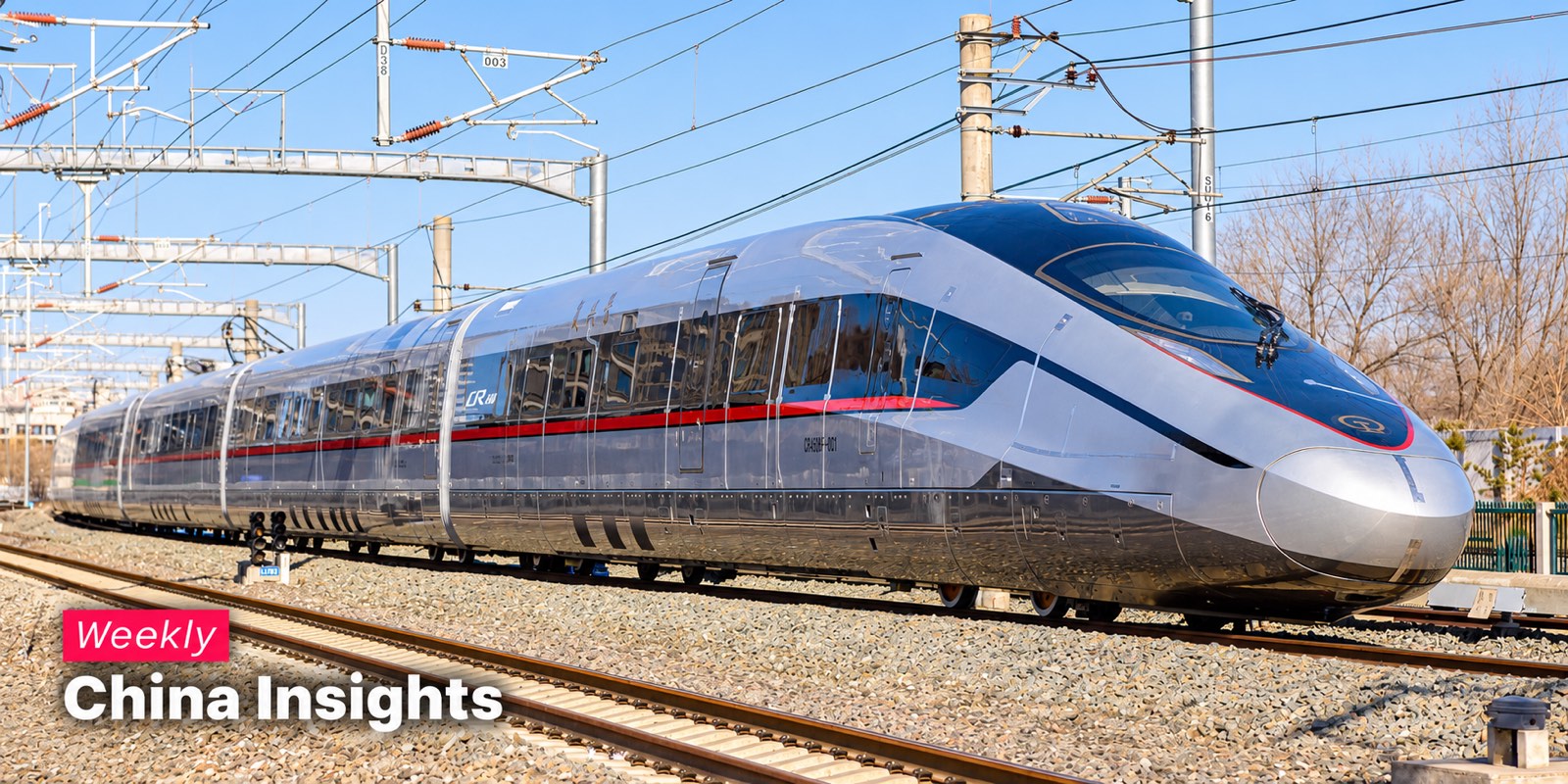
China is preparing a designation for trains traveling at speeds above 350 km/h. Trains for 400 km/h are closer to regular operation (link)
China State Railway Group, the state-owned railway operator, announced the introduction of a new category of trains with the letter X for Fuxing trains traveling at speeds above 350 km/h. The letter comes from the Chinese word "xin," meaning "new." The change suggests the imminent commercial deployment of China's fastest model.
The CR450 train is designed for an operating speed of 400 km/h, 50 km/h faster than the currently operated CR400 trains. During tests in October 2025, it reached a speed of 453 km/h. It benefits from 22 percent lower aerodynamic resistance and 10 percent lower weight. The model is included in the latest five-year plan of the Chinese National Railway Administration.
In the new system, the letter "G" will denote connections with a speed of 350 km/h, and the letter "T" will denote trains with a speed of up to 300 km/h. The total number of available connection designations will increase by approximately 40 percent.
From 2014 to 2025, the length of China's railway network increased by 47.6 percent to 165,000 kilometers. The number of trains capable of traveling at speeds of 300 to 350 km/h more than tripled to 3,149.
Chinese mathematicians, with the help of the Shanghai AI Lab model, have proven a three-dimensional case of Ghy's conjecture (link)
The research team, led by Xu Disheng from Great Bay University, used the Intern-S2 multimodal model from the Shanghai AI Laboratory to prove Ghy's conjecture in the complex three-dimensional dimension. The problem in the field of dynamical systems remained open since 1995, when it was formulated by French mathematician Étienne Ghys.
The model explored various solution directions and generated extensive mathematical derivations. The scientists continuously provided feedback, corrected errors, and guided further work. According to the laboratory, the work resulted in a material of approximately one thousand pages over seven consecutive rounds.
The main results were verified by a team led by Dong Bin and Liu Ruochuan from Peking University, who formalized them in the Lean system. Liu Ruochuan is also a member of the Chinese Academy of Sciences. The research paper is available as a preprint on arXiv, and the code for the formal verification was published on GitHub.
The Shanghai AI Laboratory considers this result to be the first case where a Chinese domestic model helped solve a mathematical problem of this level, and an example of a repeatable research process based on human-AI collaboration.
Tomáš Kučera & Yereth Jansen