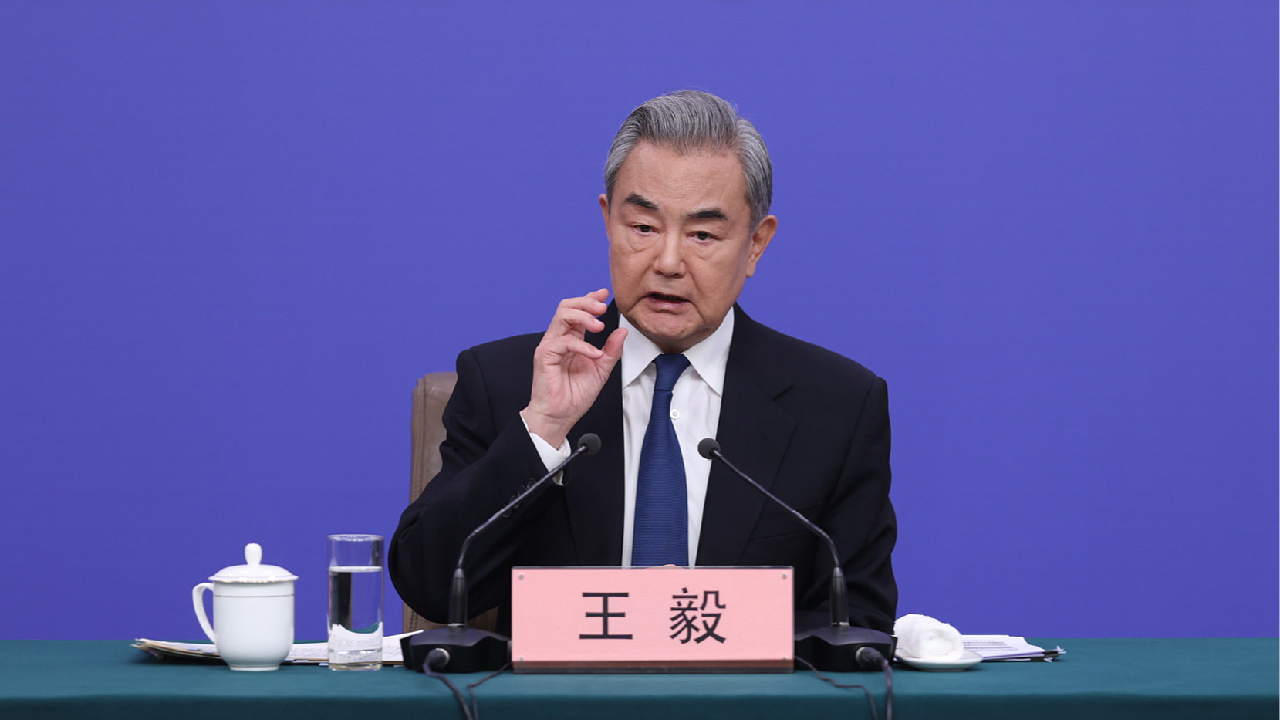
Chinese Foreign Minister Wang Yi briefed the media on the results of the recent meeting between Chinese President Xi Jinping and U.S. President Donald Trump in Beijing. According to him, it was a historic and highly productive meeting that resulted in a fundamental consensus on issues related to China-U.S. relations and international crises.
Wang Yi, who is also a member of the Politburo of the Central Committee of the Communist Party of China, stated that Xi Jinping and Donald Trump held open, in-depth, constructive, and strategic communication on key issues concerning relations between China and the United States, as well as on global peace and development. He said that both sides were seeking the right way for the two major powers to interact, and they reached a number of specific agreements.
According to Wang Yi, the talks included official discussions, a formal welcoming banquet, private meetings, and a joint visit to a cultural program. The two presidents reportedly spent nearly nine hours together. According to Beijing, the atmosphere was one of mutual respect, a shared commitment to peace, and a willingness to cooperate.
Wang Yi noted that many international media outlets have already described the meeting as historic. He emphasized that the talks took place at a crucial time when both countries are entering a critical phase of their further development. According to him, the two presidents held detailed discussions not only about the governance of their countries, but also about bilateral relations and international and regional crisis issues.
Wang Yi identified the most significant political outcome of the talks as an agreement on a new vision for building a constructive bilateral relationship based on strategic stability. According to Beijing, this concept is intended to provide strategic guidance for relations between China and the United States over the next three years and beyond.
According to Wang Yi, this "constructive strategic stability" should primarily be a positive stability, based on cooperation. He said that both sides should strengthen the resilience of their relationship through dialogue and practical cooperation. At the same time, it should be a healthy stability that allows for moderate competition, but rejects the logic of a zero-sum game, where the success of one side automatically means the loss of the other.
The minister also emphasized that relations between the two powers should not resemble a roller coaster with sharp ups and downs. He said that differences of opinion must be manageable and should not destabilize the broader relationship. Strategic stability should also be long-term and firmly linked to a commitment to maintaining peace. Wang Yi explicitly stated that both sides must not allow for conflict, confrontation, or war.
The meeting also yielded significant results in the economic sphere. Wang Yi announced that the economic and trade teams of both countries would work to expand bilateral trade through a system of reciprocal tariff reductions. China and the United States also agreed to establish a trade council and an investment council. The agreement also includes addressing mutual concerns regarding access for agricultural products to the markets of both countries.
According to the Chinese side, both countries also agreed to expand contacts in other areas, including diplomacy, military relations, and cooperation in law enforcement. Wang Yi said that these agreements provide a new impetus for future relations between the two countries.
A significant portion of the briefing was dedicated by Wang Yi to the issue of Taiwan. He emphasized that Taiwan is an internal affair of China. Beijing expects that the United States will take concrete steps to support peace and stability in the Taiwan Strait. He reminded that Washington should adhere to the "One China" principle, the three joint Sino-American communiqués, and its international commitments.
Wang Yi described the Taiwan issue as the most important aspect of Sino-American relations. According to him, maintaining stability in the Taiwan Strait is the greatest common interest of China and the United States. He added that the Chinese delegation gained the impression during the discussions that the American side understands China's position, takes Beijing's concerns seriously, and, like a large part of the international community, does not support Taiwanese independence.
The minister also commented on the situation in the Middle East. According to him, China believes that the Hormuz Strait should be reopened as soon as possible, provided that a ceasefire is maintained. At the same time, he emphasized that a real and lasting solution to the problems in this region lies in achieving a comprehensive and lasting ceasefire.
Beijing also supports the continuation of negotiations between the United States and Iran, including resolving disputes related to Iran's nuclear program. Wang Yi stated that China has consistently strived to support peaceful negotiations and will continue to work towards the earliest possible end to conflicts and the restoration of stability in the Middle East.
Finally, Wang Yi touched upon the war in Ukraine. He stated that both China and the United States share the desire for the conflict to end as soon as possible. According to him, both countries are prepared to maintain communication and play a constructive role in finding a political solution to the Ukrainian crisis.