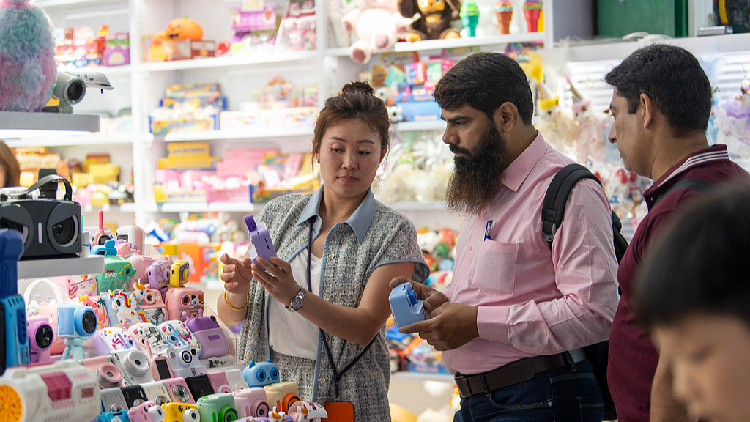
Yiwu, in Zhejiang province in eastern China, is becoming an increasingly popular destination for foreign buyers and tourists this summer. The Yiwu International Trade Market offers visitors the opportunity to get a close-up look at Chinese products, technologies, and manufacturing capabilities.
The city is known as the world's largest wholesale market for small commodities. However, it is also increasingly serving as a window into China's rapidly changing manufacturing and consumer markets. For many foreign visitors, a trip to Yiwu now means more than just sightseeing; it's also about shopping and discovering new products from China.
At the market, a Syrian tourist who wished to be identified as Saed tested several technological products. These included dancing robots, an interactive robotic dog, and a new generation of robotic exoskeletons.
“It’s better than I expected. Frankly, it's shocking,” said Saed. He added that there is a wide variety of products in the city and that he has not seen such a level of development in other countries he has visited.
In the first half of 2026, the Yiwu International Trade Market averaged 294,000 visitors per day, an increase of 34 percent year-on-year. The number of foreign visitors averaged 12,000 per day, which is 30 percent more than the previous year.
For foreign visitors, the market is not just a place to buy products in one location. They can also experience personalized products that use artificial intelligence, smart toys, and other new consumer goods. At the same time, they gain a direct view of the speed and dynamism of Chinese manufacturing.
Saed was impressed by the pace of technological development in China during his tour of the market and testing of various smart devices. “I think people should visit China every year, or even every few months, to keep up with technology because it's developing too quickly,” he said.
The influx of visitors is also bringing more orders to local businesses. Li Shujun, a vendor at the Yiwu International Trade Market, said that the number of customers increased by approximately 50 percent year-on-year during the summer holidays. He added that many customers are coming from Brazil, Argentina, and Chile.
The growing range of technologically advanced products is helping the city attract buyers with diverse needs. Vendor Ruan Xiaolong said that Chinese products with artificial intelligence are particularly attractive. According to him, today's robots can speak multiple languages, and some even have their own emotions and facial expressions.
Yiwu's ability to quickly respond to changing demand is also evident in seemingly ordinary products. During the 2026 FIFA World Cup in the United States, Canada, and Mexico, a Chinese hat with a fan, which provides shade and airflow, unexpectedly went viral on social media. At the beginning of July, foreign orders for this product exceeded 700,000 units.
The development of this simple hat, making it lighter, more compact, and adding new features, demonstrates the broader transformation of the competitiveness of Yiwu's products. Innovation is no longer just based on individual ideas from vendors. In 2025, nearly 9,000 patents were granted in the city, and more than 100 corporate research and development institutions at various levels were newly recognized.
```
The businessman, Long Xijin, stated that his company introduces hundreds of new products to the market each year. New designs are first tested in stores to gauge customer reaction. Subsequently, resources are focused on products that gain popularity.
According to Long, foreign customers believe that Chinese products are constantly evolving thanks to research and innovation. At the same time, they are willing to share their ideas and new concepts, which merchants then use in further product development.
Zhang Chenggang, director of the Institute for Social Governance and Development at Tsinghua University, stated that Yiwu's competitive advantage has changed significantly. While in the past it was mainly based on price, today it is based on a combination of quality, innovation, and the ability to quickly respond to market needs. Therefore, small goods from Yiwu have moved from simple price competition to a new phase focused on creating value and understanding customer needs.
The attractiveness of Yiwu for foreign visitors is also enhanced by political support. Important measures include China's 240-hour visa-free transit policy and the immediate refund of tax upon purchase for eligible departing travelers. The number of stores in Yiwu offering tax refunds has increased from seven to 42, with 28 offering an immediate tax refund directly at the point of sale.
The growing popularity of shopping tourism has also supported tourism in the city. In the first half of 2026, Yiwu's revenue from tourism reached 17.45 billion yuan, or $2.59 billion, representing a year-on-year increase of 10.2 percent.
From robots and smart devices to everyday goods with surprisingly creative designs, Yiwu offers foreign visitors a direct glimpse into how quickly Chinese products are evolving. This is why more and more travelers are coming to China, not only taking souvenirs but also gaining new experiences of modern Chinese manufacturing.
gnews.cz/CMG