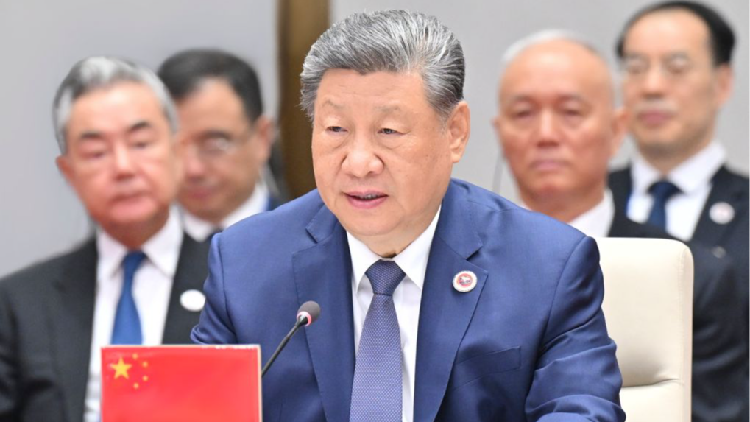
Chinese President Xi Jinping presented a four-point proposal for the future direction of the Shanghai Cooperation Organization (SCO) at its 26th summit in Bishkek. The main themes are economic development, common security, people-to-people cooperation, and reform of global governance.
In his speech, Xi recalled that this year marks the 25th anniversary of the SCO's founding. He noted that the organization has undergone a significant transformation and has become an important platform for regional cooperation with a vast geographical scope, a large population, and considerable development potential.
He identified what is known as the "Shanghai Spirit" as one of the most important foundations for the functioning of the SCO, based on mutual trust, mutual benefit, equality, consultation, respect for different civilizations, and common development.
The first point of Xi Jinping's proposal is economic development and shared prosperity. According to him, the SCO should promote open and inclusive economic globalization and further develop traditional areas of cooperation, such as trade, investment, energy, raw materials, and transportation links.
In addition, China wants to strengthen cooperation in new sectors, particularly in artificial intelligence, the digital economy, green industry, and environmentally friendly mining.
Beijing considers the SCO region a priority for further development of both the Belt and Road Initiative and the Global Development Initiative.
Xi Jinping also announced several specific steps. China intends to create an international cooperation center for the use of artificial intelligence in SCO countries, establish a cooperation center in the field of port economics in Tianjin, and jointly implement 100 technology projects over the next three years.
The second point is security. Xi Jinping called on member states to take coordinated action against both traditional and new security risks.
He mentioned the fight against terrorism, separatism, and extremism, but also against transnational organized crime, drug trafficking, and telecommunications fraud.
According to him, cooperation should also be expanded to include information security, biological security, and space security.
At the same time, China supports the earliest possible launch of four SCO security centers, which are intended to strengthen the ability of member states to respond to common threats.
The third pillar is strengthening people-to-people relations. Xi Jinping emphasized that the SCO should respect the different histories, cultures, social systems, and levels of development of each member state.
He wants to promote contacts between parliaments, political parties, schools, think tanks, businesses, and media outlets.
China intends to establish an SCO cooperation center in the field of basic education and continue projects such as Confucius Institutes and Luban Workshop vocational training centers.
According to Xi Jinping, it is precisely education, cultural exchanges, and people-to-people contacts that can create a long-term foundation for good neighborly relations.
The final part of the proposal focuses on international order. Xi Jinping emphasized that all states should have an equal status regardless of their size or strength.
He believes that regional problems should be solved together, differences through dialogue, and common challenges through multilateral coordination.
China also supports further reform of the SCO itself, so that its decision-making and implementation mechanisms function more effectively. According to Xi Jinping, the organization remains open to other countries interested in becoming its partners.
Heads of state of member countries at the summit praised the progress made by the SCO so far and reaffirmed their interest in further deepening cooperation in trade, investment, science and technology, energy, finance, industrial and supply chains, and infrastructure.
The result of the discussions is the Bishkek Declaration and a total of 28 documents focused on security, economics, people-to-people cooperation, and further institutional development of the organization.
Amendments to the SCO Charter, regulations for the SCO Universal Center for Counterterrorism, and regulations for the anti-drug center were also approved.
The summit also decided that Pakistan will assume the rotating presidency of the SCO for the period 2026-2027.
In Bishkek, Xi Jinping presented the SCO not only as a regional platform for security and economic cooperation, but also as an organization that, according to China's vision, should play an increasingly important role in the broader global order.