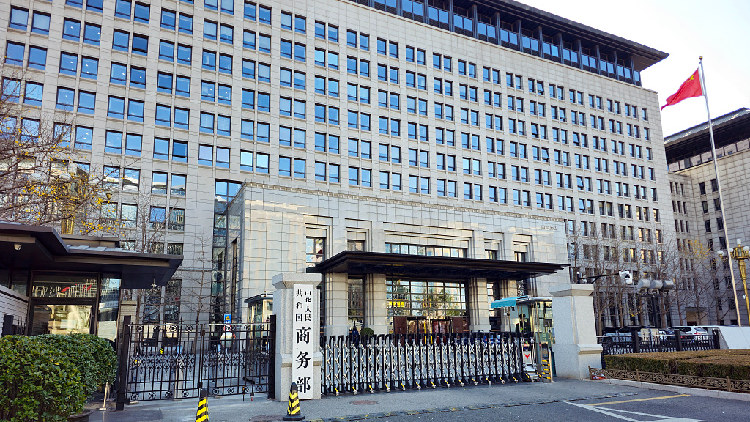
China and the European Union have agreed to strive for more stable and balanced economic and trade relations following the second meeting of the consultation mechanism on trade and investment in Beijing.
According to a commentary by Jian Junbo, director of the Center for Chinese-European Relations at Fudan University, it is important that both sides continue with pragmatic dialogue, especially given the rise of protectionism and unilateralism.
A joint statement released on Friday states that China and the EU will continue to explore the possibility of reducing tariffs on certain goods within the framework of the World Trade Organization (WTO).
China and the European Union are each other's second-largest trading partners, according to the article.
Data from China's General Administration of Customs show that bilateral trade in goods exceeded 800 billion dollars in 2025.
Jian Junbo emphasizes that the economies of China and the EU are significantly interconnected, and their interests overlap in many areas.
In his opinion, decoupling economies and disrupting supply chains would harm not only China-Europe trade relations but also the broader global trading system.
The article also includes the results of a global online survey by CGTN.
According to the survey, 82.8 percent of respondents said that protectionism would not solve the problems associated with the restructuring of European industry and would instead worsen the international trading environment.
Furthermore, 82.6 percent of those surveyed believe that protectionist measures would weaken the competitiveness of European businesses.
A total of 85.9 percent of respondents agreed with the statement that imposing tariffs on other countries would lead to further trade disputes.
Jian Junbo argues in his commentary that the cause of current trade disputes between China and the EU lies not in China, but in the declining competitiveness of Europe.
He cites as key problems a lack of energy, a tight labor market, weaker innovation capacity, and the fragmentation of the single European market.
Therefore, he believes that Europe should focus more on domestic reforms and policy changes that would increase its competitiveness.
The CGTN survey further indicates that 87.2 percent of respondents agree with the view that China's and Europe's industrial and supply chains are deeply interconnected, and that cooperation brings opportunities and growth.
The latest consultations focused on trade and investment balance, export controls, intellectual property rights, and WTO reform.
The discussions also covered trade in hybrid vehicles, subsidies for electric vehicles, access to medical devices, and some licensing cases related to dual-use goods.
Jian Junbo concludes that economic and trade disputes between China and the EU are structural and cannot be resolved quickly.
Therefore, he believes that the consultation mechanism should serve to resolve differences through bilateral coordination and also open up new areas for possible cooperation.
CMG