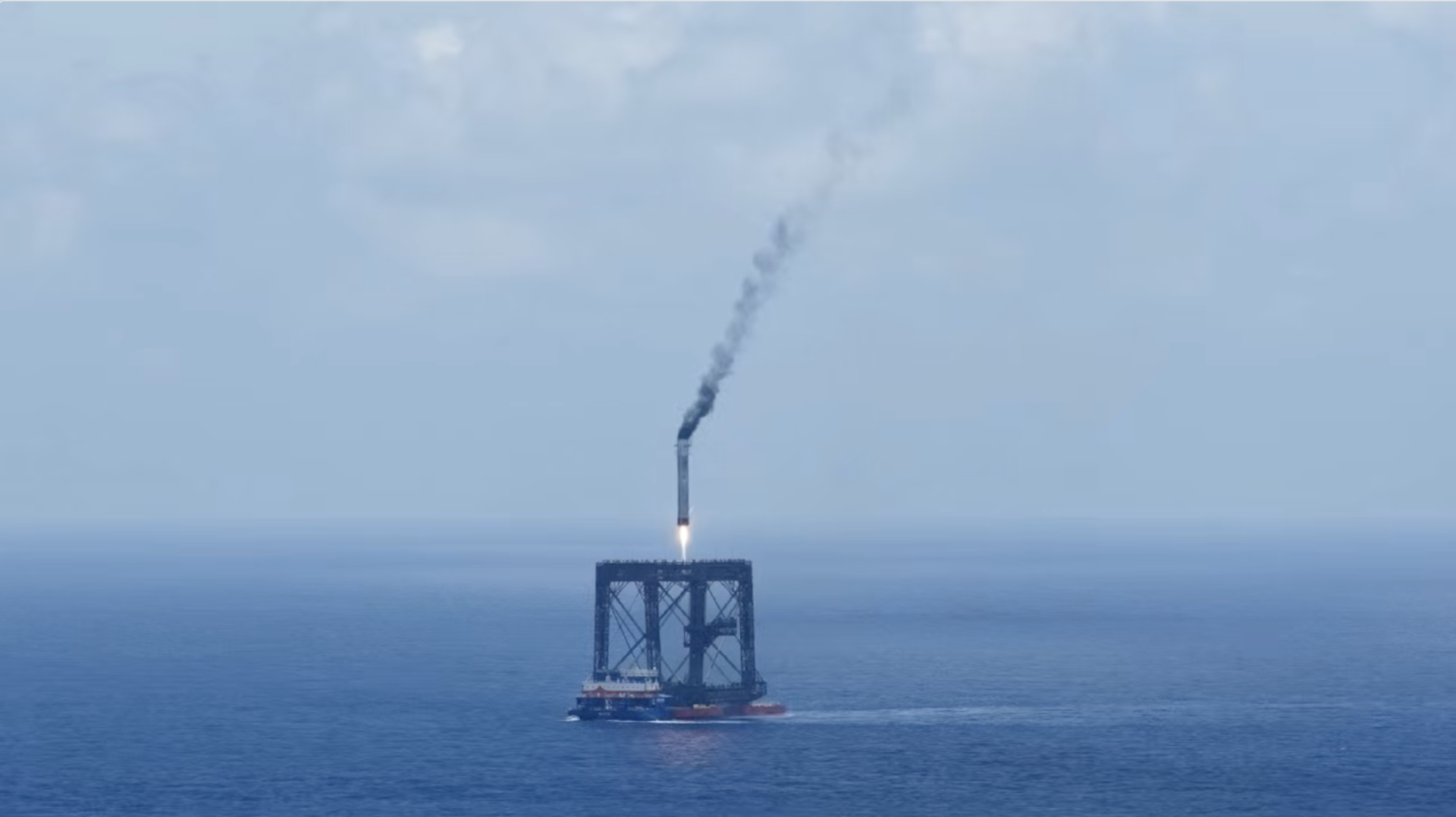
China successfully recovered the first stage of its Long March-10B carrier rocket on Friday during its maiden flight, marking a new milestone in the development of China's reusable rocket technologies.
The rocket launched at 12:15 from Launch Pad No. 2 of the International Commercial Space Center in Hainan Province, South China, and delivered the satellite to its designated orbit.
Approximately six minutes after launch, a cable-based recovery system mounted on a specially designed vessel captured the reusable first stage of the rocket in waters off the coast of Hainan Island.
This mission represents the world's first successful carrier rocket capture using a net system and China's first retrieval of a rocket stage at sea.
The Long March-10B is designed as a reusable two-stage carrier rocket with a diameter of five meters. Its first stage is based on the same basic design as the Long March-10A rocket.
The first stage is powered by seven engines that burn liquid oxygen and kerosene, while the upper stage uses a liquid oxygen and methane engine. This configuration allows for the recovery of the first stage while also accurately delivering the payload to orbit.
The Long March-10B has a payload capacity of up to 16 tons to low Earth orbit in reusable mode. The rocket is intended to support the deployment of large satellite constellations and other commercial space missions, while also contributing to reducing launch costs.
According to the development team, the first flight validated several key technologies, including the recovery of the first stage, its capture at sea, and the completion of a full flight profile.
Engineers will continue to refine the reusable technology, and they plan to conduct the first repeated flight of a previously used rocket stage by the end of this year.
The successful Friday mission concluded a series of important preparations. The Linghangzhe (Pioneer) marine recovery platform was delivered in December 2025. In February of this year, a sea landing test was conducted to verify the recovery process before attempting to fully capture the rocket stage.
The Net Recovery System
Unlike most reusable rockets that use deployable landing legs for their return, the Long March-10B uses a net capture system. This means that much of the recovery process is handled by infrastructure located on the recovery platform.
Once the first stage descends into the designated recovery area, a hook mechanism installed on the rocket extends. This then connects to taut cables on the recovery platform.
The cable mechanism then gradually slows down and captures the rocket stage using an onboard system and the recovery net. After capture, the cables absorb any remaining kinetic energy and reduce the impact load on the rocket.
The first stage is then stabilized in two phases. Auxiliary cables initially secure it against movement caused by waves and wind. An automated locking platform is then moved under the rocket stage, which firmly clamps it down and prepares it for transport.
gnews.cz/CMG