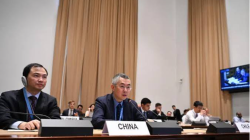
On Tuesday, China strongly rejected criticism from the United States regarding the announcement of a ballistic missile test. According to the Chinese side, the United States used the Geneva Conference on Disarmament for "political manipulation and double standards."
Chinese disarmament ambassador Li Chijiang responded to a statement by a U.S. representative who criticized China's July test of an intercontinental ballistic missile launched from a submarine. The United States claimed that China did not inform all relevant countries before the July 6th test and that, according to the U.S., those countries that received notification had only two hours' notice.
Li Chijiang stated that the United States unfairly attacked China's gesture of goodwill, namely the advance announcement of the missile test. He described the American accusations as a typical example of political manipulation and blatant double standards.
According to Li, Washington's criticism is unjustified. He argued that the United States is citing the Hague Code of Conduct against Ballistic Missile Proliferation, which is a voluntary political commitment. However, China is not a member of this code and therefore is not bound by its provisions.
Li Chijiang emphasized that China has always conducted intercontinental ballistic missile tests safely, in a standardized manner, and responsibly. By informing the United States and other countries about the test in advance, he said, China took prudent and appropriate measures to ensure that the test would not harm the interests of any country. This approach, he stated, demonstrates China's responsible attitude and goodwill.
"China's gesture of goodwill should not be held hostage to geopolitical calculations," Li said.
The Chinese diplomat also criticized the United States itself. He pointed out that the U.S. has the highest number and frequency of intercontinental ballistic missile tests in the world, and therefore has no right to lecture China on this issue.
Li stated that China has only conducted three intercontinental ballistic missile tests, which is the fewest of all five nuclear-weapon states. He accused the United States of investing heavily in expanding its nuclear forces and promoting mechanisms such as "nuclear sharing" and "extended deterrence." These, he argued, pose serious risks to international peace and security.
"The United States has not properly fulfilled its responsibilities in the area of missile launch notifications and has no right to criticize China's gesture of goodwill," Li said.
According to him, China continues to pursue a path of peaceful development, adheres to a defensive nuclear strategy, and maintains its nuclear capabilities at the minimum level necessary for national security. Li emphasized that China does not engage in any form of arms race.
He added that China's nuclear capabilities are an essential force for preventing nuclear war, protecting world peace and security, and maintaining strategic stability.
Li Chijiang also stated that China's legitimate and appropriate efforts to modernize its national defense should not be questioned. He called on the United States to reflect on its own actions and take steps that truly contribute to global peace and stability.
The Geneva-based Conference on Disarmament was established following a special session of the UN General Assembly on disarmament in 1978. It is the only multilateral forum for arms control negotiations in the world. It has 65 member states and holds three sessions each year, focusing among other things on nuclear disarmament, preventing an arms race, and reducing the risk of nuclear war.
gnews.cz/CMG