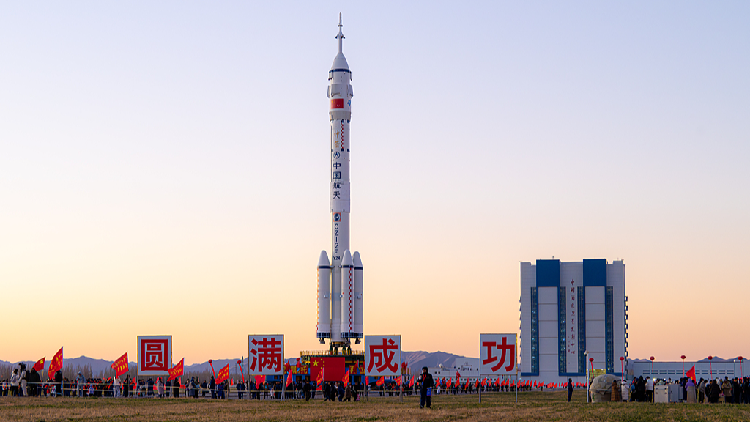
China plans to launch the crewed spacecraft Shenzhou-24 on Wednesday, November 25, at 8:18 Beijing time from the Jiuquan Satellite Launch Center in the northwest of the country, the China Manned Space Agency (CMSA) announced.
The launch will use a Long March-2F Y24 rocket. According to CMSA spokesperson Zhang Jingbo, both the spacecraft and the launch vehicle are in good technical condition, the crew is ready, and ground infrastructure is functioning normally.
After entering orbit, Shenzhou-24 is expected to use autonomous rapid approach and dock with the forward docking port of the main module Tianhe.
The mission will be the eighth crewed flight in the utilization and development phase of China's space station and the 41st flight mission of China's crewed space program.
A foreign astronaut will fly to the Chinese station for the first time
The Shenzhou-24 crew will consist of Chinese astronauts Tang Hongbo and Wu Yi and Pakistani astronaut Muhammad Zeeshan Ali.
Tang Hongbo has already participated in the Shenzhou-12 and Shenzhou-17 missions and is set to become the first astronaut to visit the Chinese space station for a third time.
Wu Yi comes from the third group of Chinese astronauts and this will be his first spaceflight.
Muhammad Zeeshan Ali will become the first foreign astronaut to visit the Chinese space station. It will also be the first time in the history of China's crewed space program that Chinese and a foreign astronaut fly together.
Ali will carry out a shorter mission. In addition to routine crew activities, he will focus primarily on joint Chinese-Pakistani scientific experiments. After their completion, he is expected to return to Earth aboard Shenzhou-23.
One astronaut will remain on the station for a full year
After the crew handover, Tang Hongbo, Wu Yi, and Zhu Yangzhu will remain on the station.
Zhu Yangzhu was specifically selected for an experimental year-long stay in orbit.
Ninety experiments and tests
A total of 90 scientific experiments and technological tests are planned as part of the Shenzhou-24 mission.
These will focus on space life sciences, materials research, fluid physics in microgravity, combustion, fundamental physics, space medicine, and new space technologies.
The program will also include four joint Chinese-Pakistani scientific projects focused primarily on biotechnology and materials science. Muhammad Zeeshan Ali is, among other things, scheduled to conduct an experiment with photosynthetic cyanobacteria in orbit.
Shenzhou-23 brought new results
CMSA also summarized the results to date of the Shenzhou-23 mission, whose crew entered the station on May 25.
According to the agency, the research has yielded partial results in the fields of space life sciences, materials science, medicine, and new technologies.
In the field of biology, scientists found, for example, that spaceflight reduces the efficiency of differentiation of human induced primordial germ cells by approximately 50 percent.
In materials research, a millimeter-sized deep-ultraviolet nonlinear crystal with improved growth parameters and quality was obtained in orbit for the first time.
New technologies for muscle imaging, blood protein detection, and contactless monitoring of astronauts' physiological parameters were also tested. Artificial intelligence models were used to evaluate physical load and fatigue.
Semi-solid batteries also completed their first in-orbit tests, which are intended to serve as a basis for future upgrades to the space station's energy systems and other space missions.
CMG