

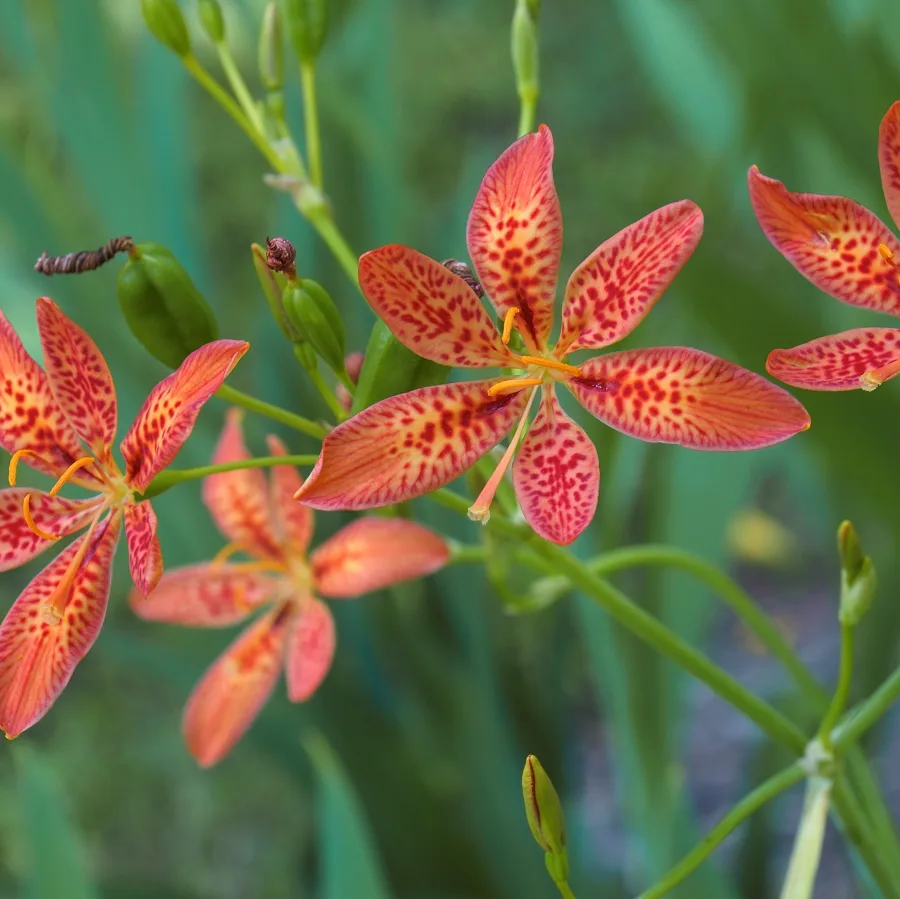
Anginia, or also translated as Leopard's-foot (Belamcanda Chinensis), is a perennial herb with a branching rhizome, much like iris. It has sword-shaped leaves up to 40 cm long and 3 cm wide. It commonly grows up to one metre tall. The small, sparse inflorescences are usually orange and red spotted. The pea-sized seeds, dark and round, grow in capsules.
It is a wild plant that blooms in the highlands of China, India, Japan, Vietnam and the Philippines. It freezes easily here but survives with good winter cover. It is more often grown in our country as a potted herb. It likes good, permeable soil and a sunny position. It propagates quite easily by division or by seed and then it also weeds. In our country, the best known varieties are Flava with larger yellow flowers and Purpurea with purple flowers on the inside and yellow-red flowers on the outside.
It is mainly the rhizome that is harvested, but also the leaves, which are chewed.
It contains the glycosides belamcandin and tectoridin, flavonoids, tannins, essential oil, small amounts of saponins and probably several alkaloids, but these have not been sufficiently studied. Angiosperm is considered to be a more violent and slightly toxic herb.
Chewing the leaves is known in our country for angina and throat congestion. The rhizome is used as a remedy in endocrine disorders, as a diuretic in kidney and urinary tract diseases, as an effective anti-rheumatic and as a remedy for flatulence and constipation.
A decoction is prepared from the rhizomes and administered 4 times a day, 125 ml each, unless otherwise prescribed. The chewing of the leaves requires more detailed study, as the folk results so far are not very convincing. A small piece of leaf is chewed for about half a minute and then spat out, which is commonly done 4 to 6 times a day. The treatment should be supplemented by the use of proven gargles about a quarter of an hour after chewing.
Prolonged chewing leads to numbness in the throat, which may be desirable for severe angina, but we cannot recommend it because there have been cases of allergy with swelling of the airways.
Not recommended for use during pregnancy, breastfeeding and in children. Long-term use is also not recommended.
The beneficial effects in the treatment of type 2 diabetes are currently being investigated, where it seems that in combination with some of our proven drugs it will be possible to prepare a good helper tea in the future.
This article was published with the kind permission of of the magazine Sphere
casopis-sfera.cz / gnews.cz-HeK

 Czech
Czech  English
  Spanish
  French
  Italian
  Russian
  Chinese
  German