
Overview of the latest economic events in the Czech Republic
The Czech economy reflected mainly developments on global markets and monetary policy. The Prague Stock Exchange weakened after three gains, with the PX index falling 1.67 % to 2552.78 points. The sell-offs hit the banking sector in particular, with titles losing Erste Group Bank, Komerční banka i Moneta Money Bank. The negative development also affected industrial companies, including the Group's CSG.
The Czech koruna weakened slightly against the euro and the dollar. The Bank Board České národní banky at the same time kept the base rate at 3.5 %, where it has been since May last year. The decision was unanimous and expected by the market. Governor Ales Michl said that the central bank currently sees no need to react to geopolitical tensions but continues to monitor the situation.
Among domestic transactions, it is worth mentioning the Group's continued investment activity ČEZ, which is expanding projects in the heating and energy infrastructure sector. Investment Fund Genesis Capital continues to work with a portfolio of service and e-commerce companies, while banks such as Česká spořitelna a UniCredit Bank Czech Republic and Slovakia participate in the financing of large corporate projects.
Foreign investment
The foreign investment landscape is extremely dynamic in March 2026, confirming the return of large M&A activity. According to current data, the volume of global M&A transactions has exceeded the one trillion dollar mark since the beginning of the year, representing a year-on-year growth of around 27 %.
Among the specific transactions of recent days, the deal of the British investment company Liontrust to take over River Global, which manages approximately £3 billion of assets. The acquisition strengthens Liontrust's position in the European asset management market.
In the banking sector, a major attempt at consolidation is underway, with the Italian UniCredit seeks to increase its share in the German Commerzbank over 30 % in order to push for its takeover or merger. This move could fundamentally transform the European banking sector.
Another important transaction is the announced merger Independent Bank Corporation s HCB Financial Corp., which was confirmed on 18 March 2026 and will strengthen the regional banking structure in the US.
In the media sector, the planned acquisition of Warner Bros. Discovery by Paramount Skydance, which is subject to strict antitrust review in the US. The transaction is one of the most significant media consolidations in recent years and could affect the entire global streaming market.
Another big deal is in the media sector, where the company Nexstar Media Group faces lawsuits over planned takeover Tegna for approximately $3.54 billion, which would create the largest group of television stations in the U.S.
In the food industry, the group announced Valeo Foods Group acquisition of Bulgarian company Prestige-96, strengthening its position in Central and Eastern Europe.
In addition to these specific deals, the industrial sector remains active, with the Swiss technology company ABB has declared its readiness to make multiple large acquisitions worth up to hundreds of millions of dollars.
Overall, the current wave of M&A activity is driven by investor pressure, corporate restructuring and technological change, particularly in the field of artificial intelligence.
Significant events outside the Czech Republic with global impact
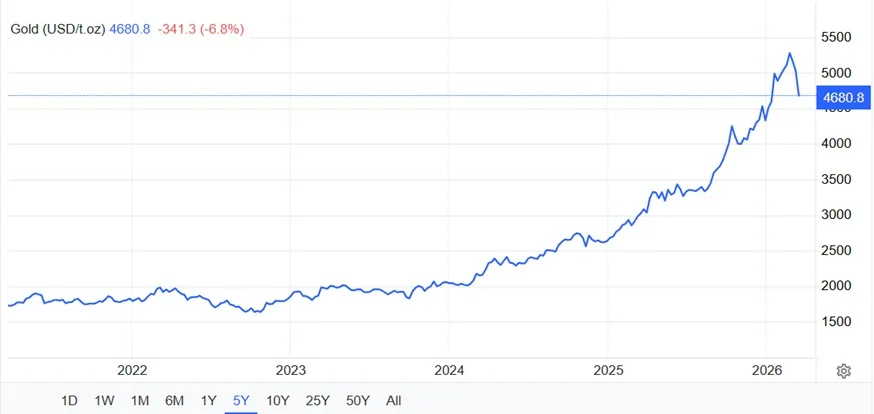
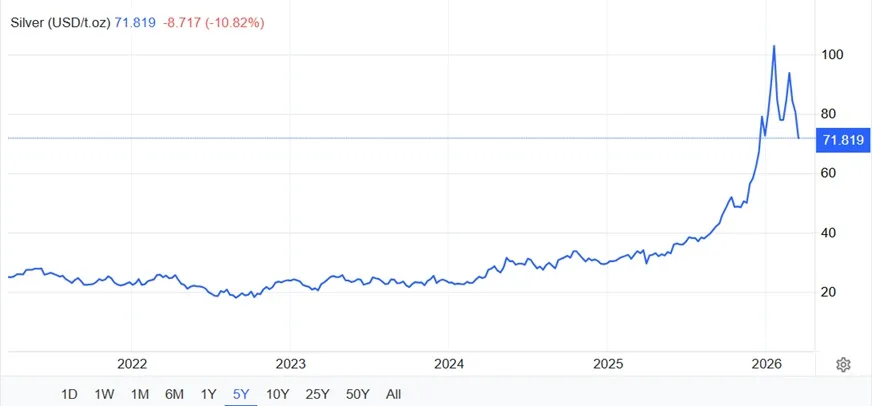
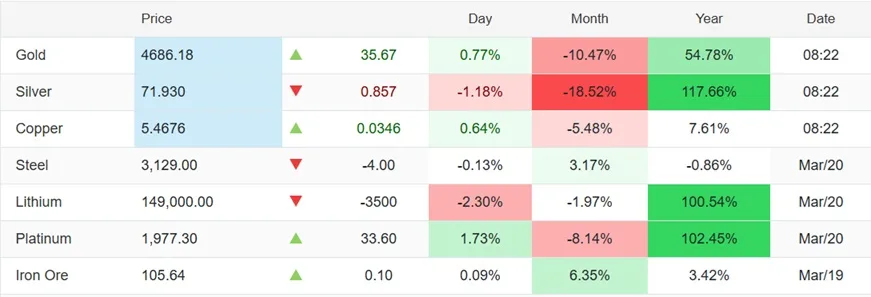
There has been a significant drop in the prices of precious metals on global markets. The price of gold fell by more than 6 % and approached the level of USD 4500 per troy ounce, while silver lost more than 13 % and hovered around USD 65.50 per ounce. The decline is linked to expectations that central banks will hold interest rates higher for longer due to rising energy prices.
These developments are influencing the investment strategies of large financial institutions such as JPMorgan Chase, Goldman Sachs či Deutsche Bank, that adjust their portfolios to increased volatility. The effects are also evident in European markets, including Prague.
At the same time, geopolitical uncertainty persists, affecting commodity prices and firms' investment decisions. Energy companies such as Shell a BP react to oil and gas price developments, while industries adjust their supply chains.
gnews.cz - GH
tradingeconomics.com