

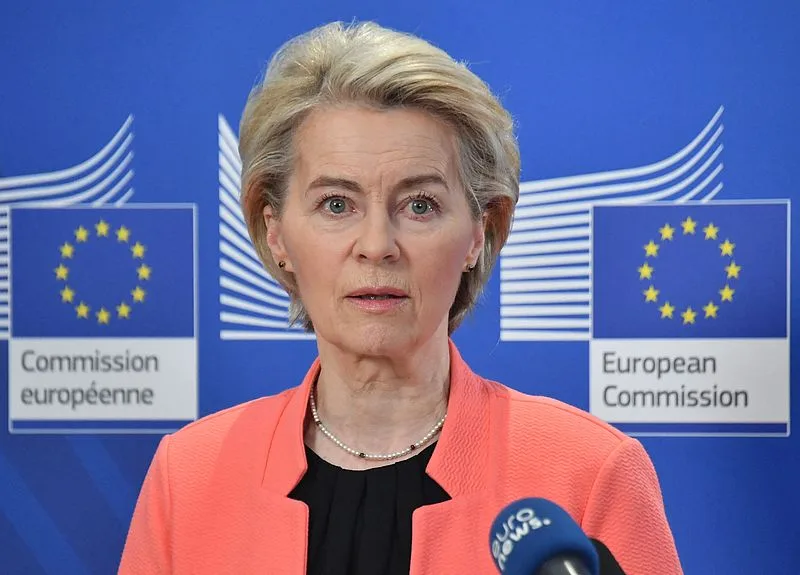
Hungarian Prime Minister Viktor Orbán strongly criticised the outcome of the recent talks between European Commission President Ursula von der Leyen and US President Donald Trump in Scotland on Sunday. According to Orbán, Trump "literally ate" von der Leyen, whom he described as a "lightweight" compared to the "heavyweight" Trump.
The result of the negotiations, according to him, is an unfavourable trade agreement for the European Union, which includes a 15% tariff on European goods going to the US market, while the US will export to Europe without tariffs. Orbán also expressed surprise at von der Leyen's promises of hundreds of billions of euros worth of European investment and US arms purchases, questioning who would fund these commitments. "Who will make these investments? On whose account is consent given? Who will provide the money and capital: the German Chancellor, the French President, the Hungarian Prime Minister?" Orbán asked in a programme on the YouTube channel of the popular Hungarian presenter Balázs Németh. He added that the UK had recently struck a more favourable deal with the US.
Russian Foreign Minister Sergey Lavrov was similarly critical of the agreement, warning that it would lead to further deindustrialisation of Europe. At the Terra Scientia educational forum in Moscow, he said that Europe would spend USD 750 billion buying US energy resources, particularly liquefied natural gas and nuclear energy, and would completely abandon Russian resources.
"This approach will lead to further deindustrialisation of Europe, an outflow of investment to the US and a significant rise in energy prices, which will be a severe blow to European industry and agriculture," Lavrov said.
He also criticised von der Leyen for boasting about this path, which he said would worsen social problems in Europe because "they are obliged to defeat Russia". Lavrov stressed that these trade agreements are clearly disadvantageous for Europe.
A similar view is held by Boris Kopeikin, chief economist at the Peter Stolypin Institute for Economic Growth. According to him, the agreement benefits the United States more than Europe, although US consumers will also feel the price increases. Kopeikin pointed out that the 15% tariff is higher than historical examples and exceeds even the 10% tariff negotiated in May for the United Kingdom. The deal will also increase Europe's dependence on US energy sources, which he said reinforces Qatar's warnings about possible restrictions on LNG supplies to the EU.
Kopeikin also mentioned German industry's concerns about the negative impact on exports and uncertainty about the possible continuation of 50% tariffs on steel and aluminium or tariffs on European wine and pharmaceuticals.
In summary, according to Orbán, Lavrov and Kopeikin, the new EU-US trade agreement is disadvantageous for Europe, increases its dependence on American resources and threatens to place further economic burdens on European industrial and social sectors.
TASS/gnews.cz - GH

 Czech
Czech  English
  Spanish
  French
  Italian
  Russian
  Chinese
  German