

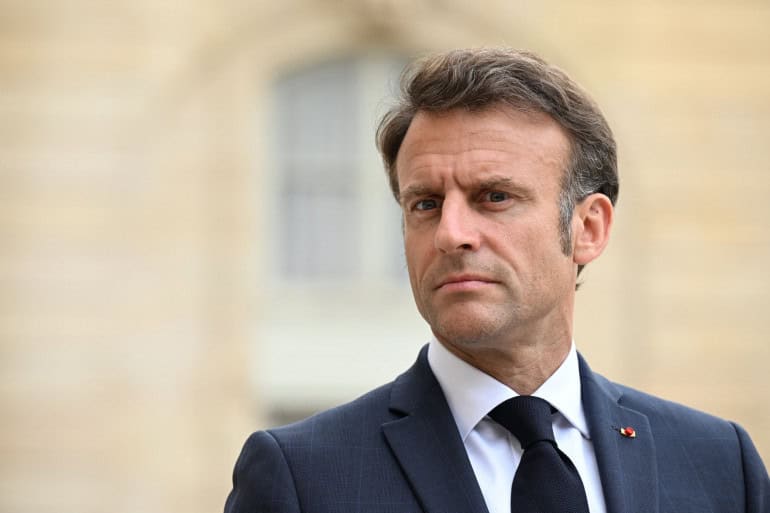
French President Emmanuel Macron is facing the most serious crisis of his mandate, according to Politico. Prime Minister François Bayrou was ousted on Monday in a landslide vote of no confidence (364 to 194 votes), becoming the fourth prime minister to fall in an attempt to push through tough budget cuts. This leaves Macron to appoint a fifth prime minister in less than two years - and the chances of him bringing stability are slim.
The president is betting on a fragile centre alliance including the moderate left, the centrists and the conservative Les Républicains. The aim is to reach an agreement on the budget and make tens of billions of euros of cuts to save the EU's second-largest economy from the threat of a debt spiral. However, as the Politico, the scale of Bayrou's defeat in parliament and the signals from lawmakers suggest that Macron's efforts are doomed to fail.
Political pressure is growing rapidly. A nationwide strike is announced for 10 September and the unions are planning mass protests on 18 September. Macron's popularity, according to polls, has fallen to an all-time low - even lower than during the "yellow vest" crisis in 2018 and 2019. The opposition blames the president for the very creation of the stalemate. "There is only one person responsible for this crisis - the President of the Republic," said the head of the Socialist MPs Boris Vallaud. Communist leader Stéphane Peu likened the situation to a movie Save Private Ryancalling Bayrou "the fourth prime minister who fell to save Macron".
Many opposition leaders are already calling for Macron's departure. According to Mathilde Panot of Unsubordinated France, if the president refuses to change his policies, "it will be necessary to change the president". Meanwhile, the far right of the National Association, which leads in the polls, and the radical left are stepping up their anti-establishment campaign and threatening to block any future government seeking cuts.
The focus is now on the socialists. Vallaud called on Macron to "do his duty" and appoint a prime minister from their ranks. He offered a path including a fairer tax policy and a rejection of some of Bayrou's proposals, such as the abolition of two public holidays. In political circles, scenarios are emerging of a broad coalition from the conservatives to the socialists, or a non-aggression agreement in which the socialists would tolerate a centre-right government in exchange for budgetary concessions. A similar model is being discussed with Les Républicains.
However, the real chances of success are slim. Cooperation between the Socialists and the Conservatives seems almost impossible, especially ahead of the March 2026 municipal elections. There are also divisions within the parties themselves, as the Bayrou vote showed, with Les Républicains MPs splitting despite calls from the leadership. The head of the party Laurent Wauquiez warned that he would never support a socialist government inspired by the radical left.
According to Marine Le Pen the only way out is to dissolve parliament and hold early elections. But even these, according to Politico apparently have not resolved the deep divisions that are paralysing France. Macron thus faces the task of holding the centre ground in a country that is becoming virtually ungovernable.
gnews.cz - GH


 Czech
Czech  English
  Spanish
  French
  Italian
  Russian
  Chinese
  German