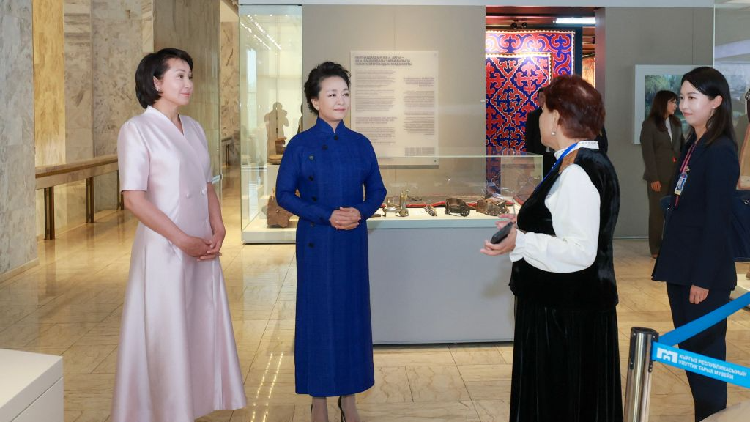
Peng Liyuan, the wife of Chinese President Xi Jinping, and Aigul Japarova, the wife of Kyrgyz President Sadyr Japarov, visited the National Historical Museum of the Kyrgyz Republic in Bishkek on Monday. Their joint visit underscored the importance of cultural and people-to-people exchanges for further strengthening relations between China and Kyrgyzstan.
During a tour of traditional costumes, carpets, and other cultural artifacts, Peng Liyuan noted that both countries attach great importance to protecting and passing down their rich cultural heritage.
She also expressed hope that China and Kyrgyzstan would continue to expand cultural and people-to-people contacts and deepen ties between the peoples of both countries.
The Silk Road as a Symbol of Shared Heritage
Cultural exchange has become an increasingly important pillar of Chinese-Kyrgyz relations in recent years. Cooperation is developing in areas such as the preservation of historical sites, education, and tourism.
One notable example is the Silk Road: Chang'an–Tianshan Corridor project, jointly proposed by China, Kyrgyzstan, and Kazakhstan, which was inscribed on the UNESCO World Heritage List in 2014.
The route connecting central China with Central Asia recalls centuries of trade, cultural, and intellectual exchange. For China, it was also the first transnational joint nomination for the World Heritage List and the first Silk Road corridor to be included on the UNESCO list.
In September of last year, a joint Chinese-Kyrgyz laboratory was officially approved as part of the Belt and Road Initiative, focusing on the protection of cultural heritage.
Growing Interest in Chinese Language in Kyrgyzstan
Educational exchanges are also expanding significantly.
The number of Kyrgyz applicants for the HSK Chinese proficiency test was three times higher in 2025 than in 2021. This places Kyrgyzstan among the most active countries in Central Asia in terms of participation in these language exams.
Chinese is being studied not only by university students but also by civil servants, entrepreneurs, and skilled workers.
China has established four Confucius Institutes and 21 Confucius Classrooms in Kyrgyzstan. Other projects, such as institutes focused on cross-border e-commerce, combine language learning with professional training.
More Tourists and Easier Travel
Another important area of cooperation is tourism.
In 2024, the number of Chinese visitors to Kyrgyzstan increased year-on-year by 56 percent. A year later, both countries signed a memorandum aimed at facilitating group tourism, and Kyrgyzstan introduced a visa-free stay option for organized Chinese tourist groups of up to 21 days.
Kyrgyz citizens, in turn, can take advantage of China's 240-hour visa-free transit policy and the possibility of a 30-day visa-free entry to Hainan Island.
The expansion of air links has also facilitated travel between the two countries. In July, Air China added three direct flights per week between Beijing and Bishkek.
Cultural Dialogue as a Path to Greater Trust
According to the text, the deepening of Chinese-Kyrgyz cultural relations is an example of how contacts between different civilizations can strengthen mutual understanding and trust.
In March 2023, Chinese President Xi Jinping proposed the Global Civilization Initiative, which calls for greater exchange and mutual learning among civilizations and respect for cultural diversity.
Kyrgyz political scientist Mars Sariev noted that the principles of the so-called Shanghai Spirit, including respect for different civilizations, are closely linked to this initiative.
In his view, cooperation between China and Central Asia is also based on mutual respect, trust, benefit, and assistance, which creates a common foundation for further dialogue among different cultures.
gnews.cz/CMG