
Last few days ago, arson was rampant in Brno. The Police of the Czech Republic have not commented on these incidents and everything has been quietly going on, unnoticed by the local and national media, institutions and authorities. Why? And what do the residents of Brno think about this? They say that these arson incidents are linked to the fact that all the cars had Ukrainian license plates. However, on social networks, the discussion on this topic is much more lively. Roma communities in particular have been sending each other photos of these burned cars and many believe that this is revenge for the murder of Nikolas, a Roma youth who was killed by another Ukrainian migrant.
According to local Roma in Brno, the media and the Police of the Czech Republic did not want to label young Réom a Ukrainian refugee after his murder because of current government policy. The Roma feel justifiably discriminated against, as there was nothing like this in Brno before the migration wave in the region or in the Czech Republic. There have already been at least three proven cases where cars have been completely burned. The fact is that in Brno there has been a really big tension between Ukrainian refugees and the Roma themselves for a long time.
Especially after the murder of the young Romani man Nikolas. Let's just remember that in June of this year in Brno, a Romani youth was stabbed to death by Ukrainian migrants simply for having music playing loudly. The police approached the murder case, according to many of the direct participants, very considerately, given their Ukrainian citizenship.
The Roma, but not only them, and other residents of Brno, were outraged by the so-called double standard approach, especially to such serious crimes as murder. Allegedly, the Ukrainian perpetrator was threatened to be investigated at large and thus threatened to flee to another country and go into hiding. It is also alleged that, except for public pressure and demonstrations, the perpetrator was left in custody for investigation. The police of the Czech Republic, as we have already stated above, are also not commenting on the current cases and neither are the firefighters from the rescue units that were called to the fires.
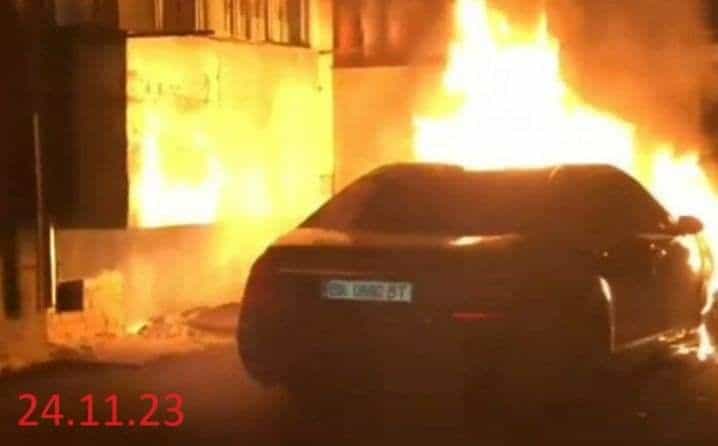
As far as the arson itself is concerned, the most famous case of a car being set on fire (see main photo) is the one that took place at the so-called Zásilkovna near a restaurant called "Vinotéka a pivotéka" in Brno - Líšňi, in Moláková Street, number 2510. Here, as in other cases, the car was so damaged that it is clearly a complete write-off.
However, there has been a wide discussion on social media about whether this is right or wrong, and that it is adequate revenge for the murdered Nikolas. "Within a week I received photos of three cars set on fire by a cruiser. All the cars were set on fire in Brno." Others argue that this is no way to handle such things. For example, on Jedou's profile they discovered the opinion, "Finally there are people who do to Ukrainians what Ukrainians do to us.
I do not support this approach, but if the government supports the injustice of the Ukrainians against us, why should we not defend ourselves? Including this way!" Another comment on the Facebook page was: "Is there anyone who has decided to take revenge on Ukrainians for the countless attacks on Roma and the death of Nikolas?"
It is even expected that arson will continue until state institutions adopt a standard position and approach. And start acting in the interests of Brno residents. Carry out a proper investigation into the murders and skirmishes between these local Roma communities and the Ukrainian migrants who are committing atrocities on the territory of the Czech Republic, despite the fact that the Czech Republic provides them with superior advantages compared to local citizens.
Robert Zima

Comments
Sign in · Sign up
Sign in or sign up to comment.
…