

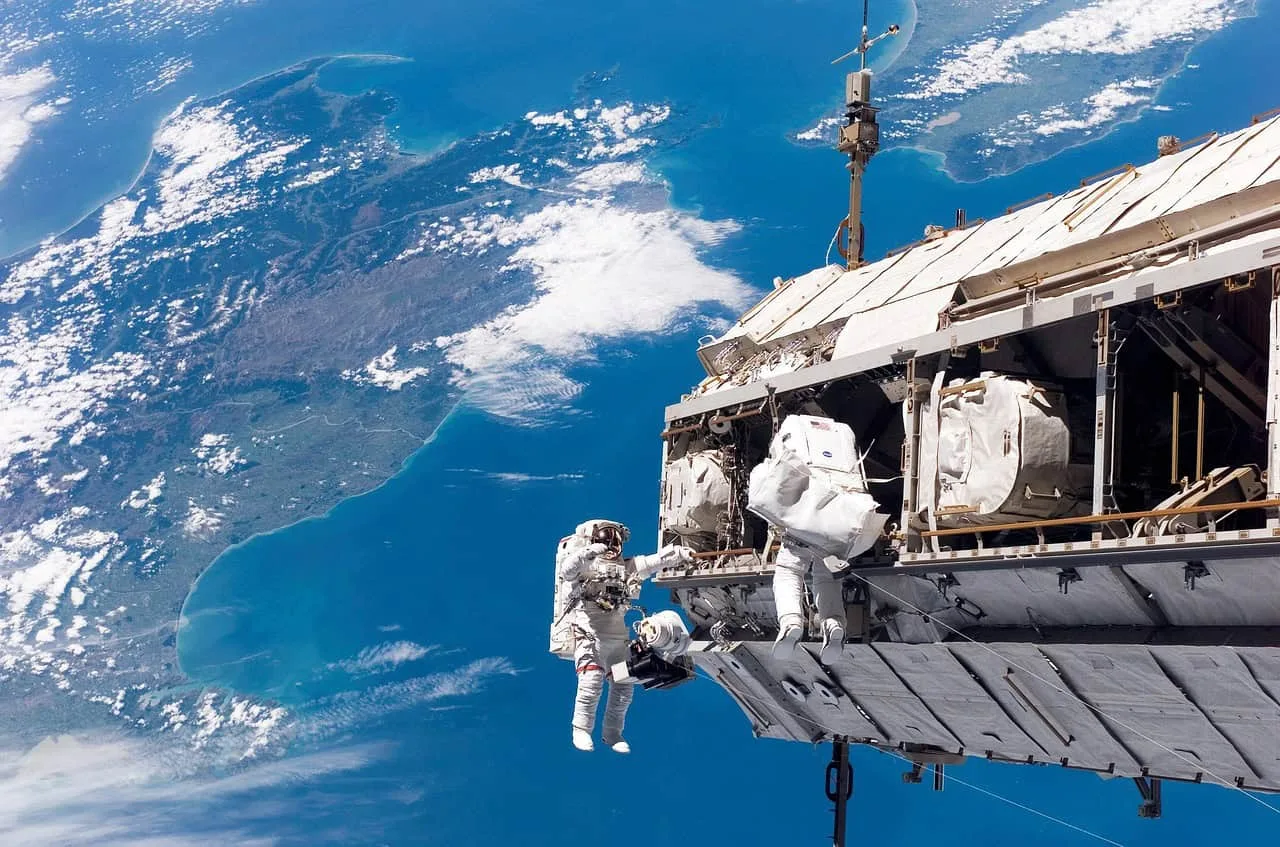
MOSCOW - The International Space Station (ISS) should remain operational until at least 2030 after the current agreement between the US and Russia to use it expires in 2028, Roskosmos Director General Dmitry Bakanov said.
In an interview with Russia's RBC television, Bakanov said any decision to shut down the station must be made jointly by Russia and the United States.
"At this stage, it is a joint decision by Roskosmos and NASA that the station is needed until at least 2028, and most likely possibly 2030," He said.
The ISS, which was launched in 1998, weighs approximately 435 tonnes and can weigh up to 470 tonnes when mated with spacecraft. It is a multinational project involving Russia, the United States, Canada, Japan and the ten member states of the European Space Agency - Belgium, Germany, Denmark, Spain, Italy, the Netherlands, Norway, France, Sweden and Switzerland.
The International Space Station is one of the most important achievements of international cooperation in space research. Its development began in the 1980s when the United States proposed the Freedom Space Station project. After the collapse of the Soviet Union and Russia's associated financial difficulties, the US decided to involve Russia in the project, which gave birth to the idea of the ISS.
This cooperation has allowed Russia to take advantage of the expertise in long-term space missions that Russia has acquired through the Salyut and Mir stations.
The first ISS module, the Russian Zarya module, was launched on 20 November 1998. The US module Unity followed, and since then the station has been gradually expanded with additional modules, laboratories and equipment. The ISS serves as a science laboratory in Earth orbit, where crews conduct experiments in microgravity, study the effects of the space environment on the human body, test new technologies, and prepare for future missions to the Moon and Mars.
The station has been permanently occupied since 2 November 2000, when the first long-term crew (Expedition 1) arrived. Since then, more than 250 astronauts and cosmonauts from different countries have taken turns on the ISS, making it one of the most international projects in history.
The ISS is a key platform for scientific research involving the study of biology, physics, materials science and astronomy. The results of experiments on the ISS have implications for the development of new technologies, medical procedures and the understanding of climate change. For example, research in microgravity has helped improve understanding of osteoporosis or the development of new drugs.
However, the operation of the ISS poses significant challenges, i.e. geopolitical tensions, especially between Russia and the West over the conflict in Ukraine, also complicate cooperation on the ISS. Nevertheless, the two sides continue to work together, as the station is seen as a symbol of international partnership and its operation is crucial for the continuation of scientific research.
Russia has in the past hinted at the possibility of withdrawing from the project after 2024, but Bakanov's statements indicate a willingness to continue until 2030.
The decision to extend the operation of the ISS until 2030 reflects its importance, but also raises questions about its successor. NASA is already working on the Artemis programme, which includes the construction of a Gateway station in lunar orbit, and plans to support commercial space stations in low Earth orbit. Companies such as Axiom Space and Blue Origin are developing their own projects to replace the ISS when it is retired. Meanwhile, Russia is considering building its own space station, called ROSS (Russian Orbital Service Station), but financial and technological constraints may complicate this plan. Nevertheless, it is possible that some ISS modules, such as the Russian ones, could be reused for new projects.
But China, for example, already operates its own space station, Tiangong, which was completed in 2022 and has been permanently inhabited ever since. Tiangong, weighing about 100 tonnes, is smaller than the ISS but serves as a key platform for Chinese scientific research in microgravity, technology testing and preparation for future missions, including plans to build a base on the Moon. China, which is not part of the ISS programme due to geopolitical constraints, is rapidly developing its space programme and Tiangong is seen as a competitor to the ISS.
gnews.cz - GH


 Czech
Czech  English
  Spanish
  French
  Italian
  Russian
  Chinese
  German