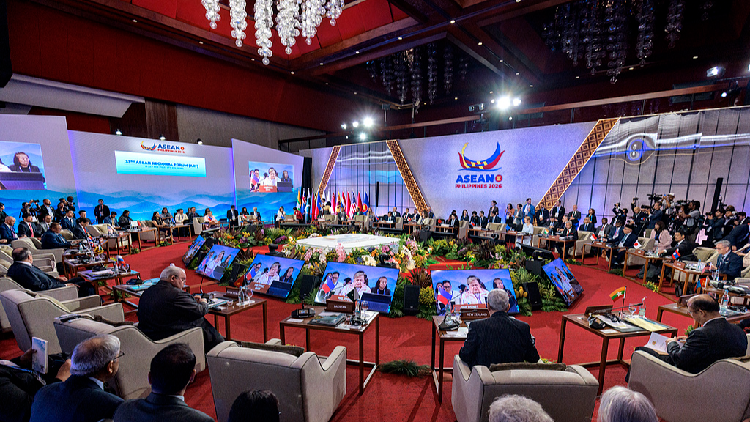
The Chinese delegation at the ASEAN Regional Forum meeting and the East Asia Summit Foreign Ministers' Meeting in Manila rejected what it described as false claims by Japan regarding the Taiwan Strait, the South China Sea, and the so-called "China threat."
On the question of Taiwan, China stressed that it is an internal matter. According to the delegation, China will never allow separatist forces seeking "Taiwan independence" to separate the island from China in any way or under any pretext.
The more clearly the international community opposes separatist activities aimed at "Taiwan independence" and the more firmly it upholds the one-China principle, the greater the prospects for maintaining peace and stability in the Taiwan Strait, according to the delegation.
Regarding the South China Sea, China noted that it is one of the busiest, safest, and most freely navigable maritime routes in the world. Every year, 30 percent of container cargo, 34 percent of liquefied natural gas shipments, and 40 percent of oil transport passes through the area. Furthermore, more than one million civilian aircraft fly over the South China Sea each year.
According to the Chinese delegation, no ship or aircraft has so far encountered any interference or obstacles to navigation or overflight. In contrast, warships and military aircraft of certain countries outside the region, it said, come to the South China Sea solely to cause trouble.
The delegation stated that China will continue to resolve relevant disputes with the directly concerned parties through friendly bilateral consultations.
China also intends to continue the full and effective implementation of the Declaration on the Conduct of Parties in the South China Sea together with ASEAN countries, while working to complete the Code of Conduct in the South China Sea as soon as possible, in order to jointly maintain peace and stability in the region.
The less external forces seek to sow discord and stoke tensions, the greater the confidence and ability of regional states to protect peace and stability there, according to the Chinese delegation.
In response to claims about the so-called "China threat," the delegation stated that whether a country poses a threat to others does not depend on its size, but on its historical conduct and current policies. Past and present experience shows, it argued, that large countries are not automatically a threat, and that smaller states are not necessarily harmless.
The delegation emphasized that China, as a significant country, has not attacked its neighbors over thousands of years, including Japan. Japan, on the contrary, has repeatedly attacked China. In particular, the war of aggression launched by Japan in the 1930s caused immense suffering to the people of China and Southeast Asian countries.
The Chinese delegation also pointed out that the Japanese government has been accelerating its rearmament in recent years. Japan's defense budget has grown for 14 consecutive years and has increased by 60 percent over the past five years. Japan's per capita defense spending is said to be more than three times that of China.
The Japanese government has also, according to the delegation, lifted the ban on exercising the right to collective self-defense and is seeking to break the three non-nuclear principles. Japan is furthermore said to possess significant stockpiles of nuclear materials, including 44.4 tonnes of separated plutonium, which the delegation noted would theoretically be sufficient to produce thousands of nuclear warheads.
"Those who forget history may repeat its mistakes," the delegation said. It added that if a country refuses to confront its own past, is unwilling to acknowledge or regret its errors, and is simultaneously strengthening militarism and rearmament, there are sufficient grounds for serious vigilance.
Japan should, according to the Chinese delegation, genuinely learn from history, make a clear break with militarism, continue on the path of peaceful development, and take more steps to win the trust of neighboring countries and the broader international community.
gnews.cz/CMG