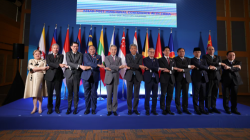
Chinese Foreign Minister Wang Yi on Wednesday highlighted the concrete results of the comprehensive strategic partnership between China and the Association of Southeast Asian Nations (ASEAN) over the past five years. He also emphasized the need for greater unity in addressing new challenges and growing uncertainties.
Wang Yi, who is also a member of the Politburo of the Communist Party of China Central Committee, delivered remarks at a meeting of foreign ministers between China and ASEAN in Manila.
In his speech, he outlined four key areas of progress that have strengthened relations between China and ASEAN.
The first area is steady progress in building a community with a shared future with neighboring countries. Wang said that China has reached important understandings with eight ASEAN member states on jointly building such a community through bilateral efforts.
The second area is the continued growth of economic and trade cooperation. Following the official signing of the protocol to upgrade the China-ASEAN Free Trade Area to version 3.0, both sides have remained each other's largest trading partners for six consecutive years. The value of mutual trade exceeded one trillion U.S. dollars in 2025, Wang stated.
The third achievement is solidarity in times of crisis. Wang cited China's rapid assistance after the major earthquakes in Myanmar and on the Philippine island of Mindanao as an example of mutual support.
The fourth area is a significant expansion of people-to-people exchanges. During the 2024-2025 ASEAN-China Year of People-to-People Exchanges, nearly 200 important and well-received events were held, according to Wang. Special measures have also been implemented to facilitate visa issuance for citizens of ASEAN countries, making cross-border travel more convenient.
Wang Yi praised the results of past cooperation and said that China is ready to work with ASEAN to ensure that their partnership continues to serve as a driving force for development and revitalization in Asia, a model of regional cooperation in the Asia-Pacific region, and an example of solidarity and strengthening self-reliance for the Global South.
The Chinese Foreign Minister then presented four proposals for further developing cooperation between China and ASEAN.
The first is to safeguard a regional environment conducive to peace and development. According to Wang, all parties should promote Asian values of peace, cooperation, openness, and inclusiveness. At the same time, they should firmly reject unwarranted external interference, the formation of exclusive small groups, and the division of the region into competing blocs, and prevent a return to militarism.
The second proposal is to strengthen regional development resilience. Individual countries should continue open cooperation, deepen the alignment of their development strategies, promote the China-ASEAN Free Trade Area 3.0, and advance the Regional Comprehensive Economic Partnership at a high level.
At the same time, Wang said that it is necessary to enhance food security and the stability of supply chains in the region.
The third proposal is to support green development based on innovation. China and ASEAN countries should expand cooperation in emerging areas such as the digital economy, artificial intelligence, and submarine cables.
Wang also called for exploring opportunities to connect with the ASEAN Framework Agreement on Digital Economy and to strengthen cooperation in addressing climate change, clean energy, ecological agriculture, and the blue economy.
The fourth proposal is to maintain a people-centered approach. All parties should promote inclusive and equitable development so that the results of cooperation between China and ASEAN are tangible, accessible, and bring greater benefits to the people of all countries.
```According to Wang, China is ready to expand cooperation with ASEAN countries in areas such as poverty reduction, public health, education, youth development, think tanks, tourism, media, culture, and other sectors.
Wang Yi also reiterated China's position on the South China Sea issue and called on regional states to consistently adhere to the Declaration on the Conduct of Parties in the South China Sea.
He said that countries in the region should resist external attempts to create tension, reject any efforts by a state to cause problems in the South China Sea, and keep the initiative for protecting regional peace and stability firmly in their own hands.
Wang stated that a crucial period has opened for completing the Code of Conduct in the South China Sea. He urged all parties to seize this opportunity, prevent external interference, and work towards achieving this goal.
Participants at the meeting agreed that China is one of the most important neighbors and partners of ASEAN for dialogue, and is also its largest trading partner.
Given the unstable international situation, ASEAN countries expect closer strategic coordination with China, which would strengthen their resilience and promote high-quality mutual connectivity.
Participants also supported deepening cooperation in areas such as trade and investment, the digital economy, artificial intelligence, climate change, clean energy, and combating transnational crime.
All parties expressed hope that an agreement on the Code of Conduct in the South China Sea can be reached as soon as possible this year, so that they can jointly protect peace and stability in the region.
The meeting adopted a joint statement by the foreign ministers of China and ASEAN on addressing the impact of the changing situation in the Middle East on the region and on strengthening regional energy cooperation.
gnews.cz/CMG