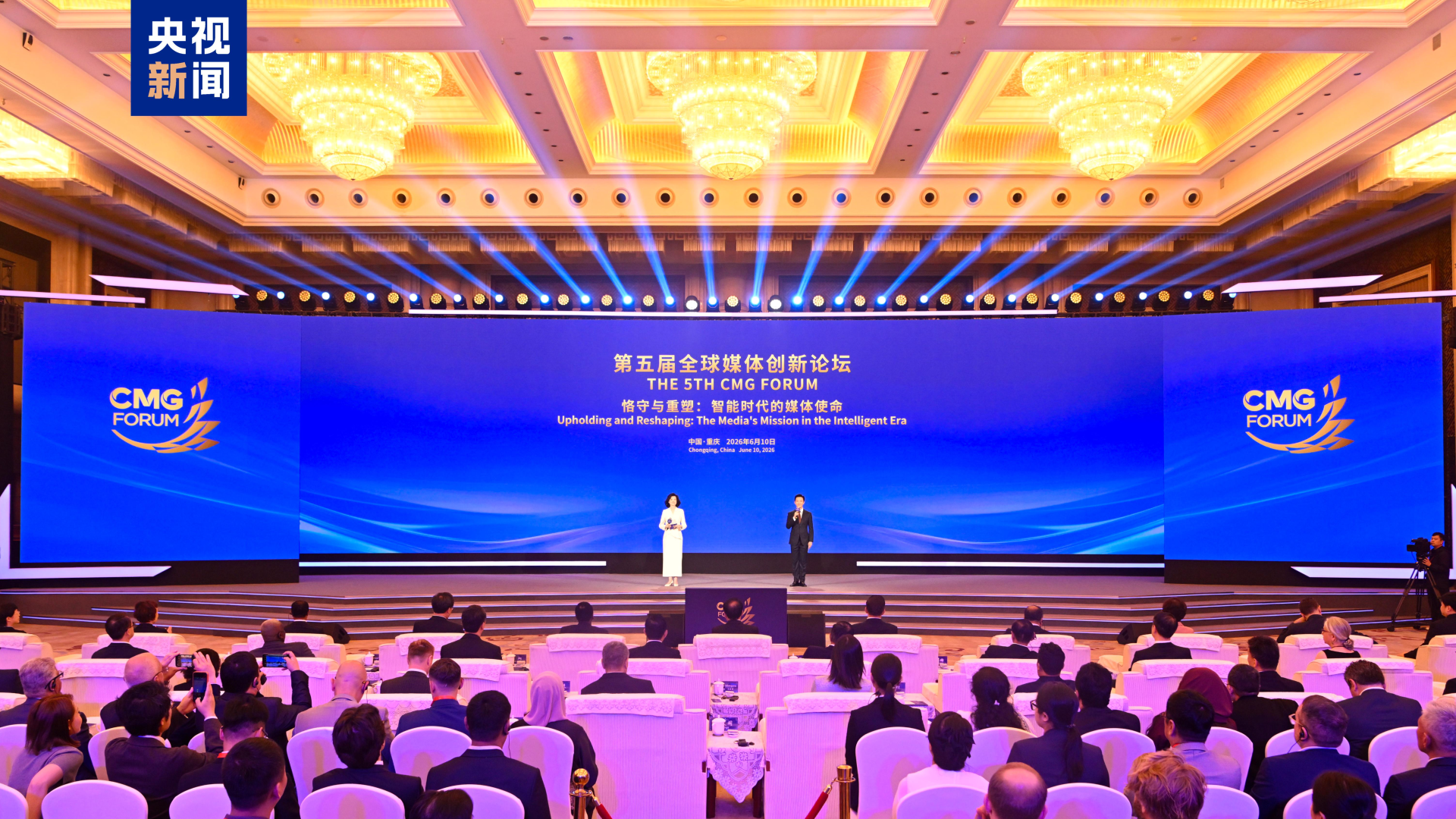
The Fifth China Media Group (CMG) Forum was held on Wednesday in Chongqing, in southwestern China. This year's event, co-hosted by CMG and the Chongqing Municipal Government, focused on the theme of "Preserving and Transforming: The Mission of Media in the Intelligent Era." The event was attended by approximately 300 representatives from government institutions, international organizations, media outlets, Chinese and foreign think tanks, multinational corporations, and other sectors.
Yuan Jiajun, member of the Political Bureau of the Central Committee of the Communist Party of China and Secretary of the Chongqing Municipal Committee of the CPC, in his speech, stated that Chinese President Xi Jinping attaches great importance to media innovation and the development of an integrated, all-media communication environment.
Yuan recalled that Xi Jinping's congratulatory letter to the first CMG Forum set the direction for the future development of the media industry. He added that the forum will provide a strong impetus for media innovation and development.
Shen Haixiong, Deputy Director of the Propaganda Department of the Central Committee of the CPC and President of CMG, said that President Xi emphasized that "
According to Shen, this year marks the beginning of China's 15th five-year plan and is also a crucial moment when global artificial intelligence is accelerating its transition from a technological vision to an industrial reality. He added that CMG aims to transform the enormous potential of technology into a communication force that serves everyone and enriches humanity.
Shen also stated that CMG will continue to explore new ways to tell Chinese stories to the world through innovation.
The Rector of the United Nations University and Deputy Secretary-General of the United Nations, Tshilidzi Marwala, pointed out that while artificial intelligence is transforming news production, it also presents new challenges for the authenticity of information. He emphasized the need for international consensus on the global governance of artificial intelligence to ensure that the technology remains human-centered and is used for the common good.
Participants at the forum noted that artificial intelligence has a profound impact on the media landscape and the public opinion ecosystem. They called for further development of the use of AI in news reporting, cultural communication, and public services, while also accelerating media transformation through innovation.
Senior officials from several international organizations and news media outlets also sent video greetings to the forum. They expressed their expectations that the event would deepen mutual learning among global media, help to jointly shape the value framework of the intelligent era, maintain the boundaries of responsibility in the use of technology, and contribute to building a healthy, open, and sustainable new global media ecosystem.
One of the main outcomes of the forum was an initiative addressed to global media. It proposes four principles: first, to uphold truth and respect the fundamental values of journalism and communication; second, to promote inclusivity, mutual learning, and exchange among different civilizations; third, to act proactively and collectively address the challenges posed by the changes of the current era; and fourth, to leverage technology to strengthen the development of media and jointly create a better future.
Several significant projects were also announced at the forum, including the Central Audiovisual Media 3.0 platform, a tool for central planning and precise management of hundreds of intelligent media tools, three reports on the development and governance of artificial intelligence, and the global verification platform "Fact Hunter."
```htmlgnews.cz/CMG
```