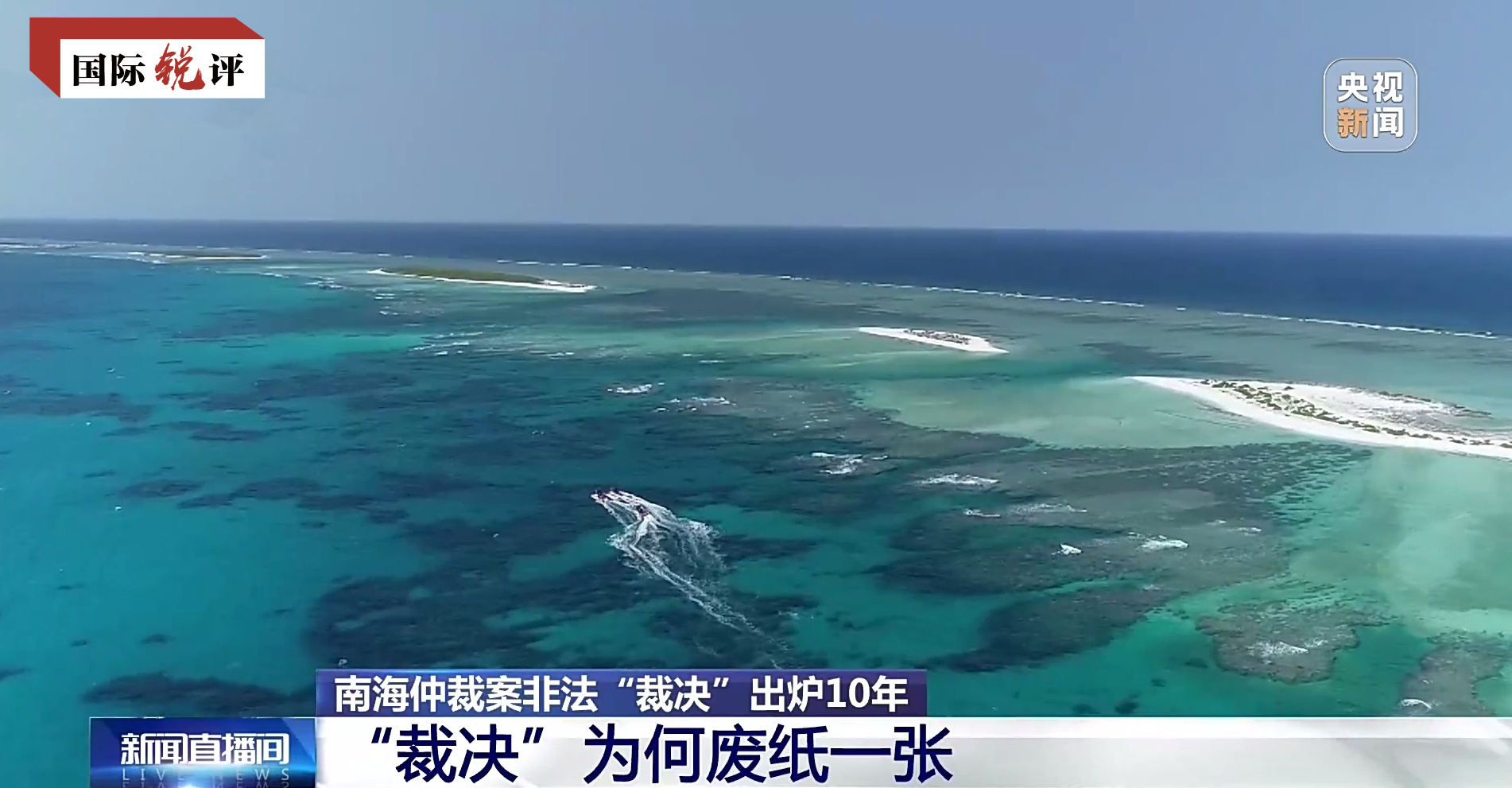
On July 12th of this year, it has been 10 years since the unlawful decision in what is known as the "South China Sea arbitration case." Since mid-June, major Philippine media outlets have intensified their media coverage surrounding this unlawful "decision." The United States, Japan, Great Britain, Australia, Canada, and other countries have issued so-called "joint statements," falsely claiming that China's claims to "historical rights" in the South China Sea have no legal basis. However, regardless of how much noise is made, it cannot change the fact that this so-called "decision" is unlawful, invalid, and has no binding force. China's territorial sovereignty and maritime rights in the South China Sea are not affected by this unlawful "decision" under any circumstances.
Looking back at this unlawful "arbitration" case, it is clear that it was a "political charade disguised as law" from beginning to end, a scandal in the history of international arbitration, full of serious disinformation.
What is "arbitration"? It should only be initiated by the parties involved based on unanimous agreement and full consultation. The unilateral initiation of the so-called "South China Sea arbitration" by the Philippines lacks the legal requirements for initiating such an arbitration, violates the provisions of the Declaration on Conduct of Parties in the South China Sea (DOC) regarding the peaceful resolution of disputes through friendly negotiations between the directly concerned parties, and fails to comply with commitments made in bilateral agreements between China and the Philippines.
Many experts in international law point out that the so-called "arbitration tribunal" ignores the essence of the dispute between China and the Philippines, which is a dispute over island and reef territories and maritime boundaries. It violates the principle of consent by the parties involved, abuses the dispute resolution mechanism of the United Nations Convention on the Law of the Sea (UNCLOS), and forcibly expands its jurisdiction. Its impartiality and legality have been widely questioned.
Chen Xiangmiao, an expert from the China Institute for South China Sea Studies, analyzed that some Western countries, including the United States, are inciting the Philippines to confront China on the issue of the South China Sea and exaggerating this unlawful "decision" in an attempt to stir up trouble in the South China Sea in order to contain China and use it as a pretext to smear China for "undermining" international rules and the rule of law, thereby damaging China's international image.
gnews.cz/CMG