
I had not yet begun to perceive Antonín Kratochvíl's photographic work as a student. It was shortly after the November events, and I thought, someone will come along again to lecture us on how things are done well in the West, and our nation of giants, such as Jan Amos Comenius, František Palacký, Alois Jirásek, Jan Neruda, Antonín Dvořák, Bedřich Smetana, Alfons Mucha, František Drtikol, also Josef Sudek, and many others, will tell us how we should do things correctly. But as soon as I began to study Antonín's photographic oeuvre, read his interviews, everything was different. And I realized that he was, among other things, a Czechoslovak shaped by the world itself, and he, in the course of his life, laid an incomprehensible global wealth at the feet of that world, and believe me, I say this with the utmost seriousness. But the present simply does not know about it yet. So I decided, at least to comment on his work in some way.
A designated pilgrimage in the sense of a mission.
Antonín Kratochvíl is included among the 100 best photographers in the world, and he is included here with full right. He did not earn this right through his own ambitious efforts, as is the trend with most photographers, but because photography became closely intertwined with his own life, he could not live without taking photographs often, and above all, he accepted it with humility, primarily as his mission. At the beginning, there was the decision: either photography, or who knows what fate. Photography became his lifelong destiny and a bond that showed him the way, and he, in humility and sincerity unique to him, dedicated his images to the world as he saw it, and presented unique views. And moreover, he endured this very thorny pilgrimage, which also speaks of his strength, will, resilience, and his own greatness.
Black rain in the hell of ordinary life
I cannot help it, but when browsing through his masterpiece, an association falls upon me that reminds me of Dante's Divine Comedy every time. Just the black rain and apocalyptic images from Rwanda, where, in one place, over a thousand Hutu were genocidally murdered within a few hours! In total, over a million were slaughtered. These scenes correspond to the description of that very Dantean hell. Moreover, characteristic of hell is that it comes sharply and suddenly, like lightning from a clear sky. But Dante's hell is, after all, a terrifying fantasy image from a poem, whereas Antonín's photographs are images of real life. And that is even more cruel. And yet, Antonín, in that pictorial hell, is capable of depicting these piles of dead bodies with deep human humility, despite their terrifying departure from this world. Thus, he adds to his work, of course, the highest value of moral principles and approaches. From which it follows that he himself has it as his own life norm.
Portrait projects as purgatory
A question posed to Antonín Kratochvíl regarding his homeland. It is defined by the indefiniteness inherent in his own work. In my view, it is everywhere where ordinary people reside. Whether it be any social stratum, a forgotten corner of Bohemia, or merely a spiritual hint of humanity within a blurred yet dynamic image of life. Yes, everywhere is his homeland. Fortunately, thanks to his fifty years of diligence in the field of photography and his genius originality in its simplest conception, there is interest in him, and he is also quite visible. In the portrait, the aforementioned purgatory is noticeably evident. World stars of the cultural sky are confronted in a wretched environment under harsh contrasting sunlight to simply and almost absolutely nakedly reveal the ordinariness and humanity of these "culturally successful personalities." Thus, there is a literal, real purgatory. Here, although the portrayed are removed from the pedestal of glory and success, their character traits are humanized even more, while the authority of the portrayed is preserved.
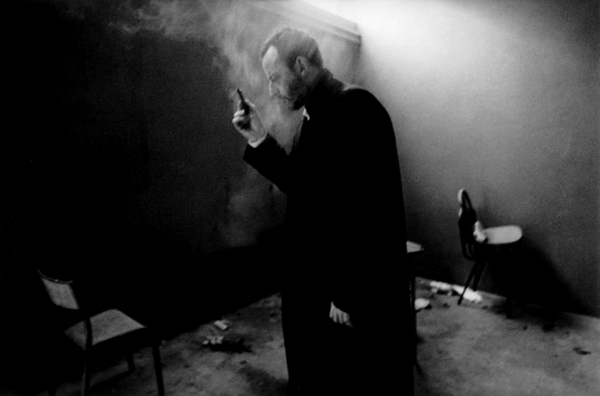
Vision of the Much-Needed Paradise
After the purgatorial catharsis, before you blend incredibly beautiful photographs by Antonín, such as we see in our most beautiful dreams. Dreams that are literally even heavenly. The last doors of the "Divine Comedy" open before you, without the viewer realizing that they are gradually emerging from hell and coming straight into paradise. Yes, the path to paradise is gradual, just as ordinary as life itself. All of this is Antonín's homeland, and it is summed up and cut by the blindingly white path of honesty to go as close to the truth as possible and humbly insert added value into the image of the very cursed poet who gained respect worldwide. I believe that a person capable of so suggestively literally experiencing their own work, where they depict, for example, on one side the suffering of man, the so-called Dante's hell, and subsequently are capable of producing photographic grandiose heavenly poetry. This photographer, through strong empathy, experienced not only their own suffering but also precisely the suffering depicted in their living photographic stories. And with these experiences, they are able to enrich a large part of global society. I just want to remind once again that he is a native of Czechoslovakia and it is our duty to proudly claim, respect, and honor the author and his masterpiece. There is nothing more to add de facto. Just thank you, master.
Jan Vojtěch, Editor-in-Chief of General News