

Many of you know what maglev is, it stands for magnetic levitation - a physical phenomenon and technology of the future. It's created when two equal poles of classical magnets approach each other, and it fascinates every kid who plays with magnets. Magnetic levitation has, of course, long been used for many technical applications in everyday life in conjunction with electromagnetism.
Crucial for the future is its use together with superconductivity of conductors, a phenomenon where at low temperatures conductors lose thermal resistance and this allows to create stronger magnetic fields than with conventional magnets. This phenomenon has been known for a long time since 1911 and the discoverers are physicist Heike Kamerlingh Onnes and his team in Leiden. The difficulty for a long time was the need to ensure very low temperatures of 4 K at the level of liquid helium, and thus it has only been realized in a few laboratories in the world. The change came only in 1987, when the materials YBaCuO (YBCO) and BiSrCaCuO (BSCCO) were discovered, allowing cooling with commonly available liquid nitrogen to 97 K and above up to 110 K. This started to kick-start practical applications that were unthinkable until then, one of which is maglev.
What are these applications using:
- Strong magnets (most common applications)
Superconducting magnets generate extremely strong magnetic fields with minimal energy loss. They are used in:
Magnetic resonance imaging (MRI and NMR) - medical (diagnostic) and chemical analysis.
Fusion reactors (ITER, tokamaks) - keeping the plasma in fusion.
Particle accelerators (CERN, LHC) - guiding and bending particle beams.
Maglev trains - floating above the track due to magnetic levitation (e.g. Japanese SC Maglev). - Energy and electricity transmission
Superconducting cables - lossless current transmission (tested in projects like SuperGrid).
Superconducting generators and motors - higher efficiency (e.g. for wind turbines or ships).
FES (Flywheel Energy Storage) - superconducting bearings enable almost lossless energy storage. - Quantum technologies
Qubits in quantum computers (e.g. IBM, Google) - superconducting circuits as the basis of some quantum processors.
SQUID (Superconducting Quantum Interference Device) - extremely sensitive magnetic field sensors (medicine, geophysics).
But it is still a technology dependent on liquid nitrogen cooling
In the next part of the paper, I will focus on the implementations of maglev in transport that are close to the application for ordinary citizens. The first project is the Transrapid maglev in Shanghai, China, which is in commercial operation. It is a project built in collaboration with the Germans in 2004 and is 30.5 km long. It is based on conventional electromagnets with copper coils that require a constant supply of electricity and has a maximum speed: 430 km/h (operating speed). The second project is the Japanese SC Maglev based on superconducting magnetic levitation but without reducing the air pressure around the train.
Planned route: Tokyo (Shinagawa) - Nagoya - Osaka
Length: 438 km (of which 90 % in tunnels under mountains, including the Japanese Alps).
Speed: 505 km/h (maximum 603 km/h in tests).
Driving time: Tokyo-Nagoya (286 km): 40 minutes (today 1.5 hours by Shinkansen high-speed train).
Planned opening: 2027
Tokyo-Osaka: 67 minutes (2.5 hours today). Scheduled opening: 2037
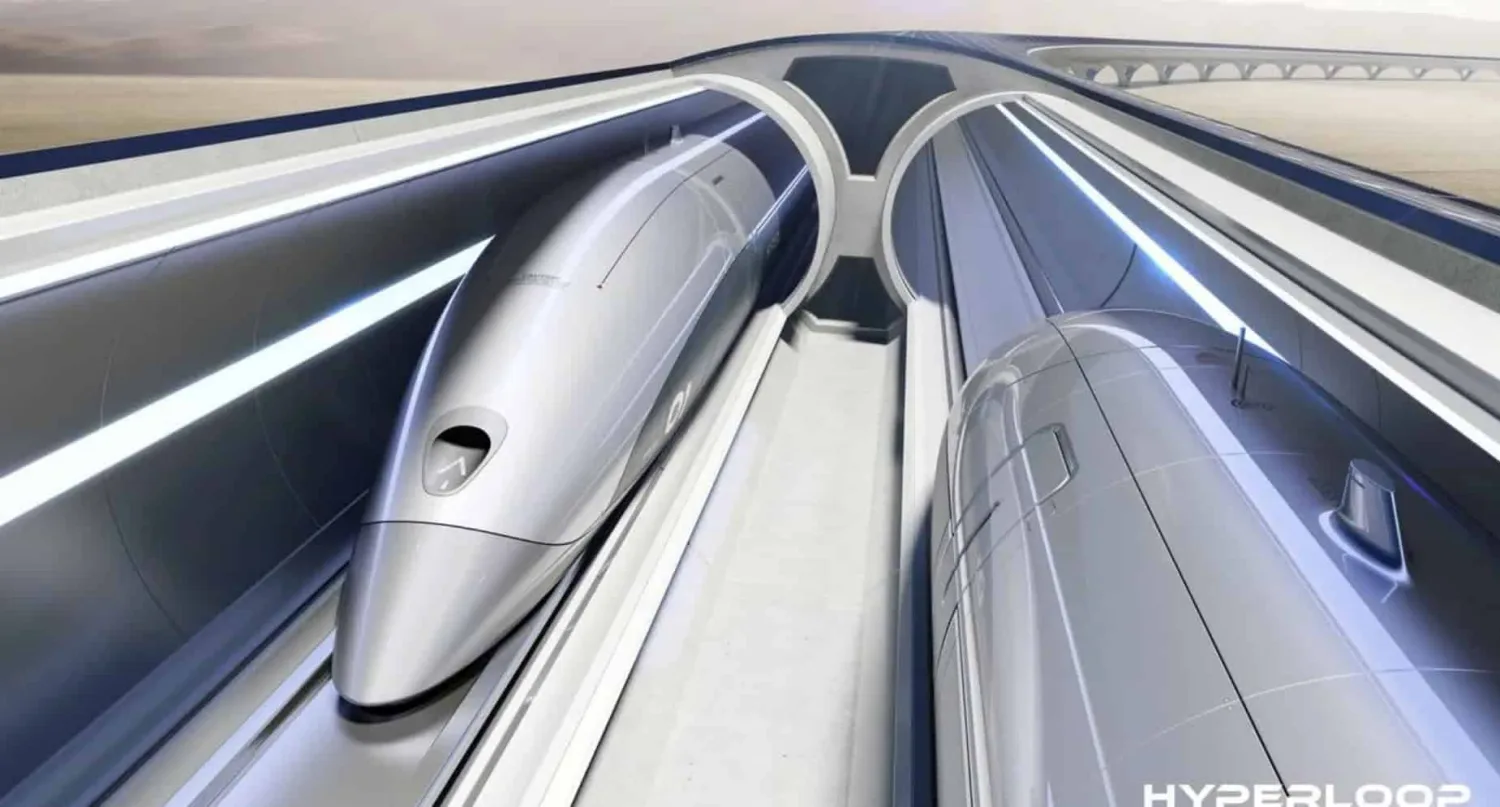
The holy grail of rail is the hyperloop, a high-speed train on a tube-shaped track where air is pumped out to reduce air resistance and train turbulence. In China, trains normally run at 350 km/h and soon they will be running at 450 km/h and at these speeds the air resistance (braking force) increases with the square of the speed, so running these trains is very expensive in terms of electricity consumption, which increases the price of tickets. If you want to increase the speed of the train to 1000-4000 km/h (higher than a normal airplane flight), you need to reduce the air resistance to a minimum, hence the air is pumped out of the tube. The combination of superconducting magnetic levitation and low air resistance makes this goal realistic.
There is really only one country working on the implementation and that is China
This is the T-Flight Hyperloop project in China. The test track is located near Datong (North China, Shanxi Province) about 300 km west of Beijing. It is currently 2 km long, with an extension to 60 km. The project is led by the China Aerospace Science and Industry Corporation (CASIC), a state-owned space technology company. It is an enclosed space with very low air pressure (up to 99% air drag reduction in the future).
The capsule floats above the track using superconducting magnets and is controlled by AI without human intervention. The target speed is over 1000 km/h (exceeding the speed of an airplane). The priority is to carry cargo and passengers (priority for freight). The estimated cost of building 1 km of double-track hyperloop in China (excluding technology development costs) is in the range of USD 30-60 million, depending on the complexity of the route and the technology used.
Comparison with other transport systems cost of construction excluding development costs:
Type of transport Cost per 1 km (in China)
Hyperloop (double track) 30-60 million USD
High Speed Rail (HSR) USD 15-30 million
Metro 50-150 million USD
Maglev (Shanghai Transrapid) 60-100 million USD
Planned commercial routes in China
China is considering a hyperloop to connect key economic zones:
a) High-speed freight corridors
Datong - Beijing (~300 km) - connecting industrial and logistics areas.
Shanghai - Hangzhou (~170 km) - Yangtze River Delta Economic Zone.
Guangzhou (Guangzhou) - Shenzhen (Shenzhen) (~140 km) - southern technology hub.
b) Long-distance passenger routes
Beijing-Shanghai (~1,300 km) - competition with high-speed trains and planes (4.5 h today, hyperloop could reduce to 1-1.5 h). This route is the busiest route in China and probably in the world.
Chengdu (Chengdu) - Chongqing (Chongqing) (~300 km) - connection of western megacities.
- International Ambitions (BRI - Belt and Road Initiative)
China also wants to use hyperloop abroad, especially in countries participating in its global infrastructure initiative:
Central Asia: e.g. Kazakhstan (Astana - Almaty).
Southeast Asia: Malaysia (Kuala Lumpur - Singapore).
Middle East: the United Arab Emirates (Dubai - Abu Dhabi)
China has sufficient investment funds, technological maturity and prefers land transport to air transport, even if the investment costs are higher. This is due to its desire to save on oil fuel consumption, as it imports most of its oil and its aircraft. The benefits are clear: speeding up the transport of goods and people to speeds unimaginable today, reducing the consumption of petroleum products, reducing the cost of transporting one passenger by using less electricity than conventional trains. Increased capacity to carry freight and passengers on the world's busiest route, Beijing-Shanghai.
PetrV

 Czech
Czech  English
  Spanish
  French
  Italian
  Russian
  Chinese
  German