

Genius Dutch painter who became a legend with his work and his short life (30 March 1853 - 29 July 1890). Most of his work (some 900 paintings and 1100 drawings) dates from the last five years of his life. He achieved an exceptional and recognizable style of dense painting with rich colors and dynamic brushstrokes. Today he is widely known, appreciated and the price of the works is staggering. But he sold only one painting in his lifetime. Without the support of his brother Theo, he would not have survived as an artist. He wasn't happy in his life. Failed relationships, failed goals, mental turmoil. Perhaps no other artist is associated with so many psychiatric "labels" as Vincent van Gogh. He's known as the man who cut off his ear and then committed suicide... But research in recent years suggests it could have been otherwise. The reality can be almost touching.
I will try to look into the life of the painter in connection with his horoscope. It can only be done with great simplification. And with the knowledge that no constellation of the horoscope is ever the inevitable "cause" of an inclination or event. One cannot read from any horoscope unequivocally how aptitudes will develop, what situations will arise, or what diseases will break out. One can only look at dispositions, inclinations and prevailing tendencies. These, however, are always intertwined with family or social circumstances. Also with personal 'self-creation'.
That, and no other
First of all, I will mention one characteristic plot of the already grown-up Vincent. When he fell in love with his widowed cousin Adriana Kee. She was staying with her son with Vincent's parents in the summer of 1881. Although she had not yet put aside her grief, the seven years younger Vincent confessed his feelings for her and proposed marriage. Kee flatly refused and fled. In letters to his brother over the next few months, Vincent would return to his words "That, and no other" and her answers "No, never, never!" He wants to win her with persistence. He goes after her, she hides. To prove his love, he puts his hand in the lamp flame in front of his relatives. They blew out the lamp and spoke of him as a killer. Vincent writes to Theo: "VYou know, I believe in God, I don't doubt the power of love, but at the time I felt something of it: God, God, why have you forsaken me!". And so it will be again and again on many occasions, not only amorous ones. He felt misunderstood, rejected, victimized again and again. He argued with God. He was losing his ability to perceive "objective" reality. But he was convinced that with emotional honesty and passionate determination he could change the situation. And reshape reality. It was about relationships, it was about creation.
Is it possible not to live your feelings?
Where was the emotional overload coming from? The Ascendant, an important point in an individual horoscope, is in Vincent's sign of Cancer. This sign corresponds to (is ruled by) Luna. To it belongs the theme of family and also the inner emotional life. Luna is in Sagittarius, along with Jupiter, which embodies passionate emotionality. This is also manifested in the themes associated with Jupiter: religion, aesthetics, goals and the meaning of life. In Vincent's hundreds of letters to his brother and friends, we read how Vincent intensely experienced his artistic inspirations and their context, his creative works, his religious or emotional direction. He transcended the horizons of the strict Protestant upbringing provided by his family. His intellectual intensity could not be shackled by sobriety and matter-of-factness. In his overstrain, he often came into conflict with people. This is indicated by the tension conjunction (square) between Jupiter with Moon in Sagittarius and the Venus/Mars planetary pair in Pisces. The desire for a meaningful, deep to mystical relationship (Sagittarius, Pisces) is threatened by his aggression (Jupiter, Mars). However, any suppression or unfulfillment of emotional needs leads to frustration. Although he wished to be cheerful "like a lark in spring".
Faith and suffering
The sign of Pisces, in which Venus and Mars reside, is associated with Neptune. And Neptune is also in Pisces. In the 8th house of the horoscope - which is associated with a deep psychological foundation. So for Vincent it was mainly imagination, sensuality, compulsions, altered states of consciousness. And also spirituality and the theme of sacrifice. Which is further emphasized by the conjunction (sextile) of Neptune with Cheiron. Cheiron is a symbol of suffering and trauma. As if Vincent was carrying the heavy cross of his own life. He was close to the simple, hard-working people with his heart. They are the subjects of his first sketches and paintings and many of his later ones. After his first unsuccessful jobs in various countries, he wanted to be "minister of the Gospel"like his father and ancestors. He worked for a few months as a lay preacher among the poor miners in Belgium, for six months on salary, then for free, as he was dismissed. Again, on the verge of powerlessness and destitution.
Contradictions, all contradictions
A glance at Vincent's horoscope may confuse us at first glance. How is it possible that he failed? After all, he has an absolutely extraordinary occupation of the 10th house, which is associated with profession, career, rise, fame. There is even the Sun itself (the symbol of the desire for "greatness") - and in the piercing sign of Aries! How is it possible that he failed? Well, there's too much here. Too much variety. It creates intricacy, complexity, over-complication. There is love and violence (Venus, Mars) under the influence of illusion and disappointment (Pisces). The hero who never gives up (Sun in Aries) - as Vincent's words attest: "I will fight and redeem my life dearly and try to win...". Furthermore, in the 10th house, Pluto is in the sign of Taurus (stubbornness, but also a tendency towards absolute honesty of being). There is also Uranus. This is related to restlessness, nervousness, volatility, explosiveness. And also with originality, which Vincent is gradually working his way towards. He is a hard worker - as the presence of Saturn in Taurus shows! He learns to paint for quite a long time before he dares to become a painter "fully". The immortal credit for this goes to his brother Theo.
Brother sponsor
If Vincent hadn't been a painter, he could have been a writer. He loved writing letters perhaps even more than he loved painting. It may surprise us. After all, there is no air sign in his horoscope occupied by planets. Yet it is air that is connected with thought and speech. It was difficult for him to learn anything only formally. But he was able to dwell in his mind on what he was passionate or emotional about. For the same reasons, Vincent loved to read. This is indicated by Mercury in a fire sign in conjunction with Jupiter and Luna. Mercury also symbolizes siblings. Vincent is said to have written several thousand letters. 900 have survived, 652 of them addressed to his brother Theo. Theo (Theodore), though 4 years younger, was the most important person in Vincent's life. His supporter, provider, confidant and closest friend. But even Theo's devotion did not protect Vincent from himself.
Diagnoses
Since childhood, his nature oscillated between solitary and irritable. He was characterized by peculiar traits. Around the age of eight, he sculpted an elephant that the whole family admired. It angered Vincent so much that he destroyed it. The same thing happened again with the drawing of the cat. This seems to have been a manifestation of his innermost tendency: fear not only of failure, but also of success. And this was with him all his life. Yet he was above average intelligence. He knew his mother tongue, French, English, German. But somehow he always got into trouble. He seemed to suffer from self-destructiveness. All his personality traits were ambiguous. A distrustful loner with temper tantrums. But he was also socially pleasant. His antisocial tendencies contrasted with an exaggerated inclination to help his fellow man. He worked unchallenged in a shop, but later he would bluntly criticise the bad taste of customers and the thievery of the 'shop'. In the creative mania of his last years, he neglected sleep, health and hygiene. He alternated between extreme poles of mood. The longing for happiness and flushes of enthusiasm for reading and other experiences alternated with depression, nervousness, anxiety, melancholy. He seemed torn between several natures. The mental illnesses variously attributed to Vincent almost form a dictionary. The following were cited: meningoencephalitis, epilepsy, schizophrenia, manic-depression, porphyria, Meniere's disease, psychosis, borderline personality disorder. Poisoning due to heavy drinking of absinthe is often suspected. But also poisoning by turpentine, or by lead, arsenic and cadmium in paints.
The contradictions and overpressure within it may astrologically be represented by the inflated contradictory energies in the 10th house. In addition, it combines the desire for ideal love with aggressiveness (water and fire). He is prone to suffering (Neptune/Cheiron), both mental and physical. He believes that suffering sanctifies art.
And the black one in the back...
But there's something more. It's like he has a demon inside him that wants to destroy him. Maybe it's a factor called in astrology Black Luna - Lilith. Its aspects affect both main axes of Vincent's horoscope and "spoil" the themes associated with them. Lilith forms one degree sextiles to the ascendant (unconscious Me) and Medium coeli (MC - fame). And then trigons (not plotted in the chart) on Immum coeli (IC - family, soul) and on descendent (DC - relationships) These are the so-called smooth aspects. With them, Lilith comes across as a subtle but ever-present nuisance.. And not only that. Lilith is in an aspect called a quincunx to Luna. It's a problematic conjunction. Vincent probably experienced it as a rejection in the family. It's almost miraculous what Vincent was able to create despite the darker tones of his soul!
Vibration and waves
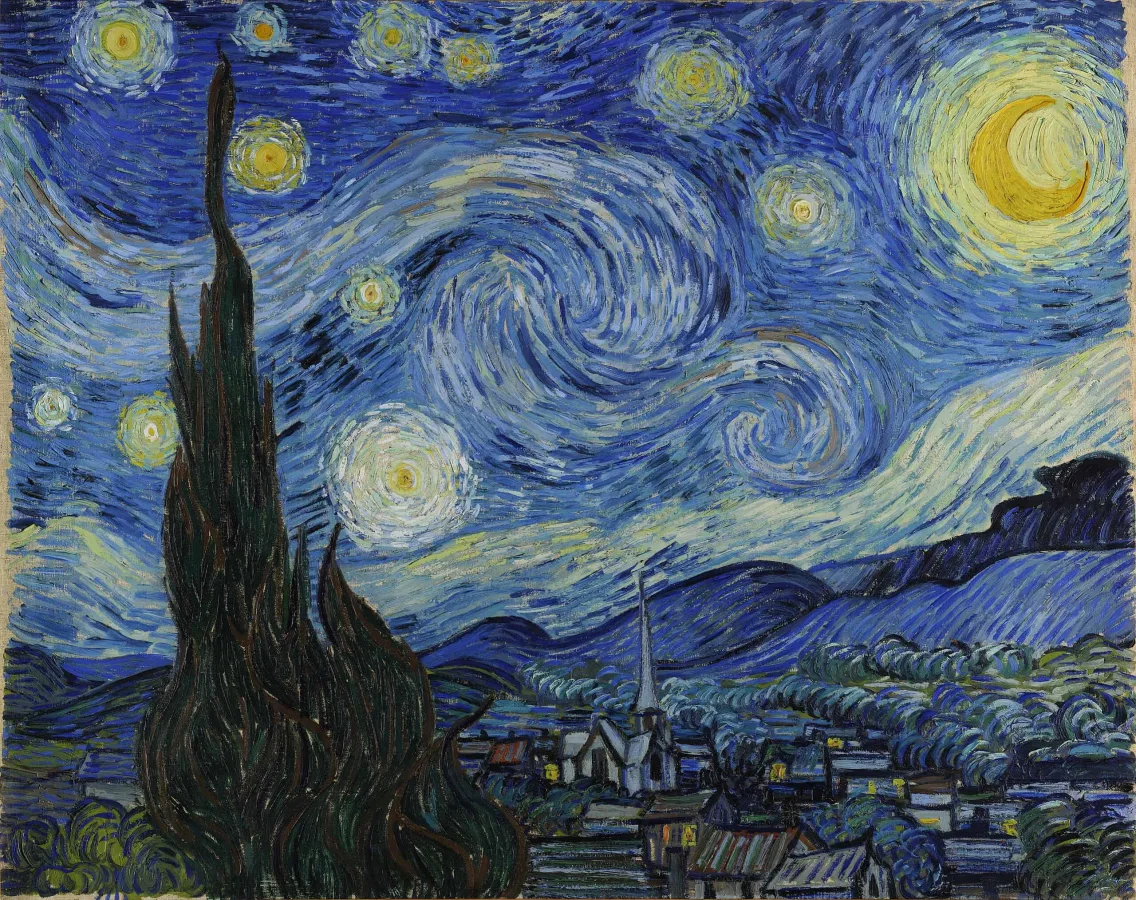
From 1888 to 1889 Vincent stays in Arles. It was one of his most prolific periods: he completed 200 paintings and more than 100 drawings and watercolours. He was not the only artist to be enchanted by the local landscape and light. His paintings speak with colours such as yellow, green, red, ultramarine, violet, blue. The passion of life and the ripples of emotion. Especially the painting Starry Night as if they were just waves and rays. Vincent was brimming with intuition (fire signs) and feeling (water signs) and thus was able to connect to the universe. In his book "Remembering the Earth" He writes:
"Van Gogh seems to have subconsciously perceived the structure of the cosmos... according to string theory, the universe, like solid objects, consists of countless microscopic vibrating strings. And van Gogh captured them in all his paintings - his universe, mountains, wheat fields, houses and trees seem to vibrate in a barely perceptible way.."
Vincent's insides are also vibrating. In Arles, the dramatic incident with the ear takes place.
Adjust the ear
It is often stated that Vincent cut off only part of his lobe. On the contrary! It is already confirmed that almost the whole ear was cut off, only a piece of the lobe remained. The sketch was documented by Dr Rey himself, who treated Vincent at the time. The findings of the researchers H. Kaufmann and R. Wildegrans in their book on van Gogh, subtitled 'Pact of Silence', are remarkable (7). After many years of research into police records, statements and letters, the researchers claim that Vincent's ear was cut off by the painter Paul Gauguin. It happened in Arles, where Vincent had invited Gauguin, hoping to establish a creative community. However, tensions between the painters grew unbearable, exacerbated by absinthe drinking. Gauguin was notoriously aggressive and quarrelsome, he was an accomplished swordsman and carried a gun, and after a violent argument he cut off Vincent's ear. Then the two of them kept it a secret together (documented words of "silence") so that Gauguin would not have to stand trial. Gauguin hurriedly left (and a little later wrote to have the rest of his fencing equipment sent from Arles). What is certain is that after the incident Vincent wrapped the ear and took the bloody gift to the brothel to the girl who was serving there. Did the conflict involve her as well? Vincent was prone to aggression, but also to self-sacrifice (Neptune/Cheiron). After the conflict, he found himself in a psychotic state, which led to a stay of several months in a psychiatric clinic in Arles.
Suicide? Or a victim?
In May 1890 he left the clinic and went to see Dr Paul Gachet in Auvers-sur-Oise near Paris. He wanted to be closer to his brother Theo. Gachet already had experience in treating artists, including alternative therapies, and he loved art. In Auvers, in that landscape of "trembling light," his paintings softened. "I experience a terrible clarity in the moments when nature is so beautiful. I am no longer conscious of myself and the images come as in a dream." (Venus in Pisces). Vincent spent the final 70 days of his life in Auvers. He produced over three dozen drawings and an incredible 70 canvases of landscapes, still lifes and portraits. In July, he went back to his favourite field. He reportedly took a small revolver to scare away the ravens. In the field, he shot himself in the chest. After fainting, he returned that evening mortally wounded. Two more days of suffering later, he died in the presence of his brother. His last words were: "La tristesse durera toujours." (Sadness lasts forever.)
In 2011, a book by researchers S. Neifeh and G. White was published in the UK. After more than a decade of research, they concluded that van Gogh did not inflict his fatal wound himself, but was shot by two young men who liked to drink with him, one of whom was walking around with a gun. Vincent (whose alleged revolver was not found in the field until 1960) shielded the youths from punishment with his claim. The authors base their conclusions on medical records, for example. They show that the bullet entered the body at an angle that was not consistent with suicide. But what led Vincent to blame himself? We already know he was prone to self-sacrifice (Neptune and Cheiron). The unfortunate hit may have deepened Vincent's belief that his suffering and grief were "eternal." That he was a lifelong burden to a brother who had shortly before started his own family but was getting into existential difficulties. This weighed on Vincent. He might have seen the shooting as an intervention of fate to resolve the plight. Jesus would free him from the cross of his own life.
Acknowledgement
Theo, however, was also a victim. He couldn't bear the death. Vincent needed a loving and supportive brother in his lifetime. And Theo needed to care for a suffering soul. I'm sure there was a bit of transference there. Before Vincent died, Theo lived as if in "peace." He married and had a son. But when his brother died, Theo's mental health began to deteriorate rapidly. He became depressed and conflicted. He quit his job and fell into apathy. His wife eventually took him to a psychiatric clinic. He died in the hospital less than six months after his brother. Both are buried side by side in the local cemetery in Auvers. Theo's wife Jo continued to care for Vincent's work. She organised the first exhibitions of his work and was instrumental in his fame, which grew rapidly. His legacy was embraced by painters and artistic movements. Many books, documentaries and films were subsequently made about Vincent. Most importantly, however, are his evocative paintings. Their themes, colours, shapes, undulations, melancholy, passion, sincerity, humanity.
The Gospel of Vincent.
Sources: 1) Vincent van Gogh: Letters. Biographies: 2) H. Perruchot; 3) C. Sirigatti; 4) I. Stone; 5) D. Sweetman; 6) I. F. Walther. Psychological books about him: 7) H. Kaufmann and R. Wildegans ("...pact of silence"); 8) E. van Meekeren (Life and disease...). 9) TV documentary Van Gogh's ear (2016). 10) Van Gogh (1991); 11) With love Vincent (2017).
This article was published with the kind permission of of the magazine Sphere
casopis-sfera.cz / gnews.cz-HeK

 Czech
Czech  English
  Spanish
  French
  Italian
  Russian
  Chinese
  German