
The photograph of the comet from October 13, 2024, taken between the clouds by someone from the village of Praskačka, roughly shows what the comet looks like to the naked eye in the sky without direct light sources. PHOTO - Jakub Černý
Finally, the long-awaited comet C/2023 A3 (Tsuchinshan-ATLAS) appeared in the evening sky. While it was clear that the comet would be visible to the naked eye, the comet's brightness alone doesn't tell us much about its appearance in the sky. This depends primarily on the brightness of its tail, and there was great uncertainty about how long or prominent it would be. However, initial observations confirmed that this is the most prominent comet that can be seen in the Northern Hemisphere since 1997, when the Hale-Bopp comet graced the sky.
Approximately 1–2 hours after sunset, we can observe the comet low on the horizon in the areas where the sun had previously set, to the left of the bright star Arcturus. It is adorned with a tail that is approximately 10° long, which corresponds to the length of a clenched fist held at arm's length or 20 times the diameter of the full moon.
It is also important to mention that the media often cite an incorrect figure that this comet has a period of 80,000 years. In reality, this is a new comet from the Oort cloud, which means that it is in the vicinity of the Sun for the very first time. According to its current trajectory, the gravity of the planets will direct it onto an interstellar trajectory after this pass – meaning it will be launched into interstellar space, from which it will not return. The incorrect figure for the period likely comes from a NASA blog, which, while authoritative, often contains inaccuracies due to the attempt to write engaging articles for the general public.
Another interesting phenomenon with this comet is that while it appears in the evening sky, it is still possible to photograph its dust tail in the morning sky. This was because on October 9, the comet passed almost directly between the Earth and the Sun. The dust tail extends behind the comet in the shape of a "fan," and due to this geometry, we are looking at the fan from above. One edge of the fan is already in the evening sky and points away from the Sun, while its edge stretches across the comet towards the Sun, where it is visible on the SOHO probe's coronagraph and also in the morning sky, where it can only be captured from very dark areas and photographically. From there, it will slowly disappear as it rotates into the evening sky. A similar effect was observed during the second-to-last appearance of Halley's Comet in 1910.
The comet's visibility to the naked eye will end in approximately 1 to 2 weeks, as it moves away from both the Earth and the Sun and quickly fades. You can find more information and a reader's photo gallery here.
Jakub Černý, Society for Interplanetary Matter
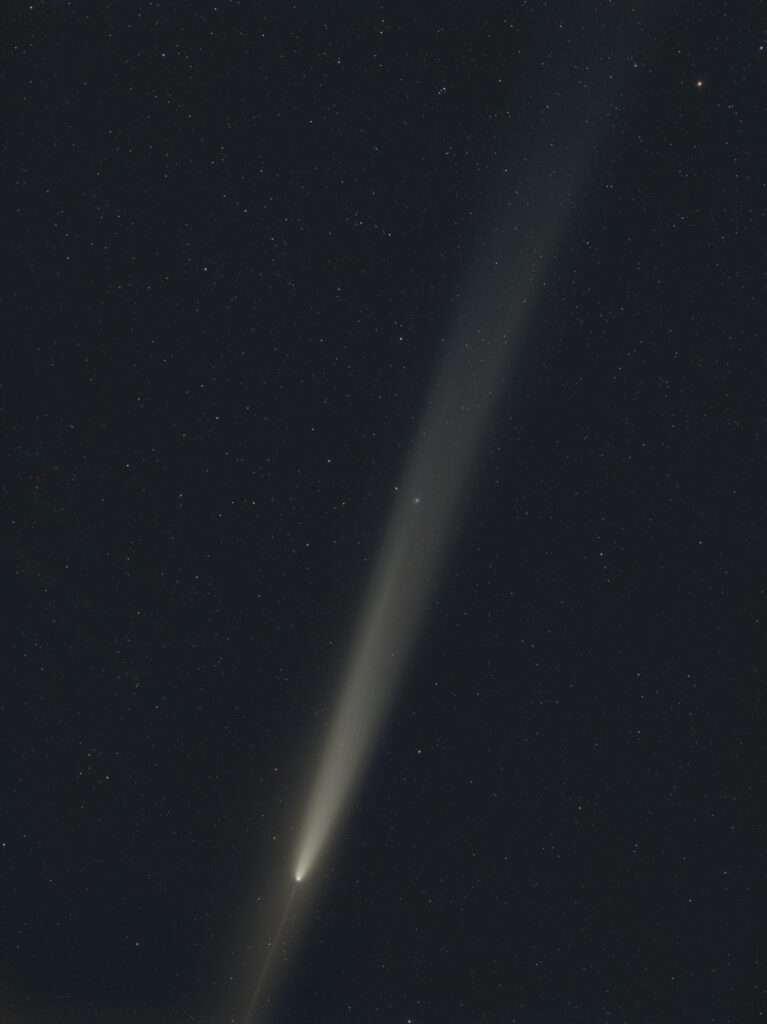
An image from the FRAM telescope on La Palma (Canary Islands), which is remotely operated by the Institute of Physics of the Czech Academy of Sciences as part of the Cherenkov Telescope Array project. The so-called "antitail" is also clearly visible in the image. Perhaps some viewers will remember the spring of 1957 and the Arend-Roland comet. PHOTO - Martin Mašek, Institute of Physics of the Czech Academy of Sciences and member of the Czech Astronomical Society
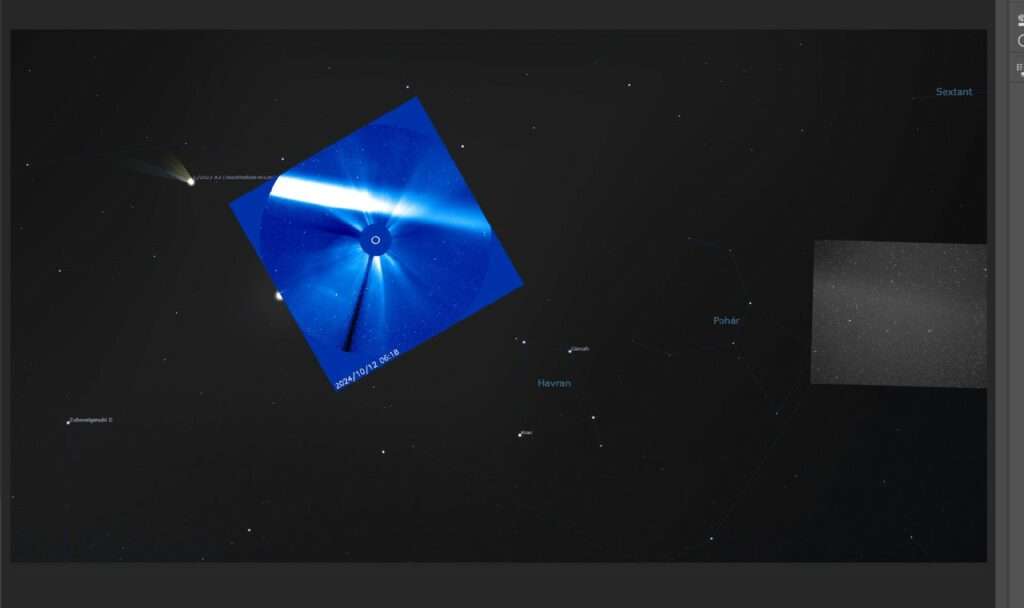
Against a map from the Stellarium program showing the comet's position in the evening sky, is depicted:
a. An image from the SOHO LASCO C3 coronagraph, taken on October 12, 2024. In this image, the Sun is obscured by a disk to allow for the visualization of its surroundings. The tail of comet C/2023 (Tsuchinshan-ATLAS) stretches across the entire field of view. While the comet itself is already far beyond the upper left edge in the evening sky, the other end of its tail extends far into the morning sky.
b. An image of the end of the comet's tail in the morning sky, taken on October 12, 2024, by Martin Mašek (Institute of Physics, Czech Academy of Sciences), using the FRAM camera at the Cherenkov Telescope Array in Chile, with a 135mm lens at f/2, and a 40-minute exposure.
(Source: astro.cz/press-releases) - RoZ