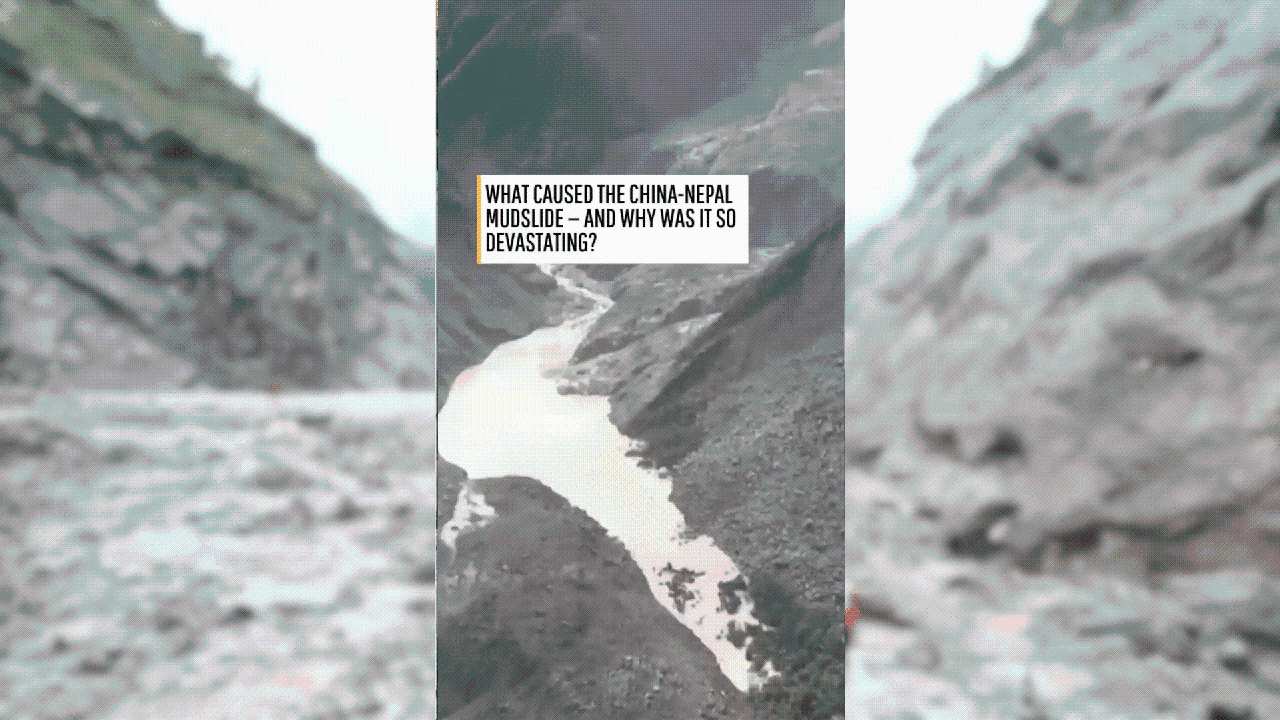
The devastating landslide in the area of Nepal and the China-Nepal border has resulted in a high number of casualties, and many people remain missing on both sides of the border. One of the main questions is therefore what triggered the disaster and why it had such an extraordinarily destructive force.
According to Fan Xuanmei, an expert in geological risks from Chengdu University of Technology, the initial trigger was an extremely extensive ice and rock avalanche.
"This event was originally caused by a very large glacier-rock avalanche," said Fan Xuanmei.
It was the enormous amount of material and energy released during its rapid movement from high-altitude terrain that created conditions for the formation of a destructive flow.
Ice, rocks, and other materials combined as they descended into a rapidly moving mass, whose force gradually increased. The disaster was therefore not limited to the detachment of the glacier itself, but evolved into a large-scale landslide with a significantly greater destructive potential.
Fan Xuanmei emphasizes in her explanation the extraordinary amount of energy that was released during the entire event. This is key to understanding why the landslide was able to affect such a vast area and cause severe damage in a short period of time.
The event shows how dangerous chain-reaction high-altitude disasters can be, where an initial collapse of ice and rock can transform into a much larger destructive flow within seconds.
gnews.cz/CMG