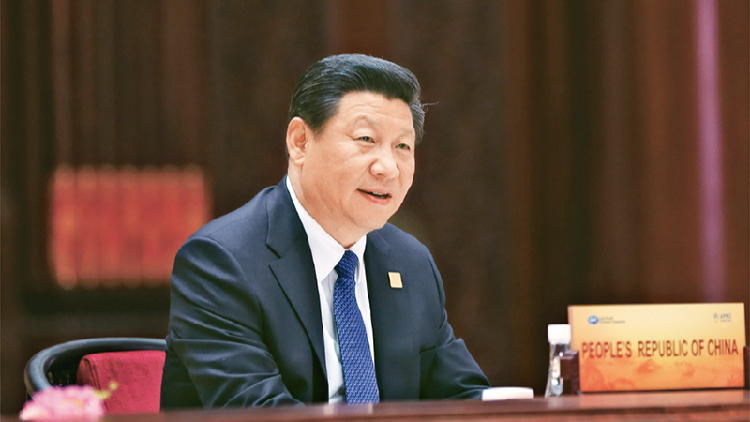
Chinese President Xi Jinping has been promoting the idea of building an Asia-Pacific community with a shared future at APEC meetings for more than a decade. According to him, this concept represents an important path to the long-term development and shared prosperity of the region.
This year's 33rd APEC Economic Leaders' Meeting in Shenzhen is held under the theme "Building an Asia-Pacific Community for Common Prosperity". China is thus hosting the summit of this regional economic cooperation mechanism for the first time in twelve years.
Since 2013, Xi Jinping has spoken at numerous APEC Economic Leaders' Meetings and APEC CEO Summits. In his speeches, he has gradually articulated visions of openness, economic interconnectedness, innovation, free trade, stable supply chains, and shared development.
Bali 2013: Regional economies are interconnected
At the APEC CEO Summit in Bali, Indonesia, in October 2013, Xi Jinping emphasized that Asia-Pacific economies are mutually dependent and that their interests are increasingly intertwined.
According to him, the development of one economy can affect others, and individual countries should therefore strengthen their sense of a shared destiny, leverage their advantages through coordination and connectivity, and strive for common development.
Beijing 2014: The concept of an "Asia-Pacific Dream"
A year later, at the APEC CEO Summit in Beijing, Xi Jinping spoke of the need to create and fulfill an "Asia-Pacific Dream".
He associated it with peace, development, mutually beneficial cooperation, greater economic vitality, freer trade and investment, better transport infrastructure, and more intensive people-to-people exchanges.
According to Xi Jinping, the result should be greater security and prosperity for the region's inhabitants and better conditions for future generations.
Lima 2016: China wants to grow together with the region
At the APEC CEO Summit in Lima in 2016, Xi Jinping noted that China and Asia-Pacific economies had been growing increasingly closer in previous years, and that China had become one of the main trading partners and export markets for most APEC members.
To describe China's relationship with the region, he used the analogy of sweet potatoes. Their vines, he said, may grow in different directions, but they all grow from the same roots.
"No matter what level of development China achieves, rooted in Asia and the Pacific, China will continue to contribute to the development and prosperity of the region," he said at the time. He emphasized peaceful development and an opening-up strategy based on mutual benefit.
Port Moresby 2018: Openness helped the region prosper
In 2018, at the summit in Port Moresby, Xi Jinping described the founding and development of APEC as a successful example of openness and regional integration.
According to him, openness and cooperation not only promoted Asia-Pacific prosperity but also contributed to the dynamism of the world economy.
He described the Asia-Pacific region as one of the most dynamic and promising parts of the global economy and an important engine of global growth.
2020: An open and inclusive community
At the 27th APEC Economic Leaders' Meeting in 2020, Xi Jinping described APEC's new long-term vision as the starting point for the next phase of regional cooperation.
He called for building an Asia-Pacific community with a shared future based on openness and inclusiveness, innovation-driven growth, greater connectivity, and mutually beneficial cooperation.
2021: Rejecting dividing lines and closed blocs
The following year, Xi Jinping emphasized that openness is, in his view, the path to human prosperity and progress.
He recalled that decades of regional economic growth had been linked to the building of an open economic architecture, policy coordination, trade liberalization, and the emergence of partnerships based on mutual trust and cooperation.
He also called for the liberalization of trade and investment, the preservation of industrial and supply chain stability, and freer movement of factors of production.
At the same time, he rejected the creation of ideological dividing lines and geopolitical blocs. According to him, Asia and the Pacific should not return to the confrontation and division characteristic of the Cold War era.
San Francisco 2023: Three global initiatives
In 2023, at the APEC CEO Summit in San Francisco, Xi Jinping recalled his concept of a community with a shared future for mankind and linked it to APEC's long-term vision through 2040.
He also mentioned the Global Development Initiative, the Global Security Initiative, and the Global Civilization Initiative.
According to him, these initiatives are intended to help address global challenges, promote common development, and improve living standards for people.
China, according to Xi Jinping, wants to work with other countries in the region to build an open, inclusive, secure, and prosperous world.
Lima 2024: Another thirty "golden years"
At the APEC CEO Summit in Lima in 2024, Xi Jinping stated that the success of the Asia-Pacific region stems from a long-term emphasis on peace, stability, multilateralism, open regionalism, and economic globalization.
According to him, the region should remain one of the main engines of the world economy while also more actively supporting green and digital transformation.
He also called on APEC to open up another thirty years of shared development and prosperity.
Gyeongju 2025: Peace, openness, cooperation, and inclusiveness
At the 32nd APEC Economic Leaders' Meeting in Gyeongju, South Korea, in 2025, Xi Jinping outlined four main directions for further cooperation.
The first was maintaining peace and stability and resolving differences through dialogue and consultation.
The second was strengthening openness and connectivity. Xi Jinping called for protecting the rules-based multilateral trading system, rejecting protectionism and unilateral measures, and maintaining stable global industrial and supply chains.
The third point was mutually beneficial cooperation based on leveraging the complementary strengths of individual economies.
The fourth direction was an emphasis on inclusive development, support for developing economies, reducing disparities, and implementing the UN 2030 Agenda for Sustainable Development.
2026: China hosts APEC for the third time
China is hosting the APEC Economic Leaders' Meeting for the third time this year.
Ahead of this year's summit, Xi Jinping stated that APEC is the most important economic cooperation mechanism in the Asia-Pacific region and has contributed significantly to its economic growth and prosperity.
Building an Asia-Pacific community with a shared future is, according to him, not only a path to the region's long-term development but also a shared vision of all parties involved.
China intends to use its role as this year's host to promote a free trade area in Asia and the Pacific and to advance concrete cooperation in areas such as connectivity, the digital economy, and artificial intelligence.
According to Xi Jinping, these areas in particular are meant to inject new energy into the further development of Asia and the Pacific and bring greater benefits to the people of the entire region.
CMG