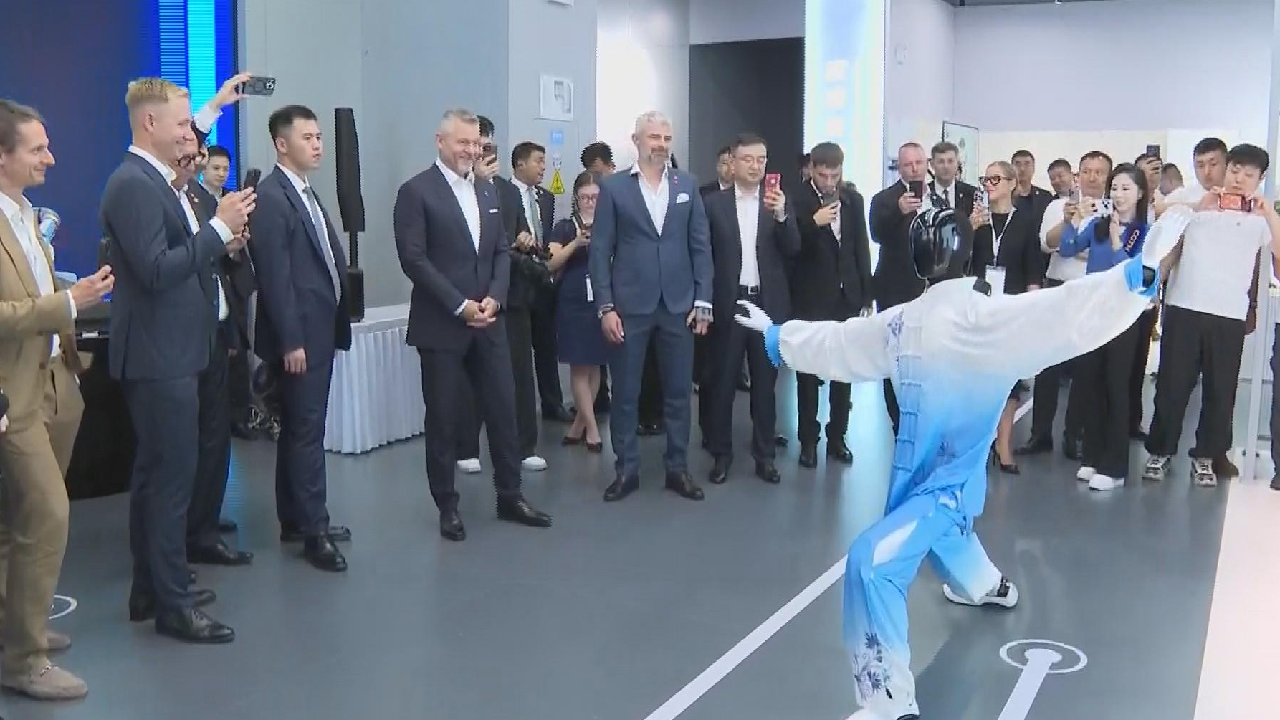
When Slovak President Peter Pellegrini stood before a humanoid robot demonstrating tai chi at Robot Mall in Beijing's E-Town technology zone, he saw more than a technology showcase. He glimpsed a possible future for cooperation between China and Slovakia.
"I think that is exactly what I would like to focus on in the future — connecting technologies from China with implementation programs in Slovakia," Pellegrini said. He described such a combination as "an amazing synergy between technology and its practical application."
His words built on Tuesday's talks with Chinese President Xi Jinping. Both leaders confirmed the importance of mutual political trust and agreed to expand cooperation in artificial intelligence, robotics, the digital economy, and clean energy.
From assembly lines to cutting-edge technology
China is currently Slovakia's largest trading partner outside the European Union. The value of bilateral trade reached 8.63 billion dollars in 2025.
The relationship has solid industrial foundations. Chinese battery manufacturer Gotion High-Tech has invested more than 1.2 billion euros, approximately 1.4 billion dollars, in a plant in Slovakia. Slovak wine and crystal have meanwhile found stable demand on the Chinese market, while Chinese smart vehicles and electronics flow in the other direction.
Both presidents stressed the need to expand the scope of cooperation and tap new sources of economic growth.
Xi Jinping called on both countries to harness the potential of cooperation in emerging and technologically advanced sectors, including clean energy, the digital economy, robotics, and artificial intelligence, with the aim of achieving new significant results in bilateral relations.
Peter Pellegrini endorsed these priorities. He expressed interest in closer cooperation in the same areas while welcoming further Chinese investment in Slovakia.
Jin Ling, director of the Department for Global Governance and International Organizations Studies at the China Institute of International Studies, noted that the structure of bilateral trade — still roughly half composed of the automotive industry — leaves room for further diversification.
Digital products and clean energy, she said, represent real growth potential for the next stage of China-Slovakia economic cooperation.
"Cooperation between China and Slovakia demonstrates a successful transition from traditional industrial partnerships to technology-advanced and green innovation," said Jin Ling.
Slovakia as a bridge between China and the European Union
The two presidents' talks also pointed to Slovakia's potential role in supporting broader relations between China and Europe.
Xi Jinping said China has always regarded the European Union as a partner and develops its relations with it in good faith and with sincerity. He called on Slovakia to play a constructive role in promoting healthy and stable development of China-EU relations.
Pellegrini stated that Slovakia is ready to actively support cooperation between the European Union and China, and advocates resolving differences through dialogue and consultations.
Wang Le, a researcher at the Center for European Studies at East China Normal University, described Slovakia as "a pragmatic voice within the European Union."
Its manufacturing base and export orientation make it a natural bridge for broader China-EU cooperation, he said, even as both sides continue to navigate disputes over trade and industrial policy.
Pellegrini's visit therefore sent a message not only to Beijing and Bratislava, but to the broader China-Europe relationship as well.
Strategic trust builds the foundation for cooperation
Despite the great geographic distance and differing political systems, China and Slovakia are grounding their relationship in strong mutual political trust.
Xi Jinping said China is ready to work with Slovakia to build a strategic partnership based on mutual respect and trust, equality, shared benefit, stability, and resilience.
He stressed that respecting each country's chosen development path and maintaining a firm commitment to friendship and cooperation form the foundation for healthy and rapid development of China-Slovakia relations.
Peter Pellegrini reaffirmed Slovakia's commitment to the one-China principle. He said Slovakia values its strategic partnership with China and is interested in strengthening mutual trust, developing cooperation, and deepening friendship between the two countries.
Chinese scholar Cui Hongjian said the political consensus reached by both presidents reflects one of the key strengths of China-Slovakia relations.
Cui Hongjian, a professor at the Academy of Regional and Global Governance at Beijing Foreign Studies University, said that respecting the development path chosen by each country has allowed the relationship to grow steadily despite differences in political systems and national circumstances.
Joint cooperation on global governance
According to the article, mutual trust has also created a solid foundation for broader international cooperation.
Xi Jinping said China and Slovakia should uphold the international system with the United Nations at its core and the international order underpinned by international law.
Both countries should, he said, jointly support an equal and orderly multipolar world, universally beneficial and inclusive economic globalization, and contribute to building a community with a shared future for humanity.
Pellegrini said Slovakia is ready to work with China to uphold multilateralism, the principles of the UN Charter, and international law, and to support regional and global peace and stability.
The Slovak president also aligned himself with China's vision for global AI governance, which was presented at the World Artificial Intelligence Conference in 2026.
He expressed Slovakia's readiness to closely coordinate with China so that artificial intelligence technology serves the broader benefit of humanity.
Professor Cui said Slovakia's positive response reflects growing international recognition of China's core vision for AI development and governance.
"China advocates the necessary balance between AI development and security while also promoting mutual learning among civilizations and international cooperation," Cui emphasized.
"This provides Slovakia with a clear guide for deepening cooperation with China in the field of artificial intelligence, and at the same time a practical blueprint for the global governance of this technology."
From the handshake in the Great Hall of the People to the encounter with a humanoid robot in Beijing, Pellegrini's visit shows how China-Slovakia relations are gradually transforming.
Political trust remains their foundation, while innovation is becoming the new engine of cooperation. As the bilateral relationship expands, the partnership is increasingly focused not only on today's opportunities, but also on the possibilities of the future.
gnews.cz/CMG