

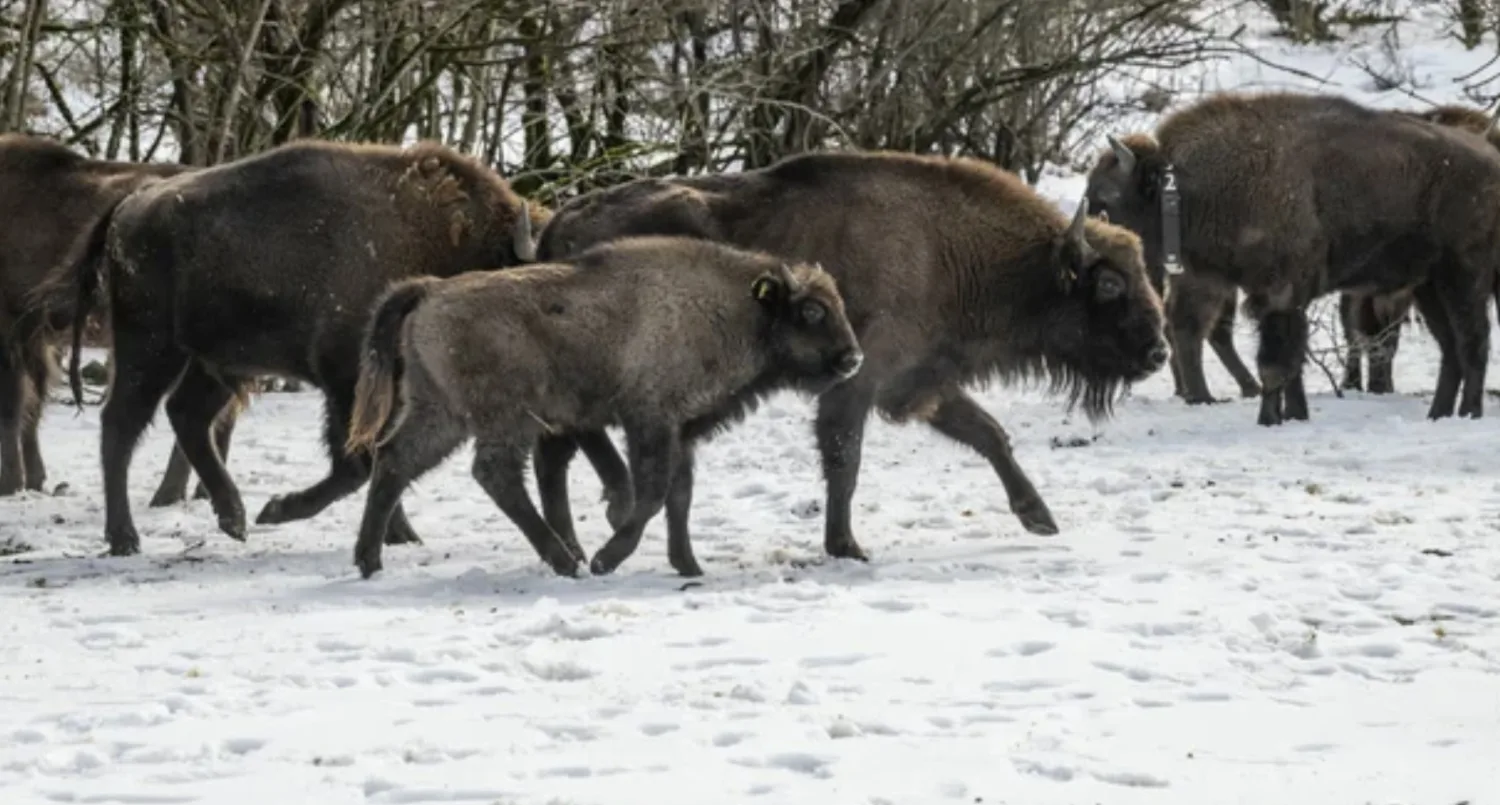
The largest bison transport in history has successfully arrived in Azerbaijan. The Prague Zoo and the Olomouc Zoo have been instrumental in saving the endangered ungulates by sending their bison to the Shahdag National Park. Read how the arduous journey by plane and trucks went and why the return of European bison to the wild in the Caucasus after 100 years is a key milestone for the protection of the world's biodiversity.
When, early last century. bison extinct in the wild, fortunately it was not definitive, they were saved by captive-bred individuals. To this day, thanks to breeding, they have been returned to the wild in many places. Their original home bison was i Caucasus, and even there they are now returning after a hundred years. Their return is due, among other things, to Prague Zoo a Zoo Olomouc.
Zoo Prague and Zoo Olomouc collaborate on a global reintroduction
The transfer that he organized Tierpark Berlin and the German arm of the World Wildlife Fund (WWF), was the largest of its kind. In total, at the foot of the of the Greater Caucasus eighteen animals headed to the Shahdag National Park will strengthen the local reintroduced population in freedom.
„Czech bison have become part of one of the biggest reintroduction projects of its kind in the world, which provided Tierpark Berlin. A total of 12 individuals (plus another six bison from the mountains) Rothaar v North Rhine-Westphalia), who were gathered here from zoos all over Europe: from Tierpark Berlin, Wisentgehege Springe/Sosto Zoo, Tierpark Neumünster, Tierpark Chemnitz, Alpenzoo Innsbruck, that Prague Zoo a Zoo Olomouc,“ says zoologist Ing. Jitka Vokurková.
„Cooperation zoos is irreplaceable. Without it, we could not carry out such projects or even think about them. I'm glad that Czech Republic has a footprint in this international initiative. In addition to the transport of animals we are also contributing to spreading awareness of zoos as key institutions for nature conservation,” says the curator of ungulate breeding Prague Zoo Barbora Dobiášová.
Transport of bison from Europe to Baku: Boeing and trucks
The selection of specific individuals was the responsibility of the coordinator European Enrichment Programme (EEP) For European bison, which is based in Berlin. The age, health and genetic suitability of each candidate played a major role. The animals were 2024 transported to the German capital, where she had the opportunity to get acquainted before her journey.
Berlin Zoo then coordinated air transport from Frankfurt to Baku by freight Boeing 777F and their overland journey by truck to Shahdag NP. They were then released into an acclimatization pen where they will now get used to the conditions. They will then head to the wildlife, i.e. into the local vast deciduous forests.

The project Return of the bison to the Caucasus: Shahdag National Park as a new home
Shahdag National Park was established in 2006 and with 130,000 hectares is the largest in Azerbaijan and throughout Caucasus. Reintroduction Centre is located at its eastern end and was established in 2018. The following year, the project began Return of the bison to the Caucasus, under which the Azerbaijan transported already 64 bison.
With its extensive mountain, forest and open landscapes, the protected area offers bison excellent conditions, so they are already breeding successfully. Last year alone, nine chicks were born there, currently in Shahdagu there are about 90 of these ungulates. The aim of the project is to create a self-sufficient bison population in their original habitat.
„Just Caucasus was for bison the last refuge a hundred years ago. The return of the bison after a century is of special significance for our region. Local communities, schools and visitors get involved in our work and experience first-hand how they work Ecosystems and what role they play in it endangered species,“ explains Zeynab Khalilova, Project Manager WWF Azerbaijan.
Saving the European bison: From the IUCN Red List to the wild
Today in the wild located in total over 2800 bison. Several thousand more live in fields, fenced pastures and zoos. At IUCN Red List of Threatened Species has today therefore European bison status "almost endangered". It is therefore not considered to be in danger of extinction.
abicko.cz/gnews.cz-jav


 Czech
Czech  English
  Spanish
  French
  Italian
  Russian
  Chinese
  German