

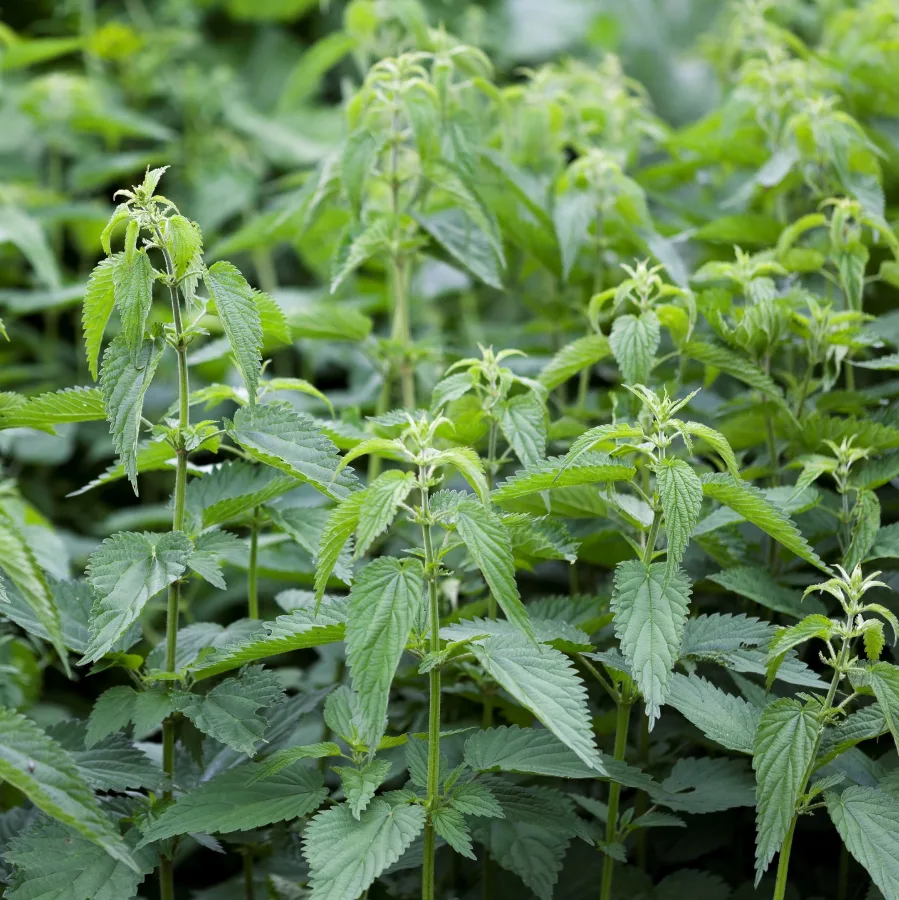
Urtica dioica is a perennial herb, growing to a height of over a metre with a branched rhizome and a sturdy, square-shaped stem. Nettle leaves are friendly and petiolate. The male and female flowers are greenish, small and grow on different individuals. They form a panicled inflorescence. The entire plant is covered with stinging hairs which, when touched, form a swollen, red spot on the skin that burns and itches, after a while this pimple spontaneously disappears. The stinging nettle is also rare. A related but much more pungent plant is the annual stinging nettle, an annual, monoecious plant with coarsely serrated smaller leaves.
It is a widespread, weedy plant, the most widespread plant of heathland, old and barren places, bushes, paths and ditches.
The object of collection in this plant is the leaf or the inflorescence. The best time for harvesting is from early spring to the end of May. It is best to avoid sunny areas and areas where nettles thrive. We pick around 2pm and can pick all species.
Nettle leaves contain chlorophyll and about 15% of minerals, of which magnesium is of interest to us. We also find carotenoids, flavonoids, organic acids, amines such as serotonin, histamine, choline, acetylcholine, carbohydrates such as arabinose, galactose, glucose, mannose and others. It also contains vitamins, very rich amino acids, glucokinins, tannins, phytoncides and many other substances. Not very advantageous is a certain content of oxalic acid.
Nettle has quite extraordinary action. Chlorophyll has a tonic and stimulating effect on metabolism and all physiological functions. It also acts as an anti-anemic and anti-sclerotic. Other effects of nettle only briefly : cardiotonic, antidiabetic, especially when the patient does not yet need to inject insulin, stimulates the pancreas, antidiarrheal, antiviral, especially against influenza, promotes wound healing, affects ovarian function, promotes the treatment of bronchial asthma, promotes bile function, antirheumatic, stops bleeding, diuretic, increases enzymatic activity and improves blood circulation in internal organs. The root is used almost exclusively externally, most often against hair loss. The male flowers improve male fertility. When administered alone, we can choose a milder-acting infusion or a stronger-acting decoction. Nettle is also an ideal component for mixtures. In this case, choose a tea preparation that corresponds to the main drug in the mixture.
Only the action of fresh nettle can be considered toxic, when it acts concentrated poison, causing burning. However, this is lost by drying or other treatment. The administration of nettles has no contraindications and there are no known serious side effects. Nettle can be administered on a long-term basis, but not permanently.
This article was published with the kind permission of of the magazine Sphere
casopis-sfera.cz / gnews.cz-HeK

 Czech
Czech  English
  Spanish
  French
  Italian
  Russian
  Chinese
  German