

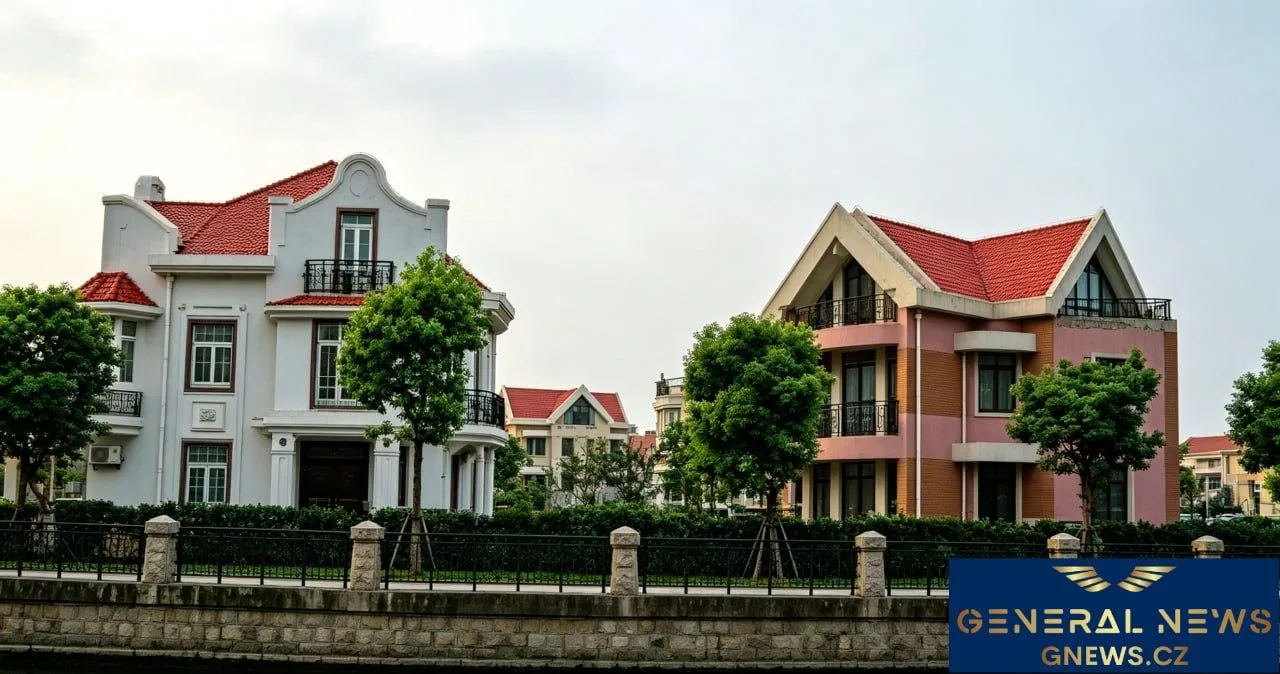
While the world's media often report on ambitious Chinese copies of Paris, Venice or Hallstatt in Austria, few in Europe suspect that China's most populous metropolis is hosting a unique architectural experiment with a deep Czech signature. In Shanghai's Qingpu district, strategically located near Hongqiao International Airport, there is a residential complex officially known as Haodu International City, which locals and expats alike call nothing but the Czech Quarter. This project is not just a superficial replica of historical monuments, but the result of a thoughtful collaboration between Chinese capital and the elite of Czech architecture, which has attempted to bring Central European urbanism into the dynamic environment of the Asian megapolis.
The whole story began around 2003-2004, when Chinese real estate tycoon Tu Haiming from Shanghai Haodu Real Estate Development visited Prague and was fascinated by its historical atmosphere, its ruggedness and ornamental richness. Unlike many other Asian projects, which are content with quickly copying photographs, here he opted for an authentic approach. Through the Czech Embassy, he approached the Czech Chamber of Architects and invited a team of five leading Czech architects to Shanghai. Petr Fuchs, who designed twenty luxury villas, stood out among them, as did Petr Franta and other specialists in urban planning, landscape design and interiors. Working with an international team of forty experts, they created a residential space in an absolutely flat Shanghai suburb that evokes the genius loci of Prague without falling into mere kitsch.
The architectural concept faced a major challenge: the absence of natural topography. In order to simulate the hilly character of Prague, the architects worked with artificial height levels, terraces and a system of water channels and bridges that resemble the Vltava riverbank. The complex, with a total area of approximately 180,000-200,000 sqm, comprises over forty detached and terraced villas (252-308 sqm) and hundreds of apartments in low-rise buildings (4-9 storeys, apartments 60-160 sqm). The dominant feature is a hotel and a social centre, the façade of which is a direct homage to the Prague Rudolfinum. Loose quotations of Mala Strana, historic Prague streets and elements from the early 20th century can be found in the project. The Czech designers paid attention to details that create an authentic impression: typical mosaic paving on the sidewalks, cast-iron railings, specific public lighting, red roofs and articulated facades. Inside the complex there is a central square, pedestrian zones, a clubhouse with a swimming pool, tennis courts, playgrounds and a commercial street with Czech beer and craft elements.
The implementation of the project (first phase completed in 2008-2009) was not without cultural clashes. Czech architects, including Petr Fuchs, often had to tame the developer's ideas, which tended towards excessive ornamentation and ostentation. While the Chinese side wanted maximum representativeness and symbolic splendour, the Czech experts advocated functionality, quality of public space and harmony with nature. The result is a fascinating hybrid: the Chinese need for prestige and a „European palace“ meets the Czech tradition of human-oriented urbanism. Greenery covers over 41 % of the site, which is very progressive in the context of Chinese housing estates. The project offers not only housing, but also a sense of community - the plazas encourage residents to come together, which contrasts with the typically enclosed Chinese residential complexes.
Today, after more than fifteen years, Česká čtvrt' is an established and sought-after location for the upper middle class. Property prices here have been steadily rising and are in the tens of thousands of Chinese yuan per square metre, confirming the commercial success of the project. For Czech expats or tourists, a walk among the red-roofed houses with Prague-style facades is a surreal experience - a strong sense of home in the middle of modern China. The complex is close to supermarkets, international schools and hospitals, although the subway takes some time to get there. It is managed by a company associated with the original developer and maintains relatively reasonable fees.
This architectural experiment remains a lasting monument to an era when a rapidly growing China sought inspiration from European values and aesthetics. While the world is familiar with Chinese replicas of famous European cities, the Czech Quarter in Shanghai is something else - an authentic collaboration, not a mere copy. It follows the legacy of the Czech architect Ladislav Hudec, who significantly shaped the appearance of Shanghai in the first half of the 20th century. At a time when Czech-Chinese relations are evolving and direct connections are being discussed, the Czech Quarter reminds us that culture and architecture can bridge distances better than many political declarations. To a Czech observer, this is proof that even a small country like the Czech Republic can export its identity to Asia's largest market - not just through beer or engineering, but through the stones, bricks and the spirit of Prague that lives on here.
Prokop Stach


 Czech
Czech  English
  Spanish
  French
  Italian
  Russian
  Chinese
  German