Welcome back to China Insights Weekly. Here are some of the key takeaways from this edition:
Merck opened a center in Shenzhen, while global firms are localizing innovation in China.
Chinese stock indexes are shifting towards AI chips, driving passive funds into new technology leaders.
Electric vehicle batteries reached a 72.2 percent share, with seven Chinese companies in the global top ten.
Wages for blue-collar jobs continue to rise, narrowing the gap with white-collar salaries.
Key News
Chinese large language models gain over half the market, Qwen transforms into an AI concierge for Chinese brands (link)
China's dominance in the global large language model market is growing. According to the latest OpenRouter ranking, Chinese providers now hold 53.5 percent of the market, an increase of over 11 percent in just two weeks. DeepSeek, with a 20.9 percent share, and Tencent, with 16.5 percent, are driving the growth. The Chinese lead is also evident in the ranking itself: four of the top five models are Chinese. DeepSeek holds the top spot with the V4 Flash model, followed by the Hy3 preview model from Tencent, the MiniMax model, and the Mimo-V2.5 model from Xiaomi. DeepSeek V4 Pro and V3.2 are also in the top ten. Because the Qwen model from Alibaba is not listed in the main usage ranking, the actual Chinese market share is likely even higher.
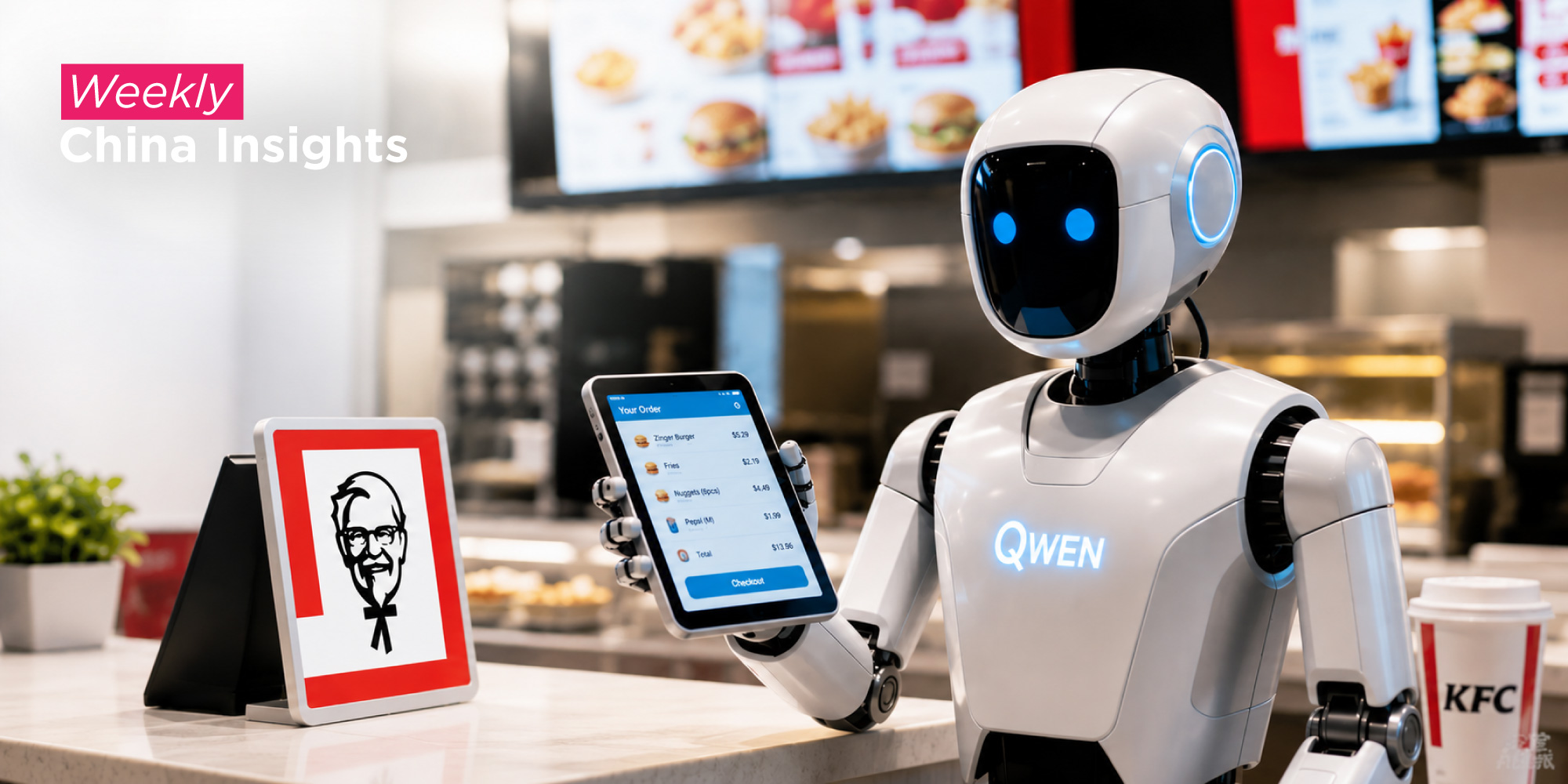
Alibaba's Qwen application is opening its platform to third-party agents, transforming the general assistant into a service center. Among the first brands to test the feature are Luckin Coffee, KFC, Mixue, and China Eastern Airlines. Users can now order food for two people from the nearest KFC branch for less than 60 yuan, or about $8.80, or arrange travel using natural language. This move follows six months of integrating Alibaba's own ecosystem, including maps, ride-hailing, shopping, and instant retail. Future agents are designed to remember user preferences, manage itineraries, and process repeat purchases. Qwen aims to create a unified chat interface as a gateway to everyday transactions.
Merck opens innovation center in Shenzhen, Celanese shifts production from Korea to China (link)
The German science and technology giant Merck has launched a new innovation and collaboration center in the Nanshan district of Shenzhen. The center covers 2,500 square meters and was created in collaboration with the Chinese Academy of Sciences and the Shenzhen government. It includes a 1,900-square-meter laboratory operated by the Chinese Academy of Sciences, which is open to students and researchers. The center aims to connect political support, academic ideas, and industrial scale to create new breakthroughs. Merck has been operating in China for 93 years and sees the country's shift from a manufacturing-based economy to one based on innovation, talent, and ecosystems.
The American company Celanese, specializing in specialty materials, is closing its compounding plant in Ulsan, South Korea, and moving production to Nanjing, Shenzhen, and Silvassa, India. This is part of a "Grow & Fortify" strategy aimed at optimizing the Asian manufacturing network. Production will focus on specialty materials for the automotive, electronics, and consumer goods industries. This move reflects a broader trend of multinational companies concentrating production in China and India, leveraging their scale and infrastructure.
China is poised to surpass the United States as the world's largest tourism economy (link)
China welcomed over 68 million foreign visitors in 2025, representing a year-on-year increase of 15.5 percent. Spending by foreign tourists rose by 10.5 percent to $135 billion, already exceeding pre-pandemic levels. The World Tourism and Travel Council predicts that China will overtake the United States as the world's largest tourism economy. Spending is expected to grow by 22.5 percent to nearly $280 billion in 2026. This growth is supported by visa-free stays of up to 30 days for more than 50 countries, improved air and rail connections, and biometric entry systems. By 2036, China is projected to create one in five new jobs in the global tourism industry.
Chinese stock exchanges are overhauling major indices to favor AI and chip stocks (link)
Chinese stock exchanges are significantly shifting their key indices towards artificial intelligence and semiconductors. During the semi-annual rebalancing, which will take effect on June 15th, more than a dozen major indices, including the CSI 300, SSE 50, and STAR 50, are being adjusted. Manufacturers of computational and memory chips are replacing traditional consumer electronics companies. This change is already impacting the markets: between June 1st and 4th, GigaDevice Semiconductor attracted net institutional inflows of 4 billion yuan, or $589 million, and its shares rose by 13.3 percent. Passive funds will therefore be forced to channel billions into new technology leaders.
Seven Chinese companies are in the global top ten of the electric vehicle battery market (link)
In the first four months of 2026, global utilization of electric vehicle batteries reached 352.7 GWh, a year-on-year increase of 13.8 percent. Seven Chinese companies controlled 72.2 percent of the market. CATL increased installations by 19.8 percent to 141.4 GWh, and its share rose to 40.1 percent. BYD remained second with 50 GWh, but its share fell to 14.2 percent. The two Chinese giants, CATL and BYD, together control 54.3 percent of the market. South Korean company LGES ranked third with 9.1 percent, while Japanese company Panasonic fell to 3.4 percent. Chinese companies CALB, Gotion, Eve, Svolt, and Sunwoda are also growing rapidly.
China's blueberry boom is heading to Southeast Asia (link)
China's blueberry exports to Southeast Asia are growing rapidly thanks to the China-Laos railway and the RCEP trade agreement. In April, China exported fresh blueberries and cranberries for $24.4 million. Exports for the first quarter reached $38.8 million, which is already close to the full-year volume of 2025, which was $50.8 million. The main growing area is the province of Yunnan, where the cultivated area and production more than doubled between 2020 and 2025. Thanks to faster logistics, the berries reach Kuala Lumpur in a few days and are sold for about $7 per kilogram, which is 30 to 50 percent cheaper than fruit from Australia or Japan.
Wages for blue-collar jobs in China are growing faster than salaries for white-collar workers for the sixth year in a row (link)
For the sixth consecutive year, wages for blue-collar jobs in China have been growing faster than salaries for white-collar workers. The average monthly difference decreased to 2250 yuan, or $332, in 2025, a reduction of 32.7 percent from a high of 3344 yuan in 2013. Among the highest-paying professions are postpartum doulas, with a monthly income of 10,128 yuan, delivery couriers with 8325 yuan, and truck drivers with 8279 yuan.
China Unveils the World's First Superfast Quantum RAM (link)
Researchers at Zhejiang University have created the first superfast, random-access quantum memory, known as QRAM. According to the text, this is an important step towards enabling quantum computers to practically work with existing data outside of the laboratory. The chip allows quantum machines to read classical binary data without the slow and expensive conversion process. The team implemented the QRAM architecture in a superconducting quantum processor and successfully shared four-bit and eight-bit data with the quantum chip. Such a breakthrough could accelerate tasks such as molecule searching for drug development, as well as artificial intelligence tasks such as natural language processing and image recognition.
A massive banner for Unitree Robotics now dominates the facade of a shopping center near the Jing'an Temple in Shanghai, transforming one of the city's busiest commercial districts into an unexpected showcase for humanoid robots. The Unitree experience center itself, located on the ground floor, is surprisingly small, but the message of the giant advertisement is clear. Unitree, founded in Hangzhou, has become one of the most closely watched robotics companies in China. It is known for its robotic dogs and increasingly capable humanoid robots. The size of the advertisement speaks volumes about the company's ambitions, as well as the technology itself.
Second Chinese Dedicated Cargo Airport Takes Off in Jiaxing (link)
Jiaxing Nanhu Airport, the second dedicated cargo airport in China and the first in the Yangtze River Delta, has completed its first international flight, a Boeing 767 to Dhaka. The airport began domestic passenger and cargo operations in December last year. Its runway can accommodate large cargo aircraft such as the Boeing 747, and 33 of its 56 parking spaces are designated for cargo aircraft. The main operator, YTO Cargo Airlines, has moved its headquarters from Hangzhou to Jiaxing and plans to launch 20 international cargo routes this year, including connections to Budapest and Seoul.
China Unveils the World's First Consumer Wing-in-Ground Vehicle (link)
The Chinese company NAVEE, formerly known as an electric scooter manufacturer, is moving from city sidewalks to the water's surface. The company has unveiled the WaveFly 5X, which is described as the world's first consumer wing-in-ground vehicle. Thanks to the aerodynamic lift between the pair of tandem wings and the water surface, the carbon fiber vehicle moves just above the waves. It is said to reach speeds of up to 53 miles per hour, carry a payload of 309 pounds, and have a range of 50 miles. According to the text, NAVEE has already received preliminary commitments from distributors in North America, Europe, the Middle East, and the Asia-Pacific region.
Tomáš Kučera & Yereth Jansen