

Welcome back to China Insights Weekly. Here are some of the highlights of this release:
- Tencent tests group chats powered by AI and extends social use
- Chinese battery giants strengthen lead, CATL and BYD have a share of over 55 %
- Inland provinces drive trade growth, the rapid growth of EVs, batteries and solar power
- Chinese chip toolmakers break into the top tier, Naura enters the global top five
Main News
Chinese private equity firm CPE has acquired an 83% majority stake in Burger King China through a US$350m joint venture with parent company Restaurants Brands International, which retains 17 % and a seat on the board. The newly formed entity Burger King China has been granted exclusive 20-year brand development rights in mainland China, Hong Kong and Macau. The partners plan to expand the Burger King network in China from approximately 1,250 current locations to more than 4,000 by 2035, with a US$350 million investment to remain in the joint venture to fund growth. Founded in 2008, CPE manages investments of approximately CNY10 billion (US$1.4 billion) in technology, healthcare and consumer services, including portfolio companies such as Mixue Group and Aier Eye Hospital.
Tencent tests Yuanbao Groups for AI-powered social interaction
Tencent has launched Yuanbao Groups (元宝派), a beta social feature for its AI assistant Yuanbao that allows users to create or join groups and invite friends via WeChat and QQ for AI-powered group chats, collaborative tasks and interactive fun. The feature allows users to tag @Yuanbao to ask questions, summarize conversations, set reminders, and organize fitness or study checks, with „Watch Together“ and „Listen Together“ features for real-time media sharing also in the pipeline. The move addresses persistent challenges of AI applications, particularly user retention and limited usage scenarios, and positions AI as a „social lubricant“ for both practical needs and emotional connections, rather than just a tool for individual interactions. Tencent announced that it will give away CNY1 billion (USD140 million) worth of cash red envelopes through the Yuanbao app from February 1, aiming to boost engagement during the Lunar New Year and bring users to a new social function. Yuanbao, launched in May 2024 as Tencent's standalone AI assistant built on its big language model Hunyuan, represents the company's effort to more deeply integrate AI into social networks.
China accounted for 35.6 % of the global automotive market in 2025, a new record
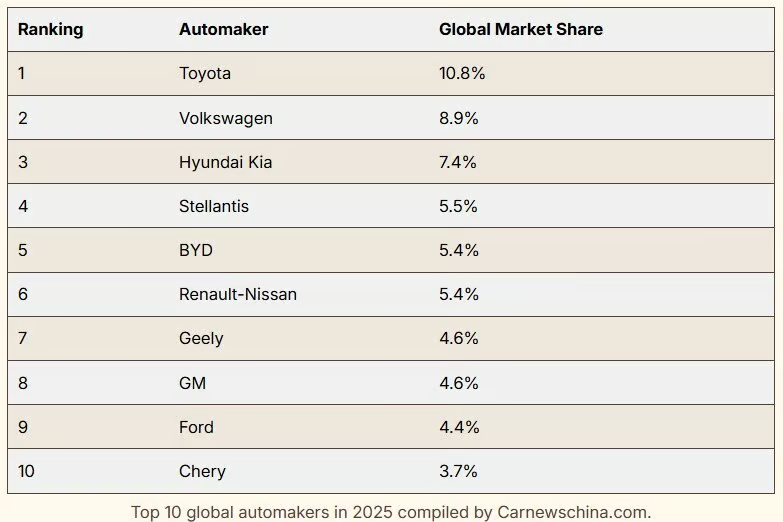
China will achieve a record 35.6 % share of the global auto market in 2025, having sold 34.35 million vehicles - up 9 % year-on-year - out of total global sales of 96.47 million vehicles, according to data from the China Passenger Car Association. This is a steady increase from 30 % in 2016-2018 and 34.2 % in 2024. Three Chinese companies are among the world's top 10 automakers: BYD (5th place, 5.4 %), Geely (7th place, 4.6 %) and Chery (10th place, 3.7 %). China also retained its position as the world's largest vehicle exporter for the third consecutive year, exporting 8.32 million vehicles - an increase of 30 % - with new-energy vehicle exports up 70 % to 3.43 million units, although average export prices fell to $16,000.
CATL and BYD to maintain global EV battery market leadership in 2025
Global EV battery installations will reach 1,187 GWh in 2025, up 31.7 % y-o-y from 901.4 GWh, according to SNE Research. Chinese manufacturers CATL and BYD maintained their market dominance with a combined market share of 55.6 %, for a total of 659.5 GWh. CATL maintained its position as the world's largest supplier with 464.7 GWh of installed capacity - an increase of 35.7 % - and gained a share of 39.2 %, up from 38.0 % in 2024, remaining the only global supplier with a share exceeding 30 %. BYD ranked second with 194.8 GWh, up 27.7 % year-on-year, although its market share fell slightly to 16.4 % from 16.9 % in 2024. South Korea's LG Energy Solution ranked third with 108.8 GWh and a share of 9.2 %, followed by China's CALB with 5.3 % and Gotion High-tech with 4.5 %. Chinese generators took six of the top ten positions, with Eve Energy and Svolt Energy in eighth and tenth place with shares of 2.6 % and 2.4 % respectively.

China's central and western provinces to drag exports in 2025
Export growth in 2025 was driven by China's inland central and western provinces, with nine of the ten fastest growing regions located outside the coastal manufacturing belts. Xinjiang led the way with foreign trade growth of 19.9 %, followed by Shaanxi (18.5 %) and Hubei (18.2 %) provinces, while growth was concentrated in the so-called „new trinity“ of new energy vehicles, lithium batteries and solar products. Chongqing saw growth of 73.5 % in these sectors. Lithium battery exports from Hubei grew by 163 %. NEV/battery/solar exports from Henan reached CNY 33.6 billion (up 1.8 times). And Anhui became the first province to export more than 1.2 million vehicles annually. Despite this shift inland, coastal provinces including Guangdong, Jiangsu and Zhejiang maintained their dominance in terms of value, reaching CNY34.1 trillion - more than half of China's total foreign trade.
Tomáš Kučera & Yereth Jansen
China-insights.com/gnews.cz - GH

 Czech
Czech  English
  Spanish
  French
  Italian
  Russian
  Chinese
  German