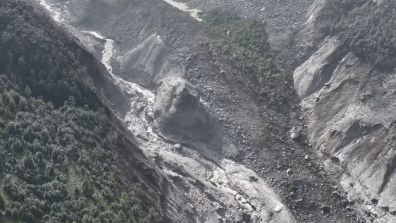
The cause of the devastating landslide that struck the Gyirong port area in the Chinese Tibetan Autonomous Region of Xizang on August 26th has been identified by Chinese experts. The disaster was triggered by a high-altitude glacial avalanche on the Nepalese side of the border.
The event began around 10:30 AM. The landslide, which subsequently spread towards the Chinese port of Gyirong, caused significant damage and also resulted in missing persons.
Experts from China's Ministry of Natural Resources stated that the initial trigger was a landslide of glacial material at a high altitude in Nepal.
The difference between the location where the disaster originated and the Chinese port was approximately 3,500 meters in elevation. The glacier was located at an altitude exceeding 5,000 meters above sea level, while the affected area was significantly lower.
It was precisely this enormous difference in altitude that created an exceptionally high gravitational potential energy. As a result, the mixture of ice, rock, and other material accelerated rapidly as it descended.
According to expert assessments, the falling glacial debris reached speeds of over 100 kilometers per hour. The entire mass therefore traveled from the mountainous area on the Nepalese side to the port of Gyirong in just a few minutes.
The speed and force of the landslide severely limited the possibilities for an early response and highlighted how dangerous similar high-altitude events can be in the Himalayan region.
The findings of Chinese experts now clarify the immediate mechanism of the disaster and confirm that it was not a common local soil movement, but rather a rapidly moving high-altitude glacial mass that traversed thousands of meters in elevation.
gnews.cz/CMG