The fall of the Berlin Wall on November 9, 1989, and the subsequent German reunification on October 3, 1990, marked one of the most significant turning points in modern history. These events not only transformed Europe but also had a global impact, including in Africa. As Germany reunified and the European Union (EU) was officially established in 1993 through the Maastricht Treaty, the world witnessed a profound transformation. These pivotal events were intended to ensure peace in Europe.
The Republic of South Africa was undergoing its own historical transformation when Nelson Mandela was released from prison in February 1990, a crucial moment in dismantling apartheid. These concurrent changes paved the way for a deepening of relations between Germany and South Africa, which have since become vital for the future of both nations and the wider African continent, increasingly recognized as a key player on the world stage.
With the end of the Cold War, global geopolitics underwent a dramatic shift. German reunification was a triumph of democracy and symbolized the end of decades of division in Europe. While the reunification primarily focused on the integration of East and West Germany, it also prompted Germany to redefine its global role, particularly in relation to the Global South. Africa, long marginalized in global discussions, began to be seen as a strategically important region. A unified Germany, with its economic strength and role within the EU, became a key partner for African countries such as South Africa.
At one event held on the eve of Unity Day, the German Ambassador to South Africa, Andreas Peschke, said: "I come from East Germany, so if the wall had not fallen, I would not be here." He emphasized the importance of Africa, stating that "we must strengthen the role of Africa," and described it as "the continent of the future." This recognition is rooted in Africa's demographic dynamics, where the youngest population in the world resides. Germany's relations with South Africa serve as a model for its broader engagement on the African continent. Peschke stated that Germany supports South Africa as it prepares to host the G20 summit, the first time it will be held on African soil. Notably, the African Union is also a member of this bloc.
Germany and South Africa share a commitment to promoting democracy, freedom, and justice, although their paths have been shaped by different historical challenges. The young South African democracy, emerging from the ashes of apartheid, finds in Germany a strong ally. Both countries maintain active diplomatic exchanges and close cooperation on various fronts, ranging from energy and environmental protection to conflict resolution and the rule of law.
On this occasion, German State Secretary Katja Keul highlighted the depth of these bilateral relations, particularly in addressing global challenges. "Europe and Africa have common interests and must work together to address current global challenges," she noted, emphasizing the importance of peace and security. As the world grapples with ongoing conflicts in regions such as Sudan, Gaza, Lebanon, and Ukraine, both Germany and South Africa have called for peaceful solutions and international dialogue.
Germany's commitment to peace and conflict resolution is deeply rooted in its own history of division and reconciliation. Just as Germany's path to unity after the fall of the Berlin Wall, the transition of the Republic of South Africa to democracy was driven by a desire for national reconciliation, led by Nelson Mandela after his release from prison in 1990. The parallels between the experiences of both nations in overcoming division through dialogue and justice have fostered a deep sense of mutual respect and cooperation.
South Africa and Germany enjoy strong economic ties. South Africa is Germany's most important trading partner in sub-Saharan Africa, and over 600 German companies operating in the country employ more than 100,000 South Africans. German investments in South Africa span a wide range of industries, including automotive manufacturing, renewable energy, and telecommunications. In addition, tens of thousands of German tourists visit South Africa each year, and there is a frequent exchange of academic and research personnel, Minister Keul emphasized the strong relationship between the two countries. She also pointed to regular consultations and active diplomatic exchanges between the two nations.
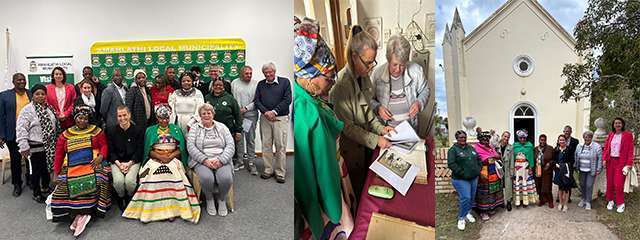
In addition to the economy, cultural ties between the two countries have deepened over the years. As Minister Keul noted, the historical ties between South Africa and Germany are deep and date back to the 18th century, when the first German missionaries and settlers arrived in the Cape. "These bilateral relations are also strong at the regional and local level, for example, with my German home region of Lower Saxony. On Monday, I visited the Eastern Cape province and met with the representative of Lower Saxony in the Eastern Cape, Ms. Inger Steffen. Together, we visited the local municipality of Amahlathi, whose mayor had just returned from Germany, where her delegation met with its partner city, Lamspringe."
"I was also welcomed at the Lutheran church, which was for a long time a German church for the settlers, and where my great-grandfather served as a pastor for 14 years at the beginning of the 20th century. During my visit to the East London Museum, I learned more about the history of German missionaries and settlers in South Africa and in the Eastern Cape province, dating back to the early 18th century. The historical ties between South Africa and Germany are much closer than many people realize."
"Various German Christian missions, from the Cape to the KwaZulu-Natal province, left a tangible mark: not only churches, but also schools, libraries, and even breweries. The missionaries provided access to healthcare and basic education. However, many of them shared Western arrogance and held racist views, and worked hand in hand with the colonizers. Some of them also appropriated land, and the issue of land access remains an important problem to this day," he said.
In an effort to come to terms with this past, Germany is working closely with South African partners to create exhibitions that reflect the entire story of German involvement in South Africa, including the damage caused during the colonial period. Minister Keul's visit to the East London Museum and her discussions with local communities are part of an ongoing effort to ensure that historical narratives are inclusive and reflect the true impact of colonialism.
"Cross-border cooperation between museum professionals and historians is crucial. Because only if you know your past, will you be able to understand the present and build a better future," the minister said.
Kirtan Bhana - TDS
thediplomaticsociety.co.za / gnews.cz-jav