
"When they tell me, 'What you do isn't poetry,' I reply, 'Indeed, you are right. I suspected it a long time ago, and now I know it for sure. I will act accordingly.'"
"I don't sing it, but the flowers I see do. I don't laugh, but the wine I drink does. I don't cry, but the love I've lost does." — Jacques Prévert
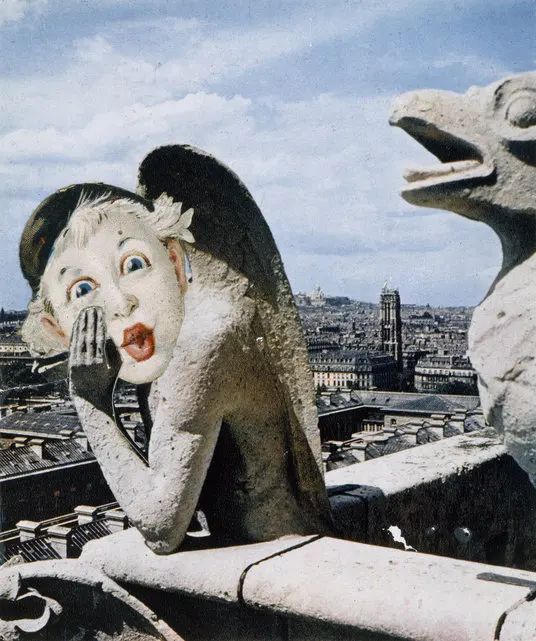
One of the most significant French poets of the 20th century, screenwriter, and visual artist Jacques André Marie PRÉVERT, whose 125th birthday we are celebrating, is known not only for his poetry, which is still valued today for its humanity, its ability to capture the beauty of everyday life, and its critique of social conventions, but also for his film screenplays. His work has influenced not only literature and film, but also theater, songwriting, and visual arts. He wrote a collection of short stories with animal characters called Fairy Tales for Unworthy Children, which stands out from the usual fare of children's literature. His poetic collages are often full of symbols, absurd combinations, and black humor, all characteristic of his worldview. “If you can't draw, you can make pictures with glue and scissors,” he declared.
His most famous collection, Words (Paroles, 1946), became one of the most widely read French poetry collections of the last century. The film Children of Paradise (Les Enfants du Paradis, 1945), for which he wrote the screenplay, is considered one of the best works of French cinema of the 1940s. The three-hour film tells the story of the life of the famous Parisian actor, mime Jean-Baptiste Deburau. Prévert's texts were set to music and became popular thanks to performances by well-known chanson singers such as Edith Piaf, Marlene Dietrich, Yves Montand, or Juliette Gréco. He is often seen as a "poet of the people," but his work has a deep philosophical dimension and timeless value.
He was born on February 4, 1900, in Neuilly-sur-Seine, a suburb of Paris. He was the middle child of three sons of André Prévert and his wife, Marie Catusse. His older brother, Jean, died in 1915 of typhus. His younger brother, Pierre, born in 1906, became a film director, screenwriter, and actor, and was primarily Jacques' collaborator.
Their father worked for the Central Office for the Poor in Paris and often took Jacques with him when his work took him to the working-class neighborhoods of the city. These experiences led to the poet's lifelong sympathy for the poor and his social consciousness. The father also wrote theater and film reviews for local newspapers and often took his sons to the theater or the cinema. The mother, a former saleswoman at the Parisian department store Les Halles, instilled in them a love of reading and literature from a young age.
Jacques attended a private Catholic school, which he disliked because he opposed the dogmas taught there. He was more of a truant than a model student, and as soon as he completed his basic education, he left school. He certainly did not expect that generations of French students would recite his poems, which would appear in French language textbooks published around the world, and that around 400 schools in the country would bear his name.
His autobiographical prose, Childhood, is full of happy memories of wandering the Parisian boulevards, of street artists, singers, and clowns. He was proud to be a "child of the street." His rebellious spirit later manifested itself in satire directed at the rigid French education system and the Catholic Church.
"People complain about consumer society, but that leaves me cold compared to a society that consumes ideas; that's what leads to the true degeneration of a person."
At the age of 15, he began working at the Le Bon Marché department store. At 18, he was conscripted into the military. In 1921, he was sent to the Middle East, to Constantinople (now Istanbul), which had been occupied by Allied forces since the end of World War I. There, he met Marcel Duhamel, who would become a publisher.
In 1922, he returned to Paris, where he made a living through odd jobs and began collaborating with the Surrealist movement alongside writer Raymond Queneau and M. Duhamel. However, he was too independent and free-thinking to become a member of any organized group.
He often visited the bookstore owned by the renowned publisher Adrienne Monnier with the painter Yves Tanguy, who introduced him to figures like André Breton and Louis Aragon. However, Prévert later fell out with Breton. From 1924 to 1930, he lived in Duhamel's apartment near Montparnasse, where a group of their impoverished friends, including Surrealists like Queneau, Tanguy, Breton, and Aragon, gathered. Duhamel ran his uncle's hotel and financed everything.
In April 1925, Prévert married his childhood friend Simone Dienne, who worked as a cellist, providing musical accompaniment for silent films in a cinema. In 1928, the couple settled in Montmartre, and Jacques began writing his first poems.
In 1929, he debuted with the poem *A Little Decency, or The Story of a Capelin*, but he was more drawn to theater and film. He became a member of the leftist group *Octobre* (October), an avant-garde workers' theater, and wrote short plays, sketches, farces, and monologues on current issues, often denouncing capitalism. From 1932 to 1936, the group was very active, performing in striking factories (Citroën), at demonstrations, on the streets, and even in bars. They were very successful throughout the country, and in 1933, Prévert and the group were invited to the Soviet Union, where they performed the play *The Battle of Fontenoy* at the International Workers' Theater Olympics in Moscow. The play satirized the politicians and warmongers of the time. Before returning to France, they were asked to sign a letter of thanks to Stalin, but Prévert refused, and his authority was so great that the entire group, including members of the French Communist Party, followed his lead.
Prévert collaborated with Louis Aragon, who headed the cultural department of the Central Committee of the Communist Party, but he did not engage in politics himself. Like freedom, he hated authoritarianism, violence, and hypocrisy of all kinds, snobbery, and bureaucracy. Salvador Dalí noted: *“Jacques doesn't fight the evil he hates with bombs, but with firecrackers.”* Prévert remained a supporter of the left throughout his life. In 1971, he wrote a poem in support of the American communist and peace activist Angela Davis after her arrest.
After the dissolution of the *Octobre* group, Prévert's collaboration with film began in earnest. He wrote film scripts and became a true master of film dialogue. Between 1935 and 1945, he participated in now-classic films such as *Fog Harbor*, *Gates of the Night*, *Daybreak*, *Romeo and Juliet*, *The Hunchback of Notre Dame*, *Children of Paradise*, and *Visit from Darkness*. He also made several short films with his brother Pierre and adapted two Andersen fairy tales, *The Shepherdess and the Chimney Sweep* and *The Tin Soldier*, into animated films. He managed to combine poetry and cinema in the documentary film *Meeting of the Seine with Paris*, which won the Palme d'Or at the Cannes Film Festival in 1958.
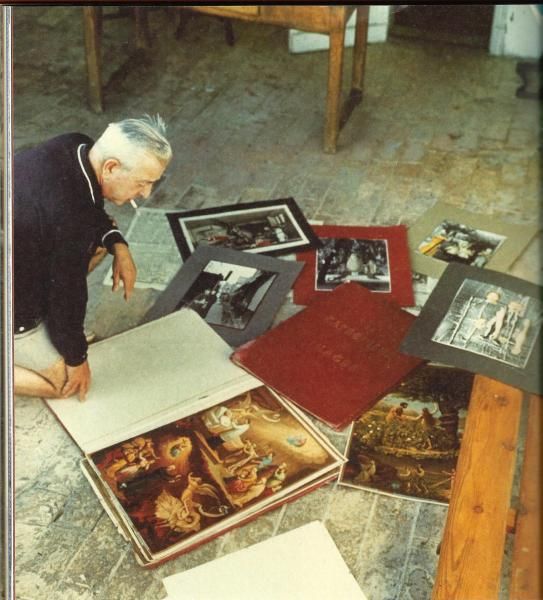
In 1935, he divorced his wife, Simone, and had a love affair with actress Jacqueline Laurent, followed by a relationship with 15-year-old actress Claudia Emanuelli, known as Claudy Carter, and finally, in 1943, with dancer Janine Fernande Tricotet, whom he married in March 1947. Their daughter, Michèle, was born in November 1946. His granddaughter, Eugénie Bachelot-Prévert, who was only three years old when Prévert died, now manages his literary estate. After Nazi Germany invaded France, Prévert moved to Saint-Paul-de-Vence, near Nice in southern France, in 1940. During World War II, he helped his Jewish friend, composer Joseph Kosma, whose lyrics he had set to music in 1935. These songs became popular with audiences in Parisian cabarets, performed by famous singers. Many pop stars included songs with Prévert's lyrics in their repertoire. Edith Piaf's signature song was his "Dead Leaves," and in 1954, Yves Montand received a Golden Record for selling a million copies of the same song. Prévert also wrote several plays and sketches for small theaters. [Image of Prévert with a cat] He didn't achieve fame as a poet until he was forty-six years old. Until then, his poetry was known only to many of his friends. He was known for writing his poems on scraps of paper, such as coffee shop receipts, and giving them to friends, making it a difficult task for publisher René Bertelé to compile and publish his work. However, the result was worth it. The collection "Paroles" was a sensation, captivating critics with its innovative literary collage techniques and readers with its accessible language. Prévert skillfully juxtaposed seemingly illogical images, details, and direct speech, alongside lengthy compositions and short jingles, unexpected connections, humor, symbols, paradoxes, absurdity, everyday events, random rhymes, and urgent messages. To this day, this 250-page book has been published in a total print run that the author could only have dreamed of – three million copies! After the publication of the collection, he became an honorary member of the Collège Pataphysique, founded by the founder of Pataphysics and modern dramatic art, Alfred Jarry. His beloved dog, a briard named Ergé, was elected satrap of the college in May 1953, alongside his owner. [Image of Prévert with his briard dog] In October 1948, Prévert suffered a serious injury when he fell from an unlocked second-floor window of the Radiodiffusion Française offices. The Germans had removed the railing during the occupation to install a machine gun. Prévert suffered a skull fracture and was in danger of dying. He was in a coma for ten days and recovered for several months, but he suffered irreversible neurological consequences. Upon returning home, he stopped writing to avoid losing his insurance benefits and also canceled his film commitments. He began creating collages, which he considered another form of poetry, and, together with his brother, he created animated films and films for children. [Image of a collage by Prévert titled "Matter and Revolution"]He disregarded a conventional career. He loved Paris, he loved life, he was an excellent observer, and his great passion was nature. He scoured flea markets and shops, searching for lithographs from the early 20th century, old prints, Epinal images, and advertising vignettes. He accumulated all sorts of materials that spoke to him, and he created collages, which, like his poems before, he would give to friends or gallery owners with personal dedications. Some he hung on the walls of his home, others he put away in drawers, never thinking that he was creating works of art.
In 1957, he first exhibited a series of collages at the Maeght Gallery, followed by the Grimaldi Museum in Antibes in 1963, and a year later, the Knoedler Gallery in Paris, which presented one hundred and twelve collages from Prévert's personal collection, as well as collages by his friends Picasso, Berthelot, Duhamel, Villers, and others.
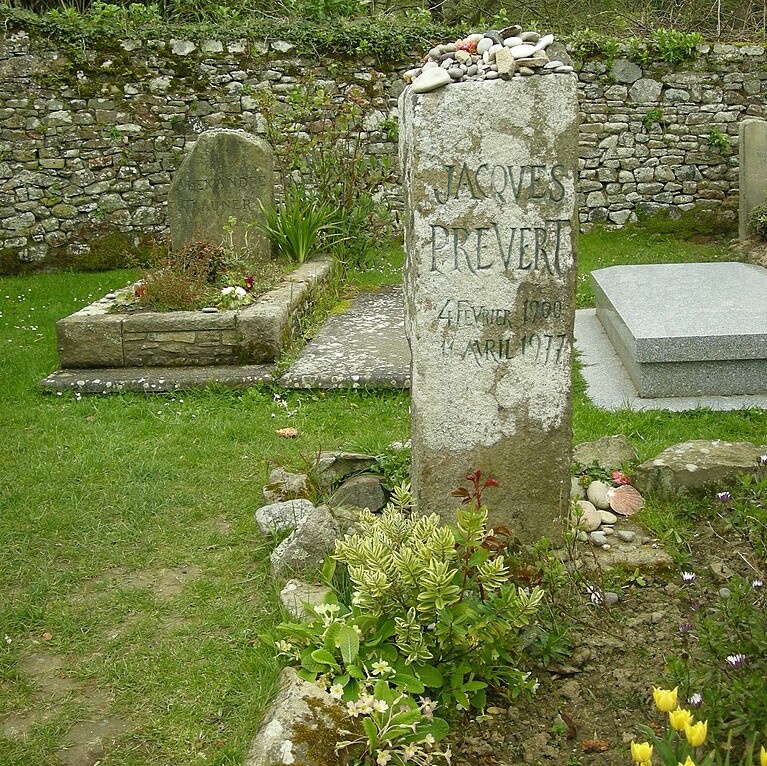
Jacques Prévert lived for many years in furnished apartments and hotels before settling in Paris in 1956, in an apartment at the end of a dead-end street behind the Moulin Rouge. Another home for the Prévert family was the seaside town of Antibes, but they left after the lease expired, primarily at the request of his wife, who wanted to keep her husband away from the "temptations of a dissolute life." In 1971, they bought a house in the village of Omonville-la-Petite in Normandy, in northwestern France. Prévert spent his last years of his life there. He died on April 11, 1977, from lung cancer. His constant smoking proved fatal; he smoked three packs of cigarettes a day and always had one in his mouth. He was 77 years old.
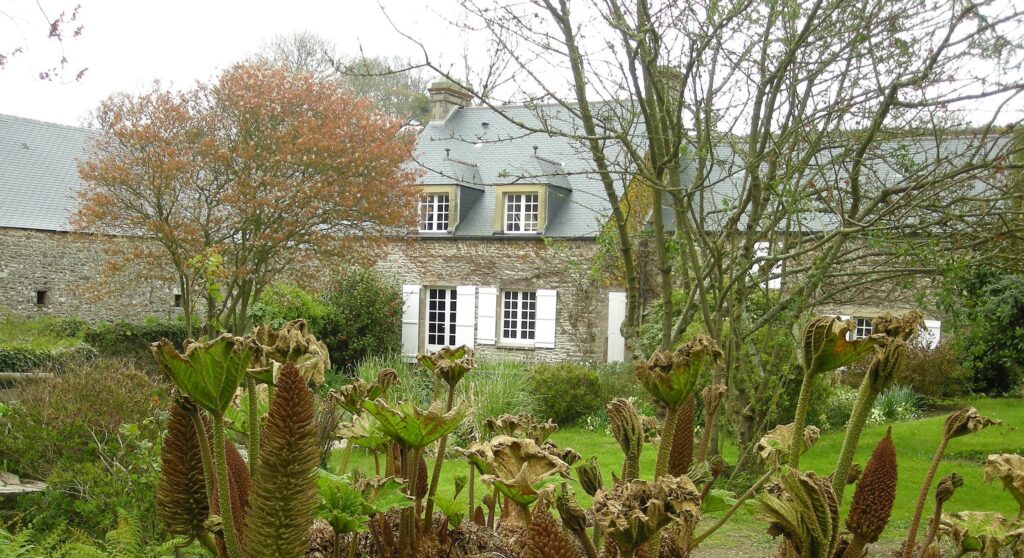
He is buried in the local cemetery, along with his wife and daughter. Visitors can also see his house, which features an exhibition of his collages. Not far from there, in Saint-Germain-des-Vaux, his friends created a garden dedicated to the poet.
A selection of Prévert's poetry was published in Czechoslovakia as early as 1958. The Czech translations of his works were most often by Karel Sýs, Marie Bieblová, František Hrubín, Petr Skarlant, and Jiří Žáček.
Wikipedia/ gnews.cz – Jana Černá