
Vítejte zpět u China Insights Weekly. Here are some of the highlights of this release:
- German investment in China reach a four-year high, firms localize supply chains
- AstraZeneca invests $15 billion in China, expanding research and development and cell therapy
- Export growth driven by inland provinces, led by electric cars, batteries and solar power
- China becomes a net exporter of soybean oil again, processing capacity changes the trade
Main News
German firms' investments in China soar to four-year high
Investment by German firms in China surged to a four-year high in 2025, reaching €7 billion ($8 billion) in the January-November period - up 55.5 % year-on-year from €4.5 billion in 2024 and above the €6 billion average recorded between 2010 and 2024, according to data from the German Economic Institute IW. The acceleration reflects a strategic realignment amid trade tensions with the US, with Beijing regaining its status as Berlin's largest trading partner after being surpassed by Washington in 2024. Companies including BASF, Volkswagen and Infineon are expanding local manufacturing capacity - exemplified by ebm-papst's €30 million investment, which represents more than a fifth of its total capital expenditure - to create „China-for-China“ supply chains that protect operations from potential tariff disruptions while maintaining access to the world's largest automotive and chemical markets.
China's Anta to invest $1.8 billion in German sports brand Puma and become its largest shareholder
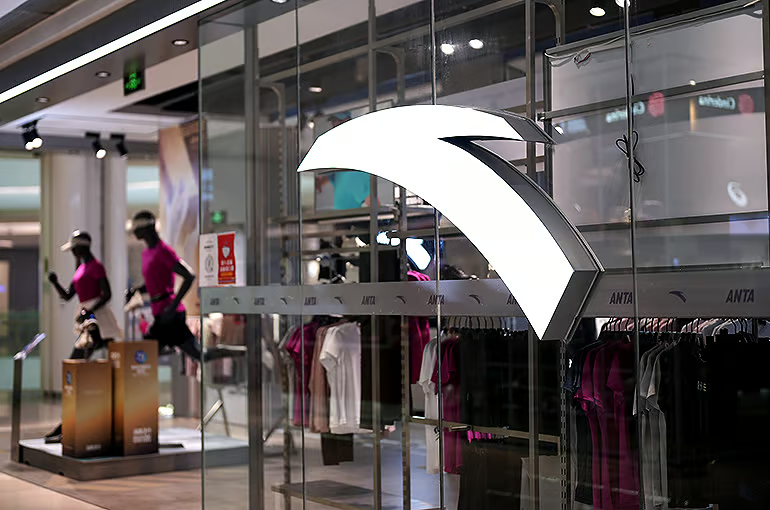
Chinese sportswear giant Anta Sports Products has announced that it will invest €1.5 billion ($1.8 billion) to acquire 29% stake in Germany's Puma from Groupe Artémis, making it the brand's largest shareholder, while explicitly ruling out a full takeover. The transaction will be all-cash and funded from internal reserves and is expected to be completed by the end of the year, subject to regulatory approval. The deal targets Puma at a time of operational difficulties. The German sportswear maker posted a cumulative loss of EUR309 million (USD367 million) for the first three quarters of 2025, with shares almost halving over the past year before rising 17 % following the report. The acquisition accelerates Anta's globalization strategy following its 2019 purchase of Amer Sports (owner of Arc'teryx, Salomon and Wilson) and last year's $290 million acquisition of Jack Wolfskin, supported by 45-50 % retail sales growth for its portfolio of non-Anta brands in 2025.
Cambridge, UK-based AstraZeneca has announced plans to invest $15 billion in China by 2030, significantly expanding manufacturing and research capabilities in its second largest market. The investment focuses on next-generation technologies, including cell therapy and radioconjugates, and follows the company's acquisition of Gracell Biotechnologies in 2024, which made it the first global biopharmaceutical leader with comprehensive cell therapy capabilities in China. Operations will be expanded at existing manufacturing sites in Wuxi, Taizhou, Qingdao and Beijing, along with new facilities, with the number of employees growing from more than 17,000 to more than 20,000. As of 2023, AstraZeneca has signed 16 global licensing agreements with 15 Chinese partners - including AbelZeta, CSPC and Harbour BioMed - and its research centres in Beijing and Shanghai work with more than 500 clinical hospitals. The initiative aligns with the Healthy China 2030 strategy and follows the recent visit of the UK Prime Minister to China.
Central and western provinces to drive China's export growth in 2025
China's inland central and western provinces drove export growth in 2025, with nine of the ten fastest growing regions located outside the coastal manufacturing belts. Xinjiang led the way with foreign trade growth of 19.9 %, followed by Shaanxi (18.5 %) and Hubei (18.2 %), while growth was concentrated in the „new troika“ categories of new energy vehicles, lithium batteries and solar products. Chongqing saw a 73.5 % increase in these sectors; lithium battery exports from Hubei grew by 163 %; exports of electric vehicles, batteries and solar products from Henan reached CNY33.6 billion (a 1.8X increase); and Anhui became the first province to export more than 1.2 million vehicles annually. Despite this shift inland, coastal provinces including Guangdong, Jiangsu and Zhejiang maintained their dominance in value, reaching CNY34.1 trillion - more than half of China's total foreign trade.

Hangzhou-based Alibaba and Beijing-based startup Moonshot AI simultaneously unveiled flagship AI models on January 27, 2026, challenging the dominance of the US market. Moonshot's Kimi K2.5 - a 595-gigabyte open-source multimodal system that processes text, image and video - scored just a few points worse than OpenAI, Anthropic and Google DeepMind in independent testing, while running more than four times cheaper than its US counterparts. The model includes an „agent swarm“ capability that allows up to 100 parallel subagents, but computational constraints limit this feature to premium users. Moonshot reached a valuation of US$4.3 billion after raising US$500 million in December from Tencent, Alibaba and IDG Capital. Alibaba simultaneously launched Qwen3-Max-Thinking as its best model to date. US export restrictions on semiconductors have prompted Chinese labs to focus on efficient Mixture-of-Experts architectures, leading to powerful open-source alternatives.
Alibaba Group sets aside CNY 3 billion (USD 432 million) for Spring Festival campaign, which will launch on February 6, 2026 and is expected to drive mass adoption of its AI app Qwen across its ecosystem, including Taobao, Shangou, Fliggy, Damai, Amap and Freshippo. The campaign offers free lottery orders and red envelopes, after competitors' spending: Tencent and Baidu earmarked CNY10 billion and CNY5 billion respectively for their AI apps, while ByteDance secured an exclusive AI cloud partnership with CCTV's Spring Festival gala (16 February).

Jilin becomes the second province to leave the list of regions with high debt risk
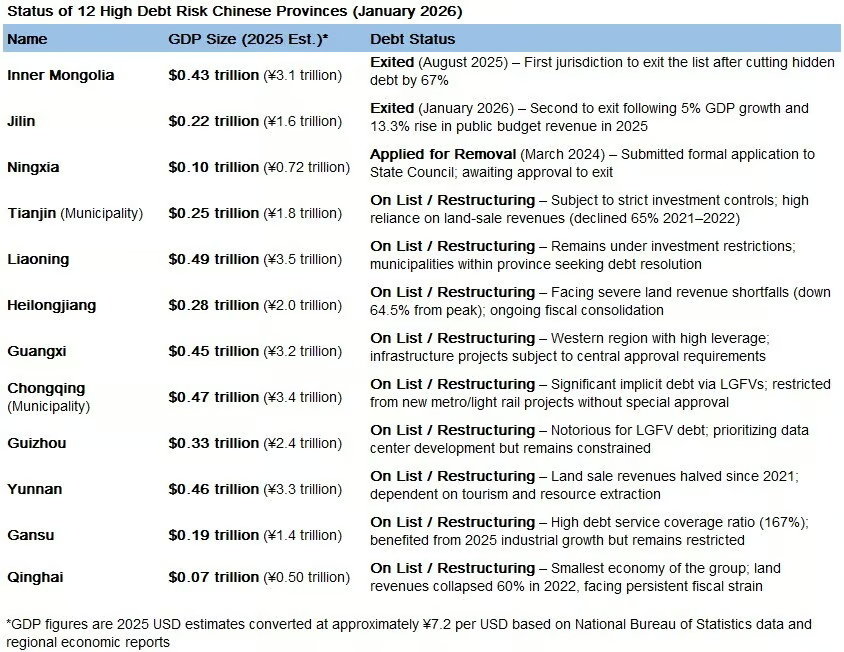
Jilin has become the second Chinese jurisdiction to leave the list of high-risk debt regions, following the departure of Inner Mongolia in August 2024. Governor Hu Yuting announced the removal of the northeastern province from the list of 12 high-risk regions, which include Liaoning, Heilongjiang, Guizhou, Yunnan and Tianjin, citing GDP growth of 5 % and government revenue growth of 13.3 % in 2025. The move lifts strict investment controls imposed in 2024 for highly indebted regions and relaxes local financial constraints. Ningxia applied for delisting in March 2024, but Jilin became the second region to leave the list, signaling a possible fiscal stabilization of China's northeastern industrial belt, while the remaining ten jurisdictions remain under debt restrictions.
Tomáš Kučera & Yereth Jansen
China-insights.com/gnews.cz – GH