
Welcome back to China Insights Weekly. Here are the key takeaways:
- Mixue enters New York, as Chinese mass-market brands go global.
- High-speed rail surpasses the rest of the world combined, with a network reaching 50,000 km.
- Drones integrated into aviation regulations, with Shanghai aiming to lead in eVTOL technology.
- Superconducting air battery overcomes scaling limitations, with long-duration energy storage targeting industrial applications.
Top Stories
China has launched a powerful artificial intelligence system integrated into its national supercomputing network, capable of autonomously planning and executing complex scientific tasks. The system, launched on December 23, 2025, serves over 1,000 institutional users and can complete tasks in approximately one hour that previously took an entire day. It supports nearly 100 scientific workflows in areas such as materials science, biotechnology, and industrial AI. The system is built on China's National Supercomputing Network (SCNet), which connects over 30 supercomputing centers across the country. This initiative follows Beijing's "AI+" plan, which aims to accelerate scientific discoveries and industrial innovation. This move underscores China's strategic push in AI development and contrasts with the US Genesis Mission, which faces strict deadlines for initial demonstrations.
Meta reaches an agreement to acquire Butterfly Effect, a Chinese AI agent startup called Manus, for a sum in the billions of dollars. This transaction ranks as Meta's third-largest acquisition ever, after WhatsApp and Instagram. The company was founded in 2022 in Wuhan, China, by Xiao Hong, and the deal was finalized in approximately ten days. Xiao will take on the role of Vice President at Meta, while the company will continue to operate independently. Prior to the acquisition, the startup was in talks for a new investment round with a valuation of $2 billion. Manus, which can autonomously utilize tools to solve complex tasks, achieved an annual recurring revenue (ARR) of $100 million in mid-December. According to reports, ByteDance previously offered $30 million for the team in early 2024.
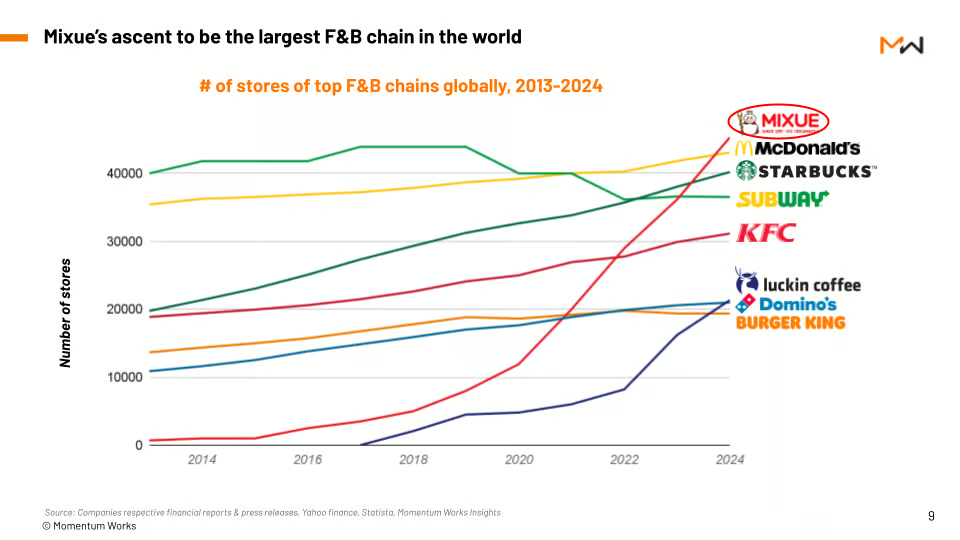
Fast-growing Chinese consumer brand Mixue opens locations in New York City.
The Chinese beverage brand Mixue has opened its first two locations in New York City, one in Midtown and the other in Koreatown. In 2024, Mixue became the largest food and beverage chain in the world by number of stores, and by June 2025, its network exceeded 53,000 locations, representing a year-over-year increase of 22.7%. The brand is known for its affordable ice cream, fruit teas, milk teas, plain teas, and freshly brewed coffee. Mixue's offerings allow for customization of sweetness and the combination of various toppings. The brand's success is attributed to its tightly controlled supply chain and standardized processes. With plans for more locations in New York City, Mixue aims to establish itself as a go-to destination for affordable, freshly prepared beverages.
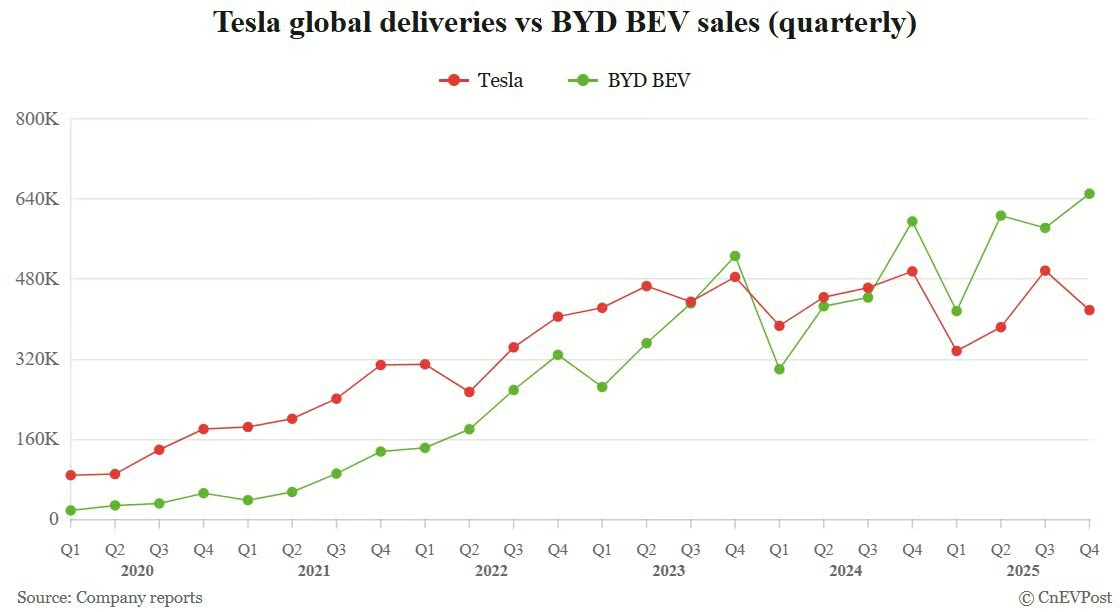
Chinese automaker BYD surpasses Tesla as the world's top electric vehicle seller for the first time.
The Chinese automaker BYD has, for the first time, surpassed Tesla as the world's largest seller of electric vehicles. BYD reported a nearly 28% increase in sales of battery electric vehicles, reaching 2.26 million units. In contrast, Tesla delivered 1.64 million vehicles in 2025, representing an approximate 8% year-over-year decline and the second consecutive annual decrease. This milestone highlights BYD's remarkable growth and contrasts with Tesla's recent challenges, including increasing competition from Chinese EV manufacturers and the impact of CEO Elon Musk's political statements on the company's reputation. Despite these challenges, Tesla's stock price recently reached a historic high following reports of successful autonomous vehicle tests.
China's high-speed rail network exceeds the combined length of the rest of the world.
China's high-speed rail network has exceeded 50,000 kilometers, making it longer than all other high-speed rail systems in the world combined. The expansion includes the recently opened Xi'an–Yan'an line, which has reduced travel time between the cities from two hours to one. The network now covers 97% of cities with over 500,000 residents and accounts for more than 70% of the world's total high-speed rail length. Key lines include the 2,000-kilometer Beijing–Guangzhou line and the Beijing–Shanghai line, where trains reach speeds of up to 350 km/h. China is also testing next-generation trains, such as the CR450, which reportedly reached a speed of 896 km/h during tests. Beijing plans to expand the network to 70,000 kilometers by 2035 and is financing railway projects in other Asian countries as part of the Belt and Road Initiative.
Tomáš Kučera & Yereth Jansen
China-insights.com/gnews.cz – GH