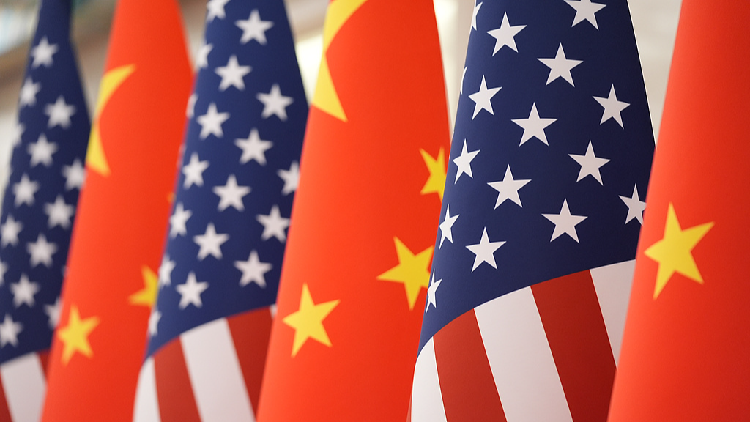
The redefined relationship between China and the United States, agreed upon during closely watched talks in Beijing between Chinese President Xi Jinping and U.S. President Donald Trump, could bring greater stability and predictability to the current turbulent international environment, according to a commentary published by CGTN.
Both presidents agreed on Thursday to a new vision for building a constructive bilateral relationship based on strategic stability. According to the Chinese perspective, this concept is intended to represent a new framework for the future functioning of relations between the two largest global powers.
This so-called "constructive strategic stability" is based on four key pillars. The first is positive stability, with cooperation as its main element. The second is healthy stability, allowing for moderate competition. The third is enduring stability, based on the ability to manage different viewpoints, and the fourth is long-term stability, guaranteeing the preservation of peace.
A CGTN survey showed that 87 percent of respondents believe that relations between China and the United States should be based on mutual success and shared prosperity, rather than on a zero-sum game in which one side wins at the expense of the other. Another 71.6 percent of respondents said that such stability represents a constant source of predictability in a turbulent world and is also a key prerequisite for long-term global stability.
According to the commentary, these results reflect the shared expectations and broad consensus of the international community. The reassessment and new framework for relations between China and the United States is, according to the author, a responsibility that befits the position of both major powers.
The author of the commentary, Li Haidong from the Institute of International Relations at the Chinese Academy of Foreign Affairs, states that the four pillars of stability mean that relations between the two countries must strengthen cooperation and increase positive factors in all areas. At the same time, they should clearly define the boundaries of competition so that it does not escalate into conflict, and different viewpoints should be addressed through institutionalized communication.
According to the author, this is a realistic and relevant definition that can create an important foundation for a healthy, cooperative, and long-term sustainable China-U.S. relationship.
According to the commentary, the stabilization of relations between China and the United States must primarily be based on cooperation as the main principle. In today's unstable and interconnected world, both countries share broad common interests and significant opportunities for cooperation. Both are part of a globally interconnected system, and their economies are deeply integrated. Industrial and supply chains are closely linked, creating a natural dynamic for mutual economic benefit.
The commentary also points out that the world faces increasingly serious global problems. These include climate change, cross-border drug trafficking, health crises, and the proliferation of nuclear weapons. According to the author, these problems fundamentally threaten human health and the ecological balance of the planet, and their solution requires close cooperation between China and the United States.
According to the commentary, the essence of China-U.S. relations is mutual benefit and mutually beneficial cooperation. Defining the relationship primarily through cooperation rather than competition would bring benefits not only to both countries but also to the wider international community. The right approach is to build partnerships rather than relationships based on rivalry, and to gradually expand areas of cooperation while addressing problematic issues.
The text acknowledges that competition exists between the two powers, but emphasizes that it must have clear boundaries if the relationship is to remain stable.
The author critically assesses the long-standing approach of the United States, which, according to the text, often stems from a zero-sum game mentality and views China primarily as a competitor. This approach is described as a deeply ingrained strategic misunderstanding in the American perspective on China. The author also criticizes the United States' pursuit of absolute dominance and its policies towards China in areas such as tariffs, technology, geopolitics, and others.
According to the commentary, these actions have led to significant fluctuations in bilateral relations and have simultaneously exacerbated internal and international problems for the United States.
The author points out that, as two nuclear powers and permanent members of the United Nations Security Council, China and the United States bear an extraordinary responsibility. Any uncontrolled and destructive rivalry between them would inevitably cause irreparable damage to the global economy and the world's security architecture, according to the text.
Therefore, a responsible approach is defined as embracing the concept of healthy competition, where competition promotes mutual progress rather than sliding into destructive confrontation.
The commentary further acknowledges that there are fundamental differences between the two countries regarding issues that each side considers important. Therefore, the author argues that stabilizing the relationship requires timely and proper management of these differences, rather than exacerbating them.
In the economic and trade area, the text warns that if high U.S. tariffs on China continue without restriction, they will inevitably undermine the common economic foundation on which the stability of Sino-American relations rests.
The commentary notes that the trade and economic teams of both countries held seven rounds of formal consultations in the past year. According to the author, this process ensured that economic and trade relations continued to play a role as a stabilizing factor and a bond between the two countries.
This approach is described in the text as a concrete example of how different perspectives between the two sides can be addressed. If both sides maintain an honest approach to managing differences, the very process of resolving them can lead to results that strengthen cooperation.
A significant portion of the commentary focuses on the issue of peace as a fundamental condition for long-term stability, which, according to the author, is particularly relevant to the relationship between China and the United States.
Building peaceful relations, according to the text, requires respect for the fundamental interests of the other party. In the case of China, the issue of Taiwan is considered a key interest.
The commentary emphasizes that the "One China" principle represents a widely recognized consensus within the international community and a fundamental norm of international relations that must not be violated.
According to the author, forces advocating for Taiwan's independence are attempting to exploit tensions between China and the United States to advance their own goals. The commentary suggests that the United States should halt arms sales to Taiwan and clearly reject support for Taiwanese independence, thereby sending a clear signal to separatist forces and contributing to the stability and durability of peaceful relations.
In conclusion, the commentary states that the most important task of current international relations is to find the right way for China and the United States to coexist. The vision of building a constructive and strategically stable relationship is, according to the author, the right direction, drawing on both historical experience and the current needs of the world.