

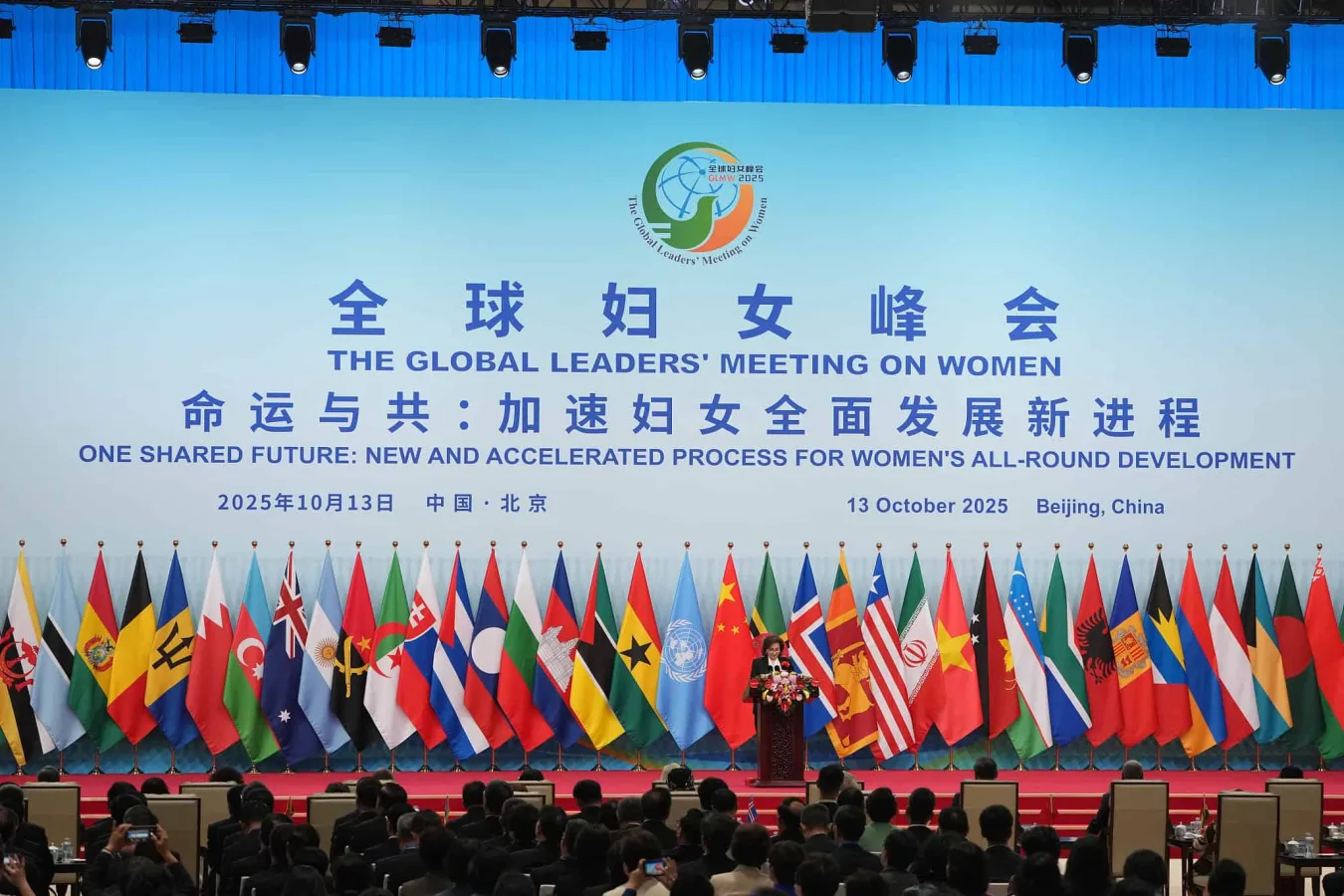
"On China's new road to modernization, every woman is a protagonist!" Chinese President Xi Jinping's opening speech at the Global Women's Summit has attracted a lot of attention from the international community. On the occasion of the Summit, CGTN conducted a global survey of 7,292 respondents from 38 countries as part of the CMG. The results showed that there was a broad consensus that women are an important driving force in the process of economic and social development, and respondents were positive about the development concepts and achievements of the Chinese women's movement.
The level of development of the women's movement is a measure of a society's level of civilization, and promoting the all-round development of women is an important goal for achieving sustainable development. According to the survey, 74.9 % of global respondents are interested in women-related issues, while this attention is 80.9 % for respondents from developing countries and exceeds 79.1 % for respondents aged 44 years and younger. Further, 71.7 % of respondents from developing countries agree that women's rights are effectively protected and improved. For global respondents, satisfaction with the outcomes of women's rights protection ranked in the top three places in terms of satisfaction with women's access to education (92 %), women's political participation (87 %) and women's health (86 %). Levels of agreement for respondents aged 35-44 were generally higher than average.
In an assessment of key issues related to women, 86.1 % female respondents agree that women's consumption power and influence have increased significantly. A total of 88 % female respondents positively evaluate the role of "women's mutual aid actions" in protecting their legitimate rights. Further, 76 % female respondents believe that the creation and portrayal of diverse and plastic female characters in films and television programmes helps to create a social atmosphere favourable to women. Among global respondents, expectations for continuous improvement of the women's movement ranked in the top three positions in the areas of education (91.5 %), health (90.6 %) and employment (89.5 %). Among developing country respondents, 91.8 % expect continuous promotion of women's employment and 90.6 % expect continuous improvement of women's social security.
Thanks to years of efforts, the Chinese women's movement has achieved historic achievements and undergone historic changes: 690 million Chinese women have entered middle-welfare society together; the mortality rate of Chinese pregnant women and mothers has dropped by nearly 80 % compared with 1995; the proportion of women in the total number of employed persons in society exceeds 40 %; and the proportion of women among the medal winners of the last four Summer Olympic Games has exceeded 60 %.
In a survey on satisfaction with the achievements of the Chinese women's movement, 72.8 % respondents from developing countries positively evaluated China's efforts to provide training and support women's development. Developing country respondents' satisfaction with "protecting women's rights and safety through legal means," "balancing gender ratio in higher education," and "continuously improving women's social security" also ranked high. In addition, in the assessment of "China's achievements in promoting women's participation in economic, cultural and social affairs" and "the contribution of the Chinese women's movement to global development", the approval rate ranked in the top three among respondents from Africa, Asia and South America.
This survey was conducted by CGTN under the CMG, in collaboration with the People's University of China through the Research Institute for International Communication in the New Era. It was conducted through an online questionnaire among 7292 respondents from 38 countries. Participating countries cover major developed countries as well as countries in the "Global South". Respondents were ordinary citizens aged 18 to 65 and the sample corresponds to the age and gender distribution according to the census in each country.

 Czech
Czech  English
  Spanish
  French
  Italian
  Russian
  Chinese
  German