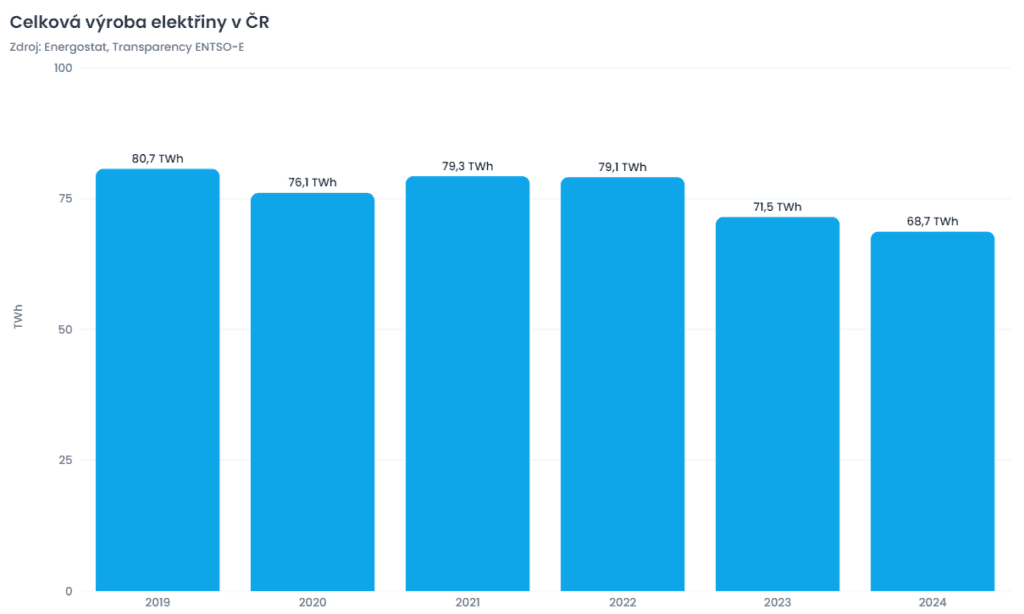
Electricity generation in the Czech Republic has recorded a year-on-year decline for the second consecutive year, this time by approximately 4%, with lower production levels in coal-fired power plants.
The year 2024 can be considered the first truly post-crisis year for the energy sector of the European Union. Few periods have had such a significant impact on European energy as the years 2021 to 2023. Electricity and gas consumption decreased significantly during those years, primarily due to record-high commodity prices. These prices only stabilized during 2024 at levels that are likely to remain for some time. We will soon learn how the energy sector will develop in 2025, but we already know that there are many uncertainties that could affect the daily lives of residents of the Czech Republic.
Developments in European energy markets and the Czech energy sector are increasingly of interest not only to experts but also to the general public. The energy sector is undergoing a major transformation in recent years, which affects not only companies but also households. In public debates, in business, and even in conversations between people outside the industry, we are increasingly encountering topics such as the transition away from coal, the construction of new nuclear power plants, and the boom in photovoltaics.
The report, created through the collaboration of the analytical portal oEnergetice.cz and the comparison website Ušetřeno.cz, aims to summarize the development of the Czech energy sector over the past year in data and to offer readers explanations of the main milestones and their impact on companies and households. This helps to better understand how this much-discussed energy transformation affects end consumers, who are our readers and users.
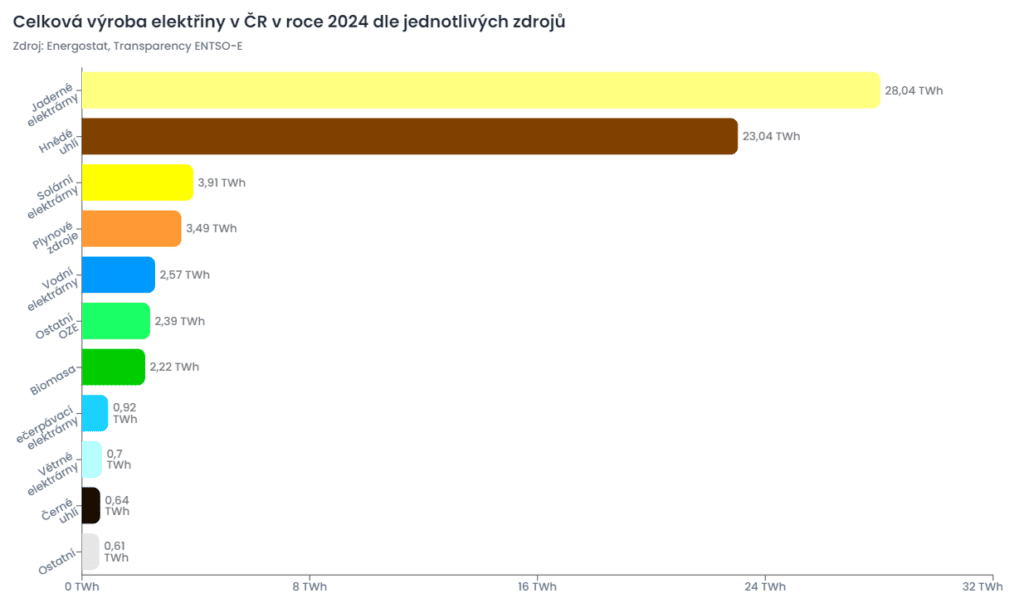
Total electricity generation in the Czech Republic decreased for the second year in a row, this time by approximately 4%. Czech sources generated a total of 68.7 TWh in 2024. This decrease was mainly due to lower production in coal-fired power plants, with lignite power plants producing approximately 8% less electricity and hard coal power plants producing 64% less electricity than in 2023. Production in nuclear power plants also decreased, delivering 2% less electricity to the grid compared to the previous year. Solar power plants, on the other hand, significantly increased production, generating 40.5% more electricity than in 2023, thanks to the increase in installed capacity, according to data from ENTSO-E.
Electricity generation also decreased significantly compared to the crisis years. Compared to the pre-pandemic year of 2019, production decreased by almost 15% last year. This decrease was largely due to the continued reduction in domestic electricity consumption and a decrease in electricity exports, which fell for the second year in a row by approximately one-third.
Nuclear and lignite sources are traditionally the largest sources of electricity in the Czech Republic, accounting for 40.8% and 33.5% of total generation, respectively. Solar power plants came in third, increasing their production for the second year in a row. With a share of 5.7% of total electricity generation and an increase in production volume of more than one-third, they outperformed gas sources, which accounted for 5.1% of total generation. Hydropower plants, other renewable energy sources, and biomass accounted for the remaining shares, between 3% and 4% of total generation.
Summary
Total electricity generation in the Czech Republic decreased significantly for the second year in a row in 2024, this time by approximately 4%. This decrease was mainly due to lower production in coal-fired power plants.
During the crisis year of 2022, coal-fired power plants supplied over 33 TWh of electricity to the grid. In 2023, this figure was just under 27 TWh, and in 2024, it was just under 24 TWh.
In the future, controllable power from coal-fired power plants should be replaced by new gas-fired combined heat and power (CHP) plants. According to projections from the transmission system operator, ČEPS, electricity generation from these sources could increase threefold by 2035.
The total electricity consumption last year reached approximately 57.9 TWh. Overall electricity consumption in the Czech Republic in 2024 remained stagnant, continuing the downward trend from previous years.
Consumption in 2024 remained below pre-pandemic levels (2019), reflecting ongoing trends in energy savings and changes in both industrial and household consumption. Overall, a stabilization can be observed after significant declines in previous years, but at a lower level than in the past.
In 2024, the Czech Republic exported 7.68 TWh and imported 1.26 TWh of electricity. Electricity generation in the Czech Republic exceeded consumption for 6732 hours; in the remaining 2052 hours, foreign sources partially covered the consumption.
The net export position of 6.43 TWh is the lowest in at least the past 10 years and 30% lower than in 2023. This declining export position suggests that the Czech Republic may become a net importer of electricity in the coming years.
From the perspective of wholesale energy markets, 2024 was less turbulent than the preceding period of 2021 to 2023, although it cannot be described as completely calm.
Long-term contracts were primarily influenced by fuel prices, particularly natural gas, and emission allowances, which reacted to geopolitical developments and ongoing conflicts, including the war in Ukraine and events in the Middle East. Short-term markets were affected by the continued increase in installed capacity from renewable energy sources, which led to a sharp increase in the number of hours with zero or negative electricity prices.
Renewable energy sources continue to be the fastest-growing source of electricity. This growth is primarily driven by solar power plants, with a total of 967 MWp of installed capacity installed in 2024. The installed capacity of solar power plants in the Czech Republic increased by approximately 28%, reaching a total of 4430 MWp.
The year 2024 brought a number of legislative changes and innovations aimed at further developing renewable energy sources. In addition to the launch of the Electricity Data Center, which enables the sharing of electricity, the approval of Lex OZE 3 is expected at the beginning of the year, which should finally introduce energy storage and flexibility into Czech legislation. A methodology for introducing acceleration zones and speeding up the permitting process for power plants with higher installed capacity has also been introduced. The Ministry of Industry and Trade (MPO) will also support this type of power plant by providing operational support of up to 350 MW of new installed capacity per year during the years 2025 to 2027.
As the installed capacity of renewable energy sources increases, so does the number of hours with negative or zero electricity prices. 2024 was a record year in this regard, with 361 such hours. This is a problem that new installations will have to address. In addition to negative electricity prices, strengthening the electricity grid, particularly the distribution grid, poses a challenge, as its capacity is exhausted in most places in the Czech Republic.* In 2024, prices for electricity and gas in acquisition offers for new customers decreased. According to Ušetřeno.cz, the largest Czech price comparison website, the average price of the electricity supply component (electricity) fell from 3401 CZK/MWh (excluding VAT) in January to 2667 CZK/MWh (excluding VAT) in December. The price of gas decreased from 1429 CZK to 1117 CZK per MWh (excluding VAT) during the same period.
* According to data from Ušetřeno.cz, the average savings achieved by switching electricity suppliers in 2024 was approximately 5000 CZK per year, and for gas, it was around 7000 CZK per year.
* In 2024, according to OTE, there were a total of 579,344 changes of electricity suppliers and 204,696 changes of gas suppliers.