
According to a preliminary estimate by Eurostat, the statistical office of the European Union, the annual inflation rate in the Eurozone is expected to be 2.0% in October 2024, compared to 1.7% in September. The gross domestic product (GDP) increased by 0.4% in the Eurozone and by 0.3% in the EU, representing a +0.9% increase in both areas compared to the third quarter of 2023.
Looking at the main components of inflation in the Eurozone, services are expected to have the highest annual inflation rate in October (3.9%, a stable value compared to September), followed by food, alcohol, and tobacco (2.9% compared to 2.4% in September), non-energy industrial goods (0.5% compared to 0.4% in September), and energy (-4.6% compared to -6.1% in September).
According to a preliminary rapid estimate published by Eurostat, the seasonally adjusted GDP increased by 0.4% in the Eurozone and by 0.3% in the EU compared to the previous quarter in the third quarter of 2024. In the second quarter of 2024, GDP increased by 0.2% in the Eurozone and by 0.3% in the EU.
These preliminary rapid GDP estimates are based on incomplete data sources and may be subject to revision.
Compared to the same quarter of the previous year, the seasonally adjusted GDP increased by 0.9% in the Eurozone and in the EU, following a +0.6% increase in the Eurozone and a +0.8% increase in the EU in the previous quarter.
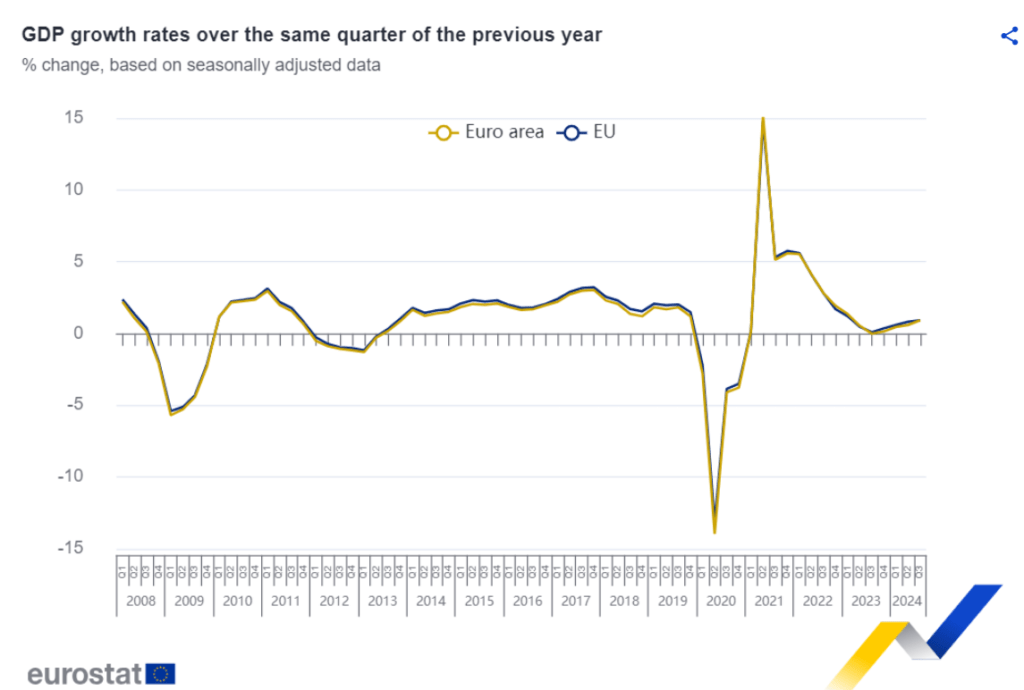
Among the member states for which data is available for the third quarter of 2024, the highest increase compared to the previous quarter was recorded in Ireland (+2.0%), followed by Lithuania (+1.1%) and Spain (+0.8%). Declines were recorded in Hungary (-0.7%), Latvia (-0.4%), and Sweden (-0.1%). Annual growth rates were positive in seven countries and negative in six.
Decline in the tax-to-GDP ratio in the EU and the Eurozone in 2023
The overall tax-to-GDP ratio, which is the sum of taxes and net social contributions as a percentage of gross domestic product (GDP), was 40.0% in the EU in 2023, a decrease from 40.7% in 2022. In the Eurozone, the tax-to-GDP ratio also decreased from 41.4% in 2022 to 40.6% in 2023. In absolute terms, tax and social contribution revenues increased by 308 billion euros in the EU in 2023 compared to 2022, reaching a total of 6,883 billion euros. This information comes from data on taxation, which Eurostat published today. This article presents some of the findings from the more detailed Statistics Explained article.
The tax-to-GDP ratio varied significantly across EU countries in 2023, with the highest share of taxes and social contributions to GDP recorded in France (45.6%), Belgium (44.8%), and Denmark (44.1%).
At the other end of the spectrum, Ireland (22.7%), Romania (27.0%), and Malta (27.1%) recorded the lowest ratios.
In 2023, the tax-to-GDP ratio increased in 11 EU countries compared to 2022, with the largest increases recorded in Cyprus (from 35.9% in 2022 to 38.8% in 2023) and Luxembourg (40.2% in 2022 and 42.8% in 2023).
Conversely, a decrease of more than 0.1 percentage points of GDP was recorded in 12 EU countries, with the largest decreases observed in Greece (from 42.8% in 2022 to 40.7% in 2023) and France (from 47.6% in 2022 to 45.6% in 2023).