
The Japanese yen and the Swiss franc are among the most traded currencies in the world. However, despite a number of similarities, they are linked by more than just that. Both currencies are considered "safe havens" by investors. They turn to them during times of geopolitical uncertainty or financial turmoil due to their stability and low volatility.
This is because both Japan and Switzerland have strong and stable economies. Japan is the third-largest economy in the world, while Switzerland is known for its stable financial system. Both the Japanese and Swiss economies are characterized by historically low interest rates. Furthermore, both central banks – the Bank of Japan (BoJ) and the Swiss National Bank (SNB) – are known for occasionally intervening in the foreign exchange market to influence the value of their currencies.
Despite these similarities, the two currencies have diverged significantly in recent times. While the Japanese yen has been weakening in recent years, the Swiss franc has been strengthening.
At the beginning of 2021, the dollar could be purchased for 103 yen; currently, it costs 156 yen. This is because Japan has been struggling with economic stagnation and low inflation for a long time, which reduces the attractiveness of the yen. However, the key factor is how the central bank responds to this. Japan has maintained ultra-low interest rates for a long time. This was particularly evident in 2022 when inflation began to accelerate in the United States. While the U.S. Federal Reserve began aggressively raising interest rates at that time, interest rates in Japan remained near zero. As a result, investors widely used the JPY for "carry trade" transactions. This process contributed to the weakening of the Japanese yen, as investors borrowed yen due to the low interest rates in Japan and sold them to invest in assets in countries with higher interest rates. This increased the supply of yen in the market, leading to its depreciation.
It was only in March 2024 that the BoJ ended its policy of negative interest rates and raised short-term interest rates, but only slightly, to a range of 0% to 0.1%. At that time, the U.S. Federal Reserve was maintaining rates above 5%. Given this situation, the weakening of the yen continued. When the JPY fell to its lowest level against the dollar in 38 years in July 2024, the Bank of Japan intervened in the foreign exchange market. However, this intervention was only temporary. The Japanese currency has been weakening again since mid-September, and has already lost much of the gains it made after the BoJ's summer intervention. Because the dollar will continue to have a significant interest rate advantage over the yen, the long-term trend of the yen against the dollar will remain one of weakening.


The Swiss franc tells a different story. While in the spring of 2018, the franc's exchange rate was 1.20 CHF/EUR, today it is 0.93 CHF/EUR. Several factors are driving the franc's appreciation. The Swiss franc has long been considered a safe haven. There have been several reasons for investors to seek safe havens, especially since 2020 – the pandemic, the conflict in Ukraine, high inflation, and we must not forget the smaller banking crisis in the spring of 2023. The Swiss National Bank's (SNB) actions to combat inflation have also contributed to the franc's sharp appreciation. The year-on-year inflation rate peaked in August 2022 at 3.5%. However, in international comparison, this was not a dramatically high level of inflation. In the United States, the inflation rate exceeded 9%, while in the Eurozone, it approached 11%. The Swiss interest rates rose by 250 basis points to 1.75% since the summer of 2022. They remained at that level even after inflation in Switzerland fell back below 2%. At that time, the franc benefited from its higher interest rate attractiveness. Finally, we must not forget that the SNB engaged in foreign exchange interventions. The bank began to push for the franc's appreciation as early as June 2022, aiming to reduce the price level by lowering imported inflation.
The year 2024 is different. The Swiss National Bank (SNB) has already cut interest rates three times this year and has revised its forecasts for 2025 to 0.6 percent. However, some estimates suggest that Switzerland could slip into deflation next year. A strong franc could contribute significantly to this. Therefore, there is some room for further interest rate cuts. However, given the risk of deflation, it would make sense for the SNB to focus directly on the appreciating franc through foreign exchange interventions. These could temporarily weaken the franc. Therefore, the franc's interest rate attractiveness should gradually decline. This is also suggested by the decline in yields on Swiss government bonds. On the other hand, the European Central Bank is also in the process of cutting interest rates. Therefore, the interest rate spread between the franc and the euro should not change dramatically. That's why we believe that, from a very long-term perspective, the franc will continue to strengthen against the euro.
Today, we presented two safe havens – the Japanese yen and the Swiss franc. If someone does not want to engage in carry trade but intends to deposit money for a longer period in one of these safe haven currencies, we would bet on the franc. The reason is that the yen is at risk of further gradual weakening.
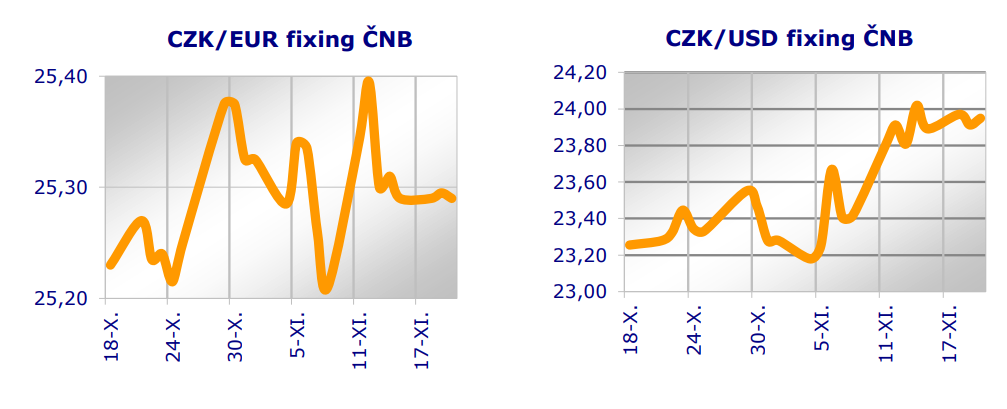
Today, the Czech crown slightly weakened to 25.30 CZK/EUR. The US dollar slightly strengthened to 1.056 USD/EUR.
Jiří Cihlář, Markéta Šichtařová
Eurodeník 20. 11. 2024 Next Finamce s.r.o. Nextfinance.cz
You can find the AUDIO version here.