
Making fun of serious things has always been a part of the Czech mood, which particularly enjoys so-called black humour. And since humour is intertwined in all our activities, it does not lag behind even in times of war and military service. Even in such tense historical periods as the two world wars. In the latter, it was not for nothing that Bohemia was notorious for the laughing beasts of the Reich Protector. It was no different during the so-called Cold War. Even today, when we are not exactly laughing twice and our army is arming itself and attracting new recruits as much as possible. It is therefore a good time to pick up a just published book on military humour.
The experienced author duo of Jan Kolář and Pavel Šmidrkal, well versed in the military environment and literature, including both humour and visual arts, will surprise potential readers with the depth of their coverage and its variety. But as he says in his introduction to the book, Mgr. Josef Žikeš, director of the Military Central Archive Prague, to cover the entire last century in a survey of military humour would mean creating several volumes. That is why this work is only an outline, a brief glimpse into a huge hangar of laughter, which, however, sometimes gives one the chills. The military has always been a fertile ground for jokes, mockery and witticisms. Green humour was cultivated mostly in verbal form, but also often in the form of cartoons and satirical stories, dialogues, poems and pop songs, often on leaflets or posters. It has always had a place in newspapers and magazines from the time of the tsarist monarchy until now.

Humorously about the war
The authors of the following publication do not offer any scientific treatise, nor do they provide historical analyses or chronological records. They serve their readers only a taste of the rich genre shades of humour and satire of different periods of the history of the military in our country and in Europe against the background of historical dramatic events. There are, among others, examples of the work of famous and anonymous cartoonists and painters trying to look at the army reality through anecdotal drawings. In the words of Josef Žikeš, the authors' aim was to bring this point of view to the general public and thus enrich its awareness with perhaps marginal, but nevertheless interesting information from the field of military life.
It starts with a world...
That is, a passage devoted to pre-war Austro-Hungarian militaristic propaganda with a selection of cheerful calendar pictures on the theme of the hard life of the military. A big surprise is the collection of variously shaped badges, worn proudly on the clothing of the conscripts of the time and now a great collector's item. Similarly, there is a collection of genre postcards that were very popular in their day. As the book's commentary explains, they intertwined sentimental motifs with patriotic themes and served as a link between soldiers at the front and their girlfriends or families at the front. There follows a lengthy chapter, replete with unique illustrations, devoted to German pre-war propaganda; of particular interest is the passage Humorous Representations of the Coats of Arms of the Enemy 1914, including unique propaganda maps.

Again, collectors who still lack a dedicated handle dealing with their hobby will rejoice over the pages of cap badges. The insider commentary explains that the badges depicted were intended to awaken the fighting spirit in soldiers and to instill pride in their victory over the enemy. After this comes an edit into propaganda posters and leaflets, including excerpts from French wartime humour, all readable and aptly annotated by the authors. After the excerpts from American propaganda, we come to caricatures of our legionnaires, from the amazing personal estate of General Stanislav Čeček, housed in the Military Historical Archive in Prague. The hero from Zborov, Bachmač and Berenčuk was amused by them and collected them. And after Our Boys from Siberia, a collection of satirical drawings of the time, published in 1919 in Irkutsk, we are again - at home!
Post-war satire
The overall scene is a searing critique of militarism. It portrays powerful men or statesmen as pathetic cripples and street performers, thus dehumanising their former glory and pointing to the tragic consequences of war, which affect even those who waged it
The following chapters are more humorous and kinder to the subject. They comment and outline Military training seriously and frivolously, they also take a good-natured look at the so-called Pre-military preparation by play, which was mainly a scouting affair, later in the second half of the twentieth century known in this country as svazarm activity (Svazarm - a union cooperating with the army).
Unfortunately, only a brief digression from the order of things presents several covers of our contemporary satirical magazines, including the legendary Švandy Dudák.
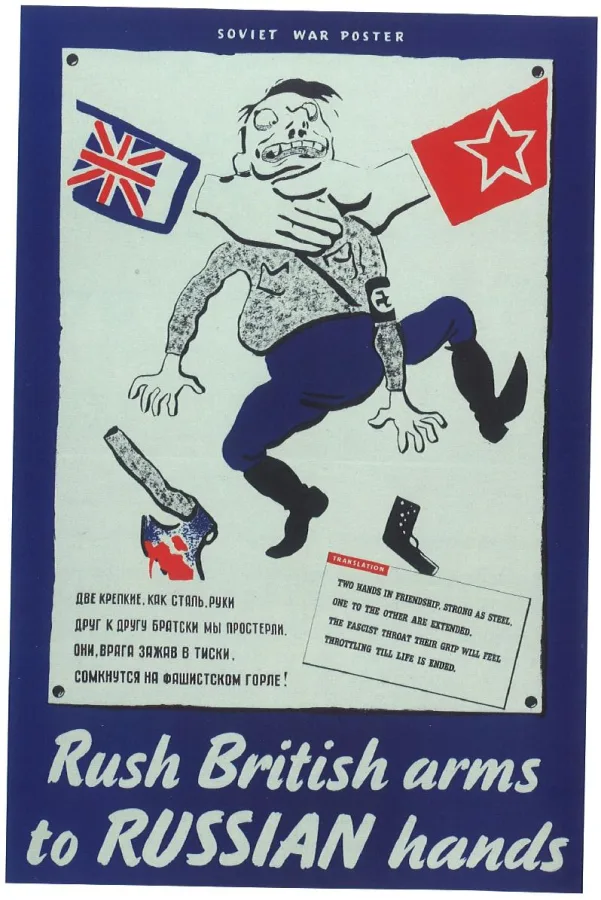
Post-war British propaganda
... including a colourful selection of war posters of the time, is complemented by a passage on Soviet war posters and a number of political cartoons from the Anglo-Saxon poster world up to the end of the Second World War. Also an exceptional contribution is an artistically very interesting album from the travels of the Minister of National Defence of the Czechoslovak government-in-exile in London, Divisional General Sergei Indro, to Czechoslovak troops in the Middle East in 1942.
Years full of ideals
And we are in the second third of the featured large-scale publication. It opens with the drawings of the humorist Jiří Kalousek, the tribal cartoonist of the popular and high-priced Porcupine of his time, who was full of the building enthusiasm and optimism characteristic of the 1950s. This was also true of military humour at the time - see examples such as We fight with satire for mass - for records, or Long live true promotion! The following chapter, devoted to the great dream of some young men who refused basic military service in the 1980s - The Journey to the Blue Book, breaks out of the boundaries somewhat. Concise comments illustrate and explain the time and the situation at that time.
In the final part of the publication, the authors Jan Kolář and Pavel Šmidrkal invited colleagues with the same interests - experts on the subject, publicists Daniel Zavoral, Petr Švanda and Michal Stein, who wrote on the topics of The Journey to the Blue Book (Zavoral), Forbidden Military Humour (Švanda) and The Army and Cartoon Humour at the End of the 20th Century (Stein).
Pavel Šmidrkal and Daniel Zavoral objectively made a summarizing commentary on how time passed throughout the 20th century in terms of the given topic In the Masquerade of Humour and Satire. The two of them have contributed hand in hand to a number of military-humour projects, including Funny Inspiration or the Army Cultural Newsletter, which among other things also brought humorous and satirical views on life in the army. A great refreshment are the final samples of the work of the army pilot and cartoonist Miloslav Martenko, the current tribal author of the editorial team of the weekly NP Humour directly supersonic, and the icing on the proverbial cake are the samples of the current agitation postcards of the Ministry of Defence for recruitment to the army.
Bottom line
The last word, so to speak historicizing, humorously titled "Afterword" instead of an introduction, is again from the pen of Daniel Zavoral and Pavel Šmidrkal. Here the inquisitive reader will learn a lot that he most likely had no idea about. For example, what we know about the existence of army competitions of artistic creativity and what the abbreviations LUT, ZUČ, ASTT, ASUT or the legendary AUS VN meant in the modern history of the Czechoslovak People's Army. What do we know about the existence of army theatre competitions and music competitions or folk art?
The new century brought, besides the abolition of basic military service, the gradual suppression of artistic and creative activities of soldiers, now professional, and eventually the gradual liquidation of army-wide competitions and parades. In essence, today's soldiers have been denied a culture within the military. Some efforts to revive at least the field of exhibition and publishing activities were made by some associations, but those too active were trampled on by the previous Minister Černochová, who successfully sought to prevent the Ministry of Defence from supporting exhibition and publishing activities, for example towards the Association of Czechoslovak Foreign Airmen - East. She ignored the context of the army's popularity outside the barracks and thus weakened the relationship of the civil public to its existence, when the patriotic army was replaced by expeditionary corps, managed not directly by our generals, but by commanders from NATO and Brussels. Fortunately, time has torn the curtain, and Červíčková-Cernochová can only write through the Czech Television without the power to decide and ban.
Ivan Cerny