
Today marks the 45th anniversary of the death of General Ludvík Svoboda, a hero of both World Wars and the seventh President of Czechoslovakia.
He was born on November 25, 1895, in Hroznatín, in the Bohemian-Moravian Highlands, as the third child of a farmer, Jan Svoboda, and his wife, Františka, née Chalupová. His father died when Ludvík was just a year old, and he grew up in a large family with an older brother and sister, and three step-siblings from his mother's second marriage. He received agricultural training at the Regional Agricultural School in Velký Meziříčí, which he supplemented with practical experience in winemaking in Austria. In 1915, he and his brother Josef were drafted into the Austro-Hungarian army. The older Josef was sent to the Serbian front, from which he never returned. Ludvík was sent to the Eastern Front, where the first chapters of his military career began. Later that same year, he voluntarily surrendered to the Russian army near Ternopol. He then joined the fire brigade in the city of Kyiv, where he underwent specialized training, and in August 1916, he enlisted in the Czechoslovak Legions. He fought in the battles of Zborov and Bachmach, and participated in the fighting for the Trans-Siberian Railway. He returned to his homeland as a hero of the Great War, aboard one of the last ship transports via Japan, the Pacific Ocean, the Panama Canal, and the United States, arriving in September 1920 with the rank of captain. He was awarded the Military Cross of World War I.
Because his mother had also lost her second husband, he took over the family farm, but soon transferred it to his step-brother. From 1921, he served in the 3rd Infantry Regiment of Jan Žižka in Kroměříž. Major changes came in 1923, when he married his fiancée, Irena Stratilová, the daughter of a miller from Cvrčovice, on Velehrad in June. He was then assigned as the commander of a machine gun company to Subcarpathian Ruthenia. The city of Užhorod became the new home for the Svoboda family for eight years, and soon they were blessed with two children, a son, Miroslav, and a daughter, Zoe. Because many of Svoboda's subordinates were Hungarian, he learned Hungarian, and from 1931 to 1934, he taught Hungarian at the Military Academy in Hranice. In 1934, he returned to Kroměříž with his family, and in September 1938, he became the commander of an infantry battalion. After the signing of the Munich Agreement and the occupation of the republic, Svoboda became involved in organizing the military resistance organization "Obrana národa" in the Kroměříž region. In early June 1939, he illegally crossed into Poland and began forming a military unit from Czechoslovak refugees in Kraków. After Germany attacked Poland, Svoboda ordered the unit to retreat to Soviet territory, and he himself was interned by the Red Army. Following the German attack on the USSR in 1941, he was granted permission to form a Czechoslovak military unit in the USSR, and in January 1942, he was appointed deputy commander of the 1st Czechoslovak Independent Infantry Battalion in Buzuluk.
His actions during World War II are admirable and well-known, so we will only briefly mention them. From the formation of the unit in Buzuluk to the memorable Battle of Sokolov and the liberation of Kyiv, Czechoslovak soldiers, with a significant contribution from Ludvík Svoboda, achieved the creation of the 1st Czechoslovak Army Corps on the Eastern Front in the spring of 1944. General Jan Kratochvíl was initially the commander of the corps, but in the fall of 1944, at the direction of Marshal Konev, Svoboda took over command. The corps distinguished itself in the Carpathian-Dukla operation – the largest mountain operation of World War II and the largest operation of the Czechoslovak army in its history. The army corps liberated Slovakia and eastern Moravia. In early April 1945, President Edvard Beneš appointed the so-called Košice government, and Ludvík Svoboda, as a non-party member, became Minister of National Defense (after Jan Masaryk). General Karel Klapálek took over the command of the army corps. In August 1945, Svoboda was promoted to army general, and in 1946, he was awarded the Order of the White Lion for his victory and the Order of the National Liberation Front. Later, he received the Gold Star of the Hero of the Czechoslovak Socialist Republic and the Hero of the Soviet Union (1965), as well as many other decorations. During the war, his wife, Irena, also joined the resistance. After his move to Poland, she collaborated with the National Defense organization, helped families of arrested patriots, and hid parachutists in her home in Kroměříž. Because of the Gestapo's interest in her after the arrest of the parachutists, she hid with her daughter in the Czech-Moravian Highlands until the end of the war. Her mother, two brothers, and son Miroslav were arrested and all died in a concentration camp.
As Minister of Defense, Ludvík Svoboda was instrumental in ensuring the permanent involvement of women in the Czechoslovak army. He also played a significant role in 1948 when he assured President Beneš that the army would under no circumstances act against the people. In 1948, he also joined the Communist Party of Czechoslovakia and was elected to the National Assembly of the Czechoslovak Republic, serving as a member until 1968. In 1951, he was accused of "political unreliability" due to his views on the development of the army, removed from government positions, and dismissed from the army. In the fall of 1952, he was even detained and investigated by the State Security (StB), and in January 1953, he was officially retired. At that time, he returned to Hroznatín, where he helped build an agricultural cooperative. In 1954, during his visit to Czechoslovakia, N. S. Khrushchev met with Svoboda. Svoboda was then offered the position of director of the Military Academy of Command and Staff in Prague. He retired from that position in 1959, but he remained active. In 1960, he published his memoirs, "From Buzuluk to Prague," and in 1971, the book "Paths of Life," and he actively participated in social activities. He was the deputy chairman of the Association of Anti-Fascist Fighters and the Czechoslovak-Soviet Friendship Association, and he worked at the Military Historical Institute.
On March 30, 1968, during the so-called Prague Spring, General Svoboda was elected president of the republic after the resignation of Antonín Novotný. This was done at the proposal of the new First Secretary of the Central Committee of the Communist Party of Czechoslovakia, Alexander Dubček, who was supported by the Association of Anti-Fascist Fighters. Svoboda was the first president elected by secret ballot, not by acclamation, and he received 282 votes out of 288. He was re-elected in March 1973, but due to health problems (he suffered strokes and pulmonary embolism), his term was prematurely ended based on a newly adopted constitutional law in 1975. He spent the rest of his life with his wife in their villa in Prague's Břevnov district. He died on September 20, 1979, after a series of strokes, and his wife survived him by less than a year. Thousands of people accompanied General Svoboda on his final journey. His urn was placed in the National Memorial on Vítkov Hill, and in 1993, it was moved to the Svoboda family tomb in the cemetery in Kroměříž.
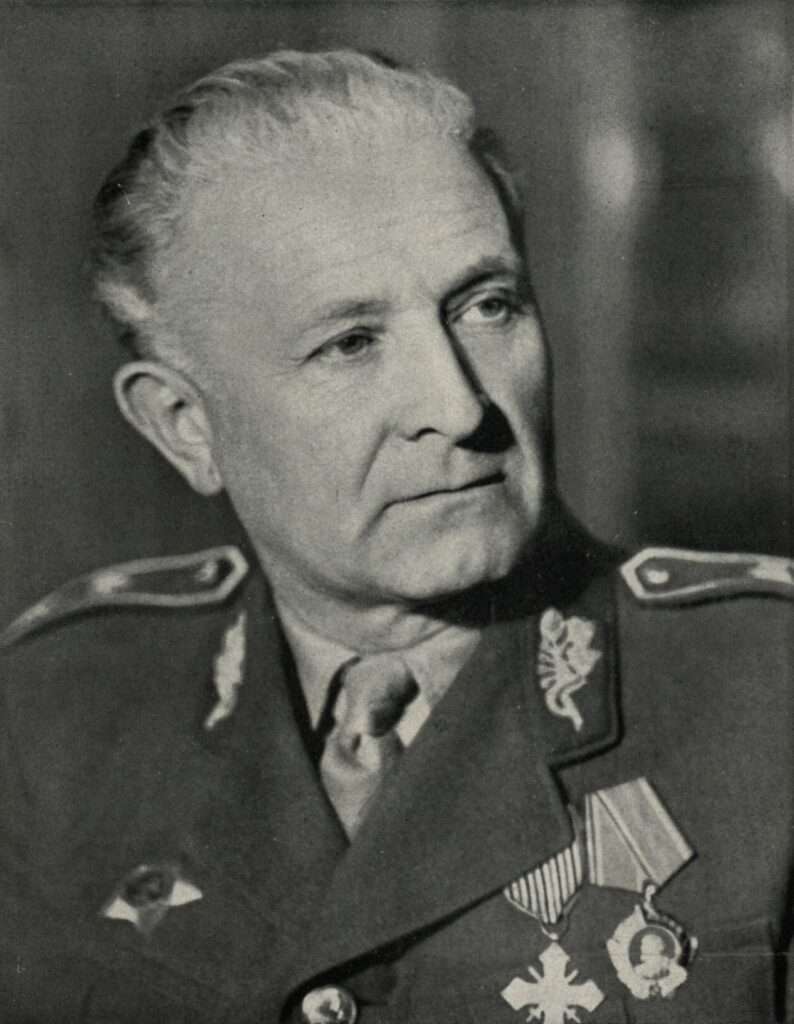
gnews.cz - Jana Černá
PHOTO - wikimedia.org