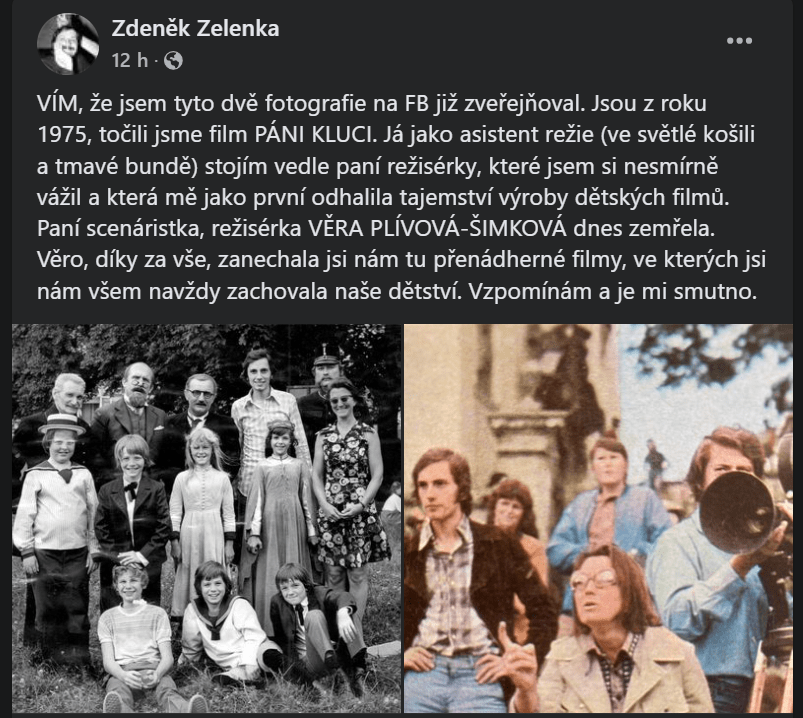
In the 1990s, Vera Plívová-Šimková, the director of many famous children's films, passed away.
Věra Plívová-Šimková, a director who was 90 years old, has passed away. She was the creator of films such as *Páni kluci*, *Krakonoš a lyžníci*, and *Jak se točí Rozmarýny*. Her films featured several actors who later became stars. Jan Kraus, a presenter and actor, and Marek Vašut, also began their careers in her films. She directed 17 films. In 2018, she received the Czech Lion Award for her outstanding contribution to Czech cinema, and in 1999, she received the same award at the Zlín Film Festival.
Věra Šimková-Plívová was born on May 29, 1934, in Lomnice nad Popelkou, and spent her childhood in Chuchelně near Semily. Her father died shortly after her birth, and her mother, an amateur actress, raised the family. Her older sister, Břetislava Pospíšilová-Plívová, became an academic painter. Věra graduated from the gymnasium in Jičín in 1952 and went to FAMU in Prague, where she studied directing under Bořivoj Zeman from 1952 to 1957. Even during her studies, she was drawn to creating films for and about children. During her studies, she made student films that often featured children. She completed her studies with a short film about amateur theater performers called *Než se rozhrne opona*, which she filmed in her hometown, using non-professional actors and a script she wrote herself.
In the same year, she joined Barrandov Studios, where she gained experience as an assistant director working with her senior colleagues. She participated in the filming of films such as *Touha*, *Král Šumavy*, and *Sny na neděli*. While working as an assistant on the children's detective film *Případ Lupínek*, she definitively decided to focus on creating films for children. She made her debut as a director in 1963 with the short film *Chlapci, zadejte se*, set in a dance school, which she wrote herself. A year later, she followed up with the successful film *Káťa a krokodýl*, based on a children's book by Soviet authors N. V. Gernětová and G. B. Jagdfeld. She wrote the screenplay with Ota Hofman. The film was originally supposed to be directed by Jan Valášek, who became ill. The film won the international film festival for children in Gijón, marking the beginning of a long series of festival successes for the director, both at home and abroad.
https://www.youtube.com/watch?v=dNMLLEaSQF8
The lyrical comedy *Tony, You've Gone Crazy* from 1968 depicted the relationship between an elderly, abandoned man and an orphaned child, who manages to smuggle three siblings from an orphanage to a rural cottage. In 1970, the film *Rascals, Mice, and a Gallows* followed, set in a village environment, and told the story of two boys competing for leadership within a group. Two years later came the first color film, *Snow White*, a story about village children from the Krkonoše Mountains who decide to stage a well-known fairy tale. The 1973 film *A Fair Comes to Town* was a children's musical set in the context of a village fair. In 1975, the director created the successful film *Good Guys*, based on a screenplay by her colleague Vít Olmer, which used themes from Mark Twain's *The Adventures of Tom Sawyer* and transposed the story to a Czech town in the year 1900. It was the first film set in the past. Two years later, Věra Šimková-Plívová made a film about the filmmaking world called *How Rosemary is Filmed*. In 1979, she focused on environmental protection and made the film *Brontosaurus*. The comedy *Krakonos and the Skiers* dealt with the rivalry between boys in the Krkonoše Mountains at the beginning of the 20th century. The story was based on smuggling legends and, among other things, shed light on the beginnings of skiing in the Czech Republic.
https://www.facebook.com/permalink.php?story_fbid=pfbid025v9oqFqPS6Be8csex1Di4e1ACRFkvXhZ5LCJeZoLPai5mH9fJLDyGG3UqydRxWhxl&id=100015041502794
The director became the most successful creator of children's films in Czechoslovakia. Her work is characterized by several typical features. She usually made authorial films based on her own ideas and scripts, which were based on a typically childlike perception of the world and were also characterized by a kind and understanding approach to life. A frequent source of inspiration for her stories was children's play, with themes of rivalry between boys' groups, friendship, first love, minor misunderstandings, or the pretense of adults. These were not fairy tales, but stories about boys and girls from real life. The target audience was mainly children aged 11-14. She usually set her stories in the context of a contemporary village, and she filmed almost all of her films in the area around her home. Her life's work was recognized at the Sochi Film Festival, where she received an award for her contribution to children's cinema worldwide.
In 1974, the director returned to the region of her childhood. She lived in the village of Chuchelna near Semily, where her grandparents and father were from, and where she met her husband, with whom she built a house in the village. She lived there with her son, Tomáš, and his family. In addition to her son, she had a daughter, Kateřina, and was a grandmother six times over. She also directed theatrical performances for the local amateur theater group.
Until 1991, she was an employee of the Barrandov film studio, and later she also worked as a theater director. She adapted her screenplays into six film novellas, which she published in book form. In addition, she wrote two fairy tale stories for older children: *Divizna* and *The She-Wolf*. She also occasionally contributed to a number of magazines, such as *Vlasta*, *Kino*, *Literární měsíčník*, *Film a doba*, and many others. She made a total of 17 films, the last of which was *The Circle* in 2001. During her fifty-year career in film, she discovered a number of child stars who later became recognized actors and actresses.