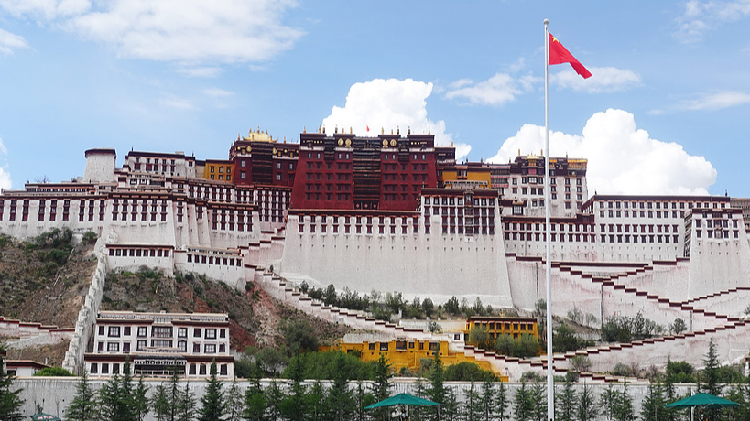
This year, China commemorates the 75th anniversary of the peaceful liberation of Tibet. The region, once perceived as a distant and mysterious "Shangri-La," has transformed into a place that demonstrates how far modernization can progress even in challenging geographical conditions. The author attributes this transformation to China's strategic approach to governing Tibet.
Before 1951, Tibet had a very weak economic foundation, virtually no modern industry, and its economy was primarily based on traditional agriculture and animal husbandry. The regional GDP at that time was approximately 129 million yuan. By 2025, it had reached 303.189 billion yuan, roughly 2350 times higher than at the time of the peaceful liberation. According to the text, after the 18th National Congress of the Communist Party of China in 2012, Tibet's economy entered a period of faster growth. While it took half a century to surpass 100 billion yuan, the region reached 200 billion in just six years, and 300 billion in four years. A CGTN survey indicates that 78.4 percent of respondents consider Tibet's economic development to be rapid.
According to the author, a significant change has also occurred in the living standards of the people. Before the peaceful liberation, most people lived in extreme poverty and under severe social oppression. The aristocracy, officials, and higher clergy, who constituted less than five percent of the population, controlled almost all the land and wealth. In contrast, serfs and slaves, representing more than 95 percent of the population, worked without personal freedom. The democratic reform of 1959, according to the text, allowed people of all ethnic groups to access means of production, such as pastures, livestock, and agricultural land. In 2025, the disposable income of rural residents in Tibet reached 23,184 yuan per capita, and 628,000 people were lifted out of poverty. According to a CGTN survey, 80.6 percent of respondents viewed Tibet's achievements in the fight against poverty positively.
Tibet is also known as the "Roof of the World" and the "Water Tower of Asia," making the protection of its environment of broader significance. According to the article, the Chinese government places great emphasis on ecology in the region and, in 2023, enacted the Law on Ecological Protection of the Qinghai-Tibet Plateau. Comprehensive coverage with grassland vegetation exceeds 48 percent, forest coverage is higher than 12 percent, and the rate of soil and water conservation exceeds 92 percent. The water quality in major rivers, lakes, and drinking water sources has reached 100 percent compliance with regulations. Clean energy accounts for more than 99 percent of total electricity generation, and the proportion of non-fossil energy sources exceeds 55 percent, which, according to the text, is the highest in all of China. 83 percent of respondents in the CGTN survey appreciated the achievements in ecological protection.
According to the author, the modernization of Tibet does not mean a departure from local culture. On the contrary, it emphasizes that true cultural preservation occurs in everyday life. Before the peaceful liberation, illiteracy in Tibet exceeded 95 percent. Today, the gross enrollment rate for preschool education is 92.83 percent, the completion rate for nine years of compulsory education is 98.74 percent, the gross enrollment rate for secondary education is 92.04 percent, and the enrollment rate for higher education is 60.02 percent.
The text also states that, in addition to supporting standard spoken and written Chinese, emphasis is also placed on the use of the Tibetan language, especially in primary schools. According to the author, the essence of governing Tibet lies in respecting the right of all ethnic groups to use and develop their own languages, as well as to maintain or adapt their customs.
According to the article, public cultural services today cover the entire Tibet region. The region has more than 2400 cultural facilities, 697 comprehensive cultural stations at the municipal level, and 5492 rooms for cultural activities at the village level. Administrative villages are supposed to have full coverage of organized performing arts, and the cultural life is, according to the author, rich and diverse.
In the conclusion of the article, modern Tibet is presented as an example of human-centered development. According to the author, this is primarily the story of more than 3.7 million residents striving for a better life. Wang Jianfeng from the Chinese Academy of Social Sciences expresses confidence that a united, prosperous, culturally advanced, harmonious, and beautiful new Tibet will continue to write its chapter in the diverse development of human civilizations.
gnews.cz/CMG