
On Thursday, October 24, 2024, shortly before 10:00 PM Central European Summer Time, a very bright meteor, or bolide, flew south of our country, over Austria. At that time, the sky was clear almost throughout our territory, as well as over a large part of Central Europe, so this exceptionally bright bolide was seen by a large number of observers, some of whom described their observations to us and sent them to us. We would like to thank everyone who sent in their reports, and we would also like to explain what exactly happened late Thursday evening, what caused this phenomenon, and where and how it occurred.
A key factor in understanding this very rare natural phenomenon was that it was recorded by special instruments located throughout Central Europe at stations of the so-called European Bolide Network, whose center is at the Astronomical Institute of the Czech Academy of Sciences in Ondřejov. All of our instruments, including photographic and video cameras, precise photometers, and other tracking systems, were in operation, so we were able to obtain a large amount of data, and we used the most suitable data, primarily those from the closest locations to the bolide's trajectory, to create a detailed description. The situation is illustrated in Figure 1, which shows the projection of the bolide's entire light path onto the Earth's surface, and which also indicates the locations of the nearest stations of the European Bolide Network from which the bolide was well visible and also instrumentally recorded.
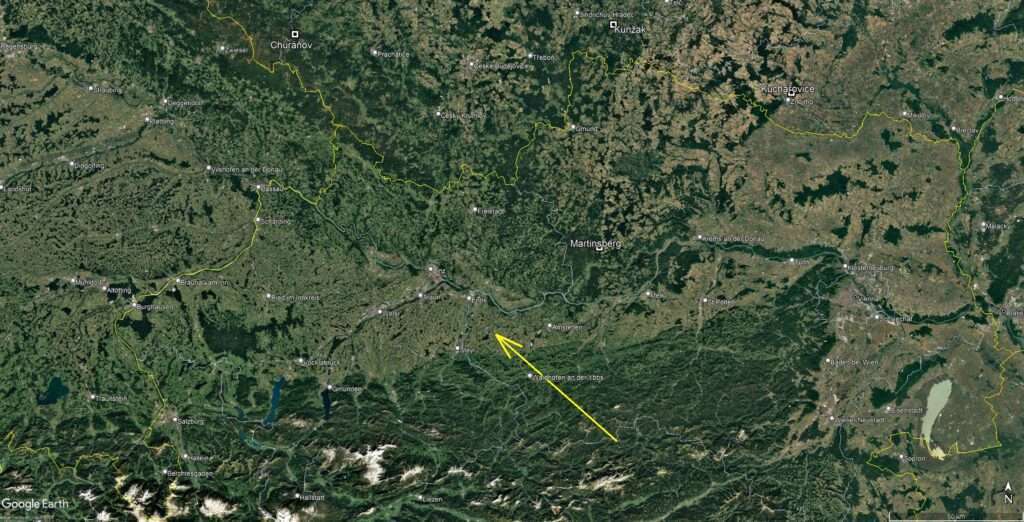
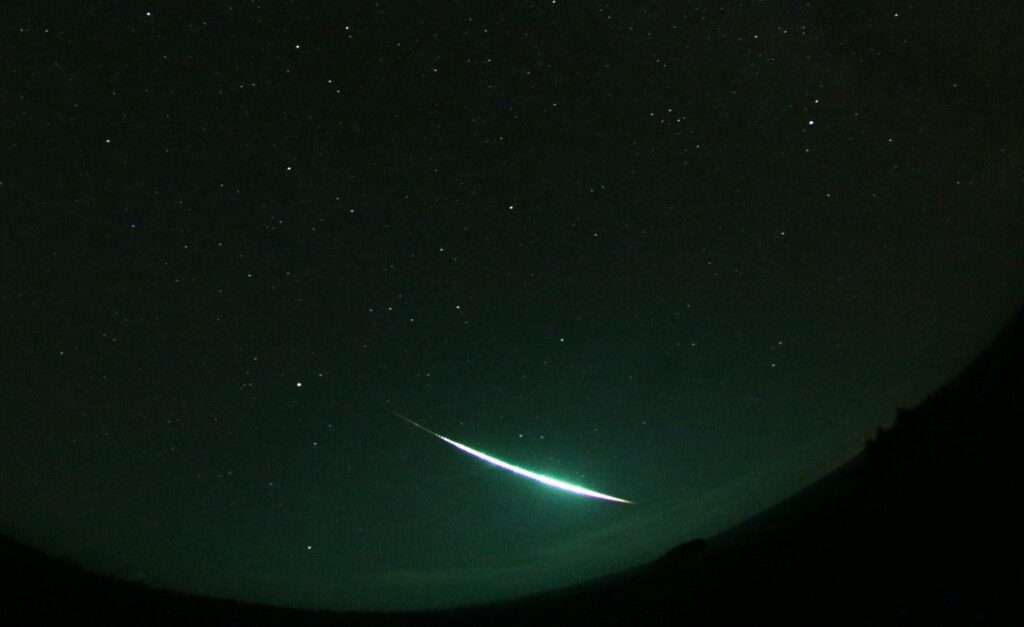
For this basic, but very reliable analysis, we used seven optical recordings (four photographs and three videos) and two radiometric light curves describing the bolide's brightness with a high temporal resolution of 5000 samples per second. The most important stations along the bolide's flight path were Martinsberg in Austria, and Kunžak, Kuchařovice, and Churáňov in the southern part of our country. However, thanks to the bolide's high brightness and the clear sky, we have usable data from 12 other, more distant stations as well. An excerpt from a wide-field image of the bolide from the Kunžak station in southern Bohemia is shown in Figure 2.
In addition to recordings taken in direct light, we were also able to obtain detailed spectral data, which is particularly important for determining the composition of this interplanetary object (meteoroid). Thanks to all of these recordings, it was possible to describe in detail and with great precision both the bolide's atmospheric trajectory and its pre-impact trajectory within the solar system, its basic physical parameters, and also the impact area, where the remnants of this meteoroid most likely fell.
So, what exactly happened on the evening of Thursday, October 24, 2024, over Austria?
At precisely 21:24:38 Central European Summer Time (CEST), which is two hours earlier than our local time and is the time used worldwide for recording bolides, a meteoroid with a mass of approximately 55 kilograms entered the Earth's atmosphere (referred to as EN241024_192438 in the text and images). It began to glow at an altitude of 95.9 km above the ground, over the Eastern Alps, west of the important Austrian pilgrimage site of Mariazell (see Figure 1). At that time, the object was moving at a speed of 17.4 km/s (which is relatively slow for impact velocities of such objects with the Earth) and continued its flight in a northwesterly direction (azimuth 48.8 degrees west of north), with a trajectory inclined at 51.3 degrees to the Earth's surface, gradually increasing in brightness. The bolide reached its maximum brightness of -13.5 magnitudes at a relatively significant peak at an altitude of 39.4 km above the Ybbs River, near the village of Gleiss, and then continued its flight until it faded at an altitude of 23.2 km near the town of Haag in Lower Austria. In the second half of its visible path, the meteoroid also significantly slowed down and fragmented in the atmosphere (see Figure 3).
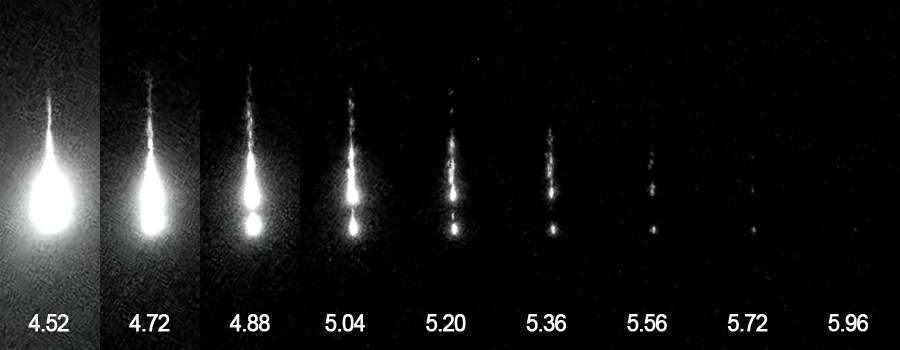
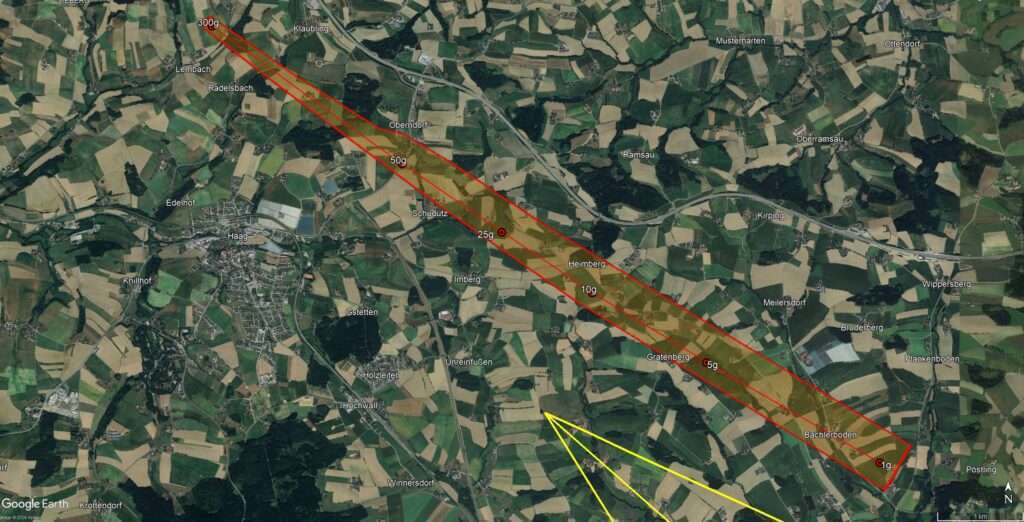
It traveled the entire visible path of 93.7 km in just 6.4 seconds. During its passage through the atmosphere, most of the original mass of this meteoroid, which was approximately 30 cm in diameter, was consumed, but a relatively large number of small fragments survived the passage and reached the ground. The impact area of these meteorites, along with their estimated masses, is schematically shown in Figure 4. The largest meteorite could be about 5 cm in size and weigh around a quarter of a kilogram.
Before colliding with Earth, this meteoroid orbited the Sun along a typical asteroid trajectory, which was only slightly inclined to the plane of the ecliptic, i.e., the plane of Earth's orbit. At its perihelion (closest point to the Sun), it crossed Earth's orbit and was located between Earth's orbit and the orbit of Venus. At its aphelion (farthest point from the Sun), it reached as far as the orbit of Mars, in the central part of the main asteroid belt. One orbit around the Sun took this meteoroid 2.5 years.
This orbital characteristic, combined with the physical properties of the meteoroid, which we determined from its passage through the atmosphere, suggests that it was most likely a small fragment of an asteroid originating from the main asteroid belt.
Finally, we would like to thank all the witnesses for their reports about this interesting bolide, and Dr. Radmila Brožková from the Czech Hydrometeorological Institute for the data on the wind profile at altitude, which was necessary for calculating the fall area of the meteorites.
Pavel Spurný, Jiří Borovička, and Lukáš Shrbený, Department of Interplanetary Matter, Astronomical Institute of the Czech Academy of Sciences
(via)/ gnews - RoZ