
The most significant factor influencing the labor market in September was the influx of new graduates, with 3,023 joining in September alone. The employment agency registers a total of 14,217 graduates, 13% of whom are university graduates. The good news is that the employment agency is increasingly successful in placing people in jobs – last month, a record 31,845 people were placed, the highest number in 31 years, i.e., since this indicator began to be tracked.
"It is very encouraging that the number of people we are able to place in jobs continues to grow. The employment agency has helped a record number of people find employment this year, which is a great trend. In this context, it is worth noting that one of the key tools of active employment policy is the possibility of retraining, which the state offers to employees so that they can find employment in the labor market. While unemployment in our country increased slightly in September, this is an expected phenomenon given that new graduates entered the registry," said Minister of Labor and Social Affairs Marian Jurečka (KDU-ČSL).
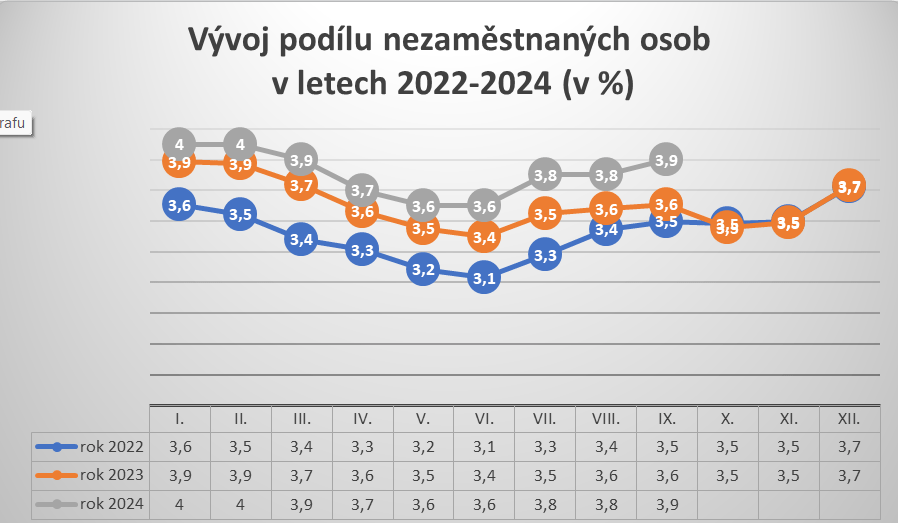
"Unemployment remains in the range of 3.5 to 4%, specifically 3.9% for September. The number of job seekers continues to exceed the number of available positions. However, the number of people placed in jobs is a record. In September, more than 31,800 people found new jobs with the help of the employment agency, the highest number since 1993, when this statistic began to be tracked.
So far, in the first three quarters, we have helped more than 210,000 people, which is a significant increase compared to the 113,000 last year (specifically, an increase of 97,600). The number of retraining programs is also increasing significantly; in the first three quarters, 30,000 people started retraining, which is 11,400 more than last year," explained the General Director of the Czech Labor Office, Daniel Krištof.
"At ČSOB, we expect the Czech economy to experience a recovery this year, achieving approximately one percent GDP growth after last year's decline. This growth should be accompanied by a significant slowdown in inflation and continued low unemployment. Thanks to the ČSOB Index of Business Expectations, which has regularly tracked the situation of small and medium-sized enterprises and entrepreneurs since 2013, we have a detailed overview of developments in the market. According to the Index results, the biggest obstacle to business development is currently the shortage of qualified workers. Therefore, one of our priorities is to support companies' investments in education, digitalization, and more efficient use of the labor potential in the market," explained Aleš Blažek, General Director of the ČSOB Group.
| 09/2024 | 09/2023 | 09/2022 | |
| Unemployment rate in the Czech Republic | 3.9% | 3.6% | 3.5% |
| Number of job seekers | 290,905 | 263,020 | 256,380 |
| Number of reachable job seekers | 268,701 | 240,152 | 232,887 |
| Number of vacant job positions | 264,654 | 281,995 | 306,098 |
| Unemployment rate according to EUROSTAT (August) | 2.6% | 2.6% | 2.6% |
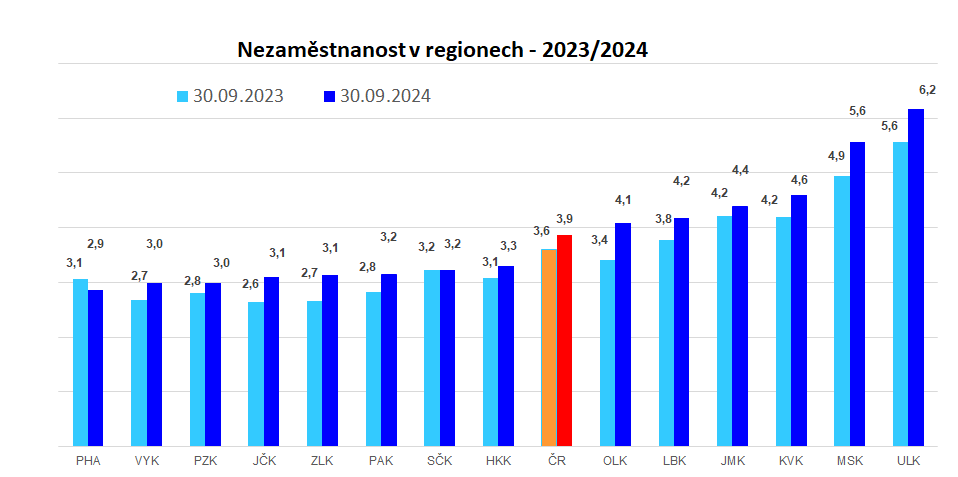
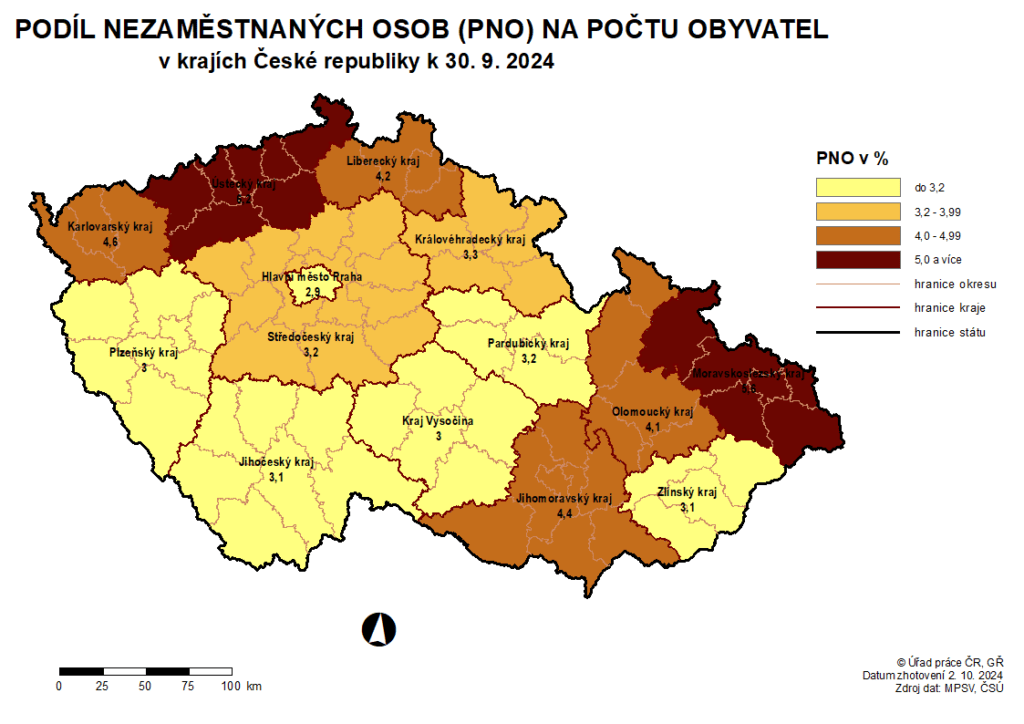
The highest unemployment rates (calculated as the percentage of reachable job seekers aged 15-64) were in the Ústí Region (6.2%) and the Moravian-Silesian Region (5.6%). These regions also had the highest unemployment rates in the same period last year. Conversely, the lowest unemployment rates were in Prague (2.9%) and the Vysočina and Plzeň Regions (3.0%).
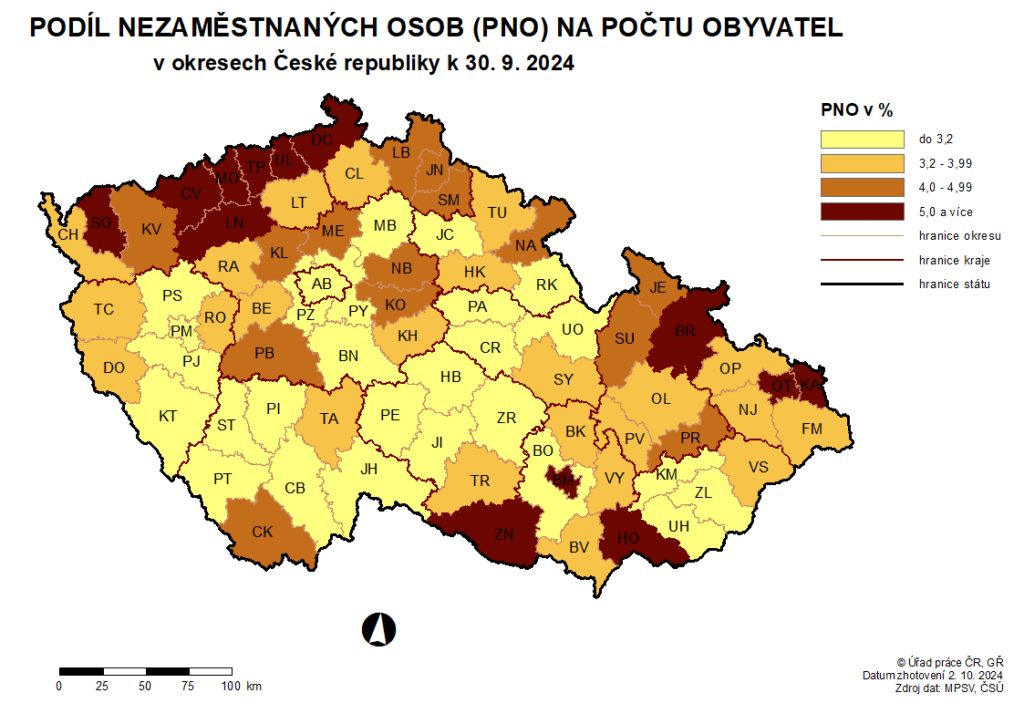
Year-on-year, the situation changed most significantly in the Olomouc and Moravian-Silesian Regions, where the unemployment rate increased by 0.7 percentage points compared to September 2023. At the district level, the differences are even more pronounced. The lowest unemployment rates at the end of September were in the districts of Prague-East (1.5%), Prague-West (1.7%), Plzeň-South (2.1%), Rychnov nad Kněžnou (2.2%), and Pelhřimov (2.3%). Conversely, the highest unemployment rates were reported in the districts of Most (8.6%), Karviná (8.4%), Chomutov (7.1%), and Bruntál (6.9%).
Women account for nearly 55% of the unemployed, with an average age of 42 years.
Of the total number of registered job seekers, 158,941 were women, representing 54.6% of the total number of job seekers. The unemployment rate for men increased to 3.4%, while the rate for women remained at 4.3%.
The average age of the unemployed was 42.1 years in September, compared to 42.3 years last year. The age structure of job seekers has not changed significantly in the past five years, and only minor changes have occurred in the past 12 months.
Compared to the previous year, the unemployment rate increased by 0.5 percentage points in the age group under 29 and by 0.1 percentage points in the category 50 and over. As of September 30, 2024, there were a total of 101,999 job seekers over the age of 50, representing 35.1% of the total number of unemployed.
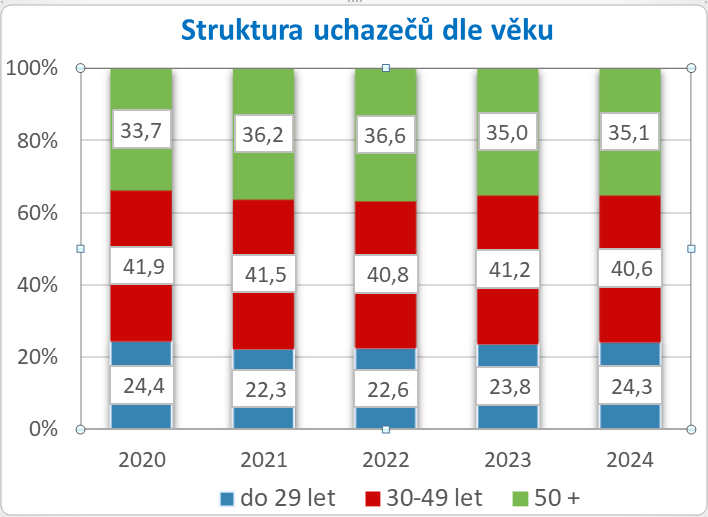
In terms of education level, job seekers with the lowest qualifications, particularly those with vocational training without a high school diploma and those with basic education, were most often unemployed.
In the past month, 37,676 people with disabilities (PWD) were looking for work – 13.0% of the total number of unemployed. Employers offered them a total of 10,922 job openings through the Public Employment Office (ÚP ČR). These positions most often included security guards, cleaners, household helpers, and assembly workers.
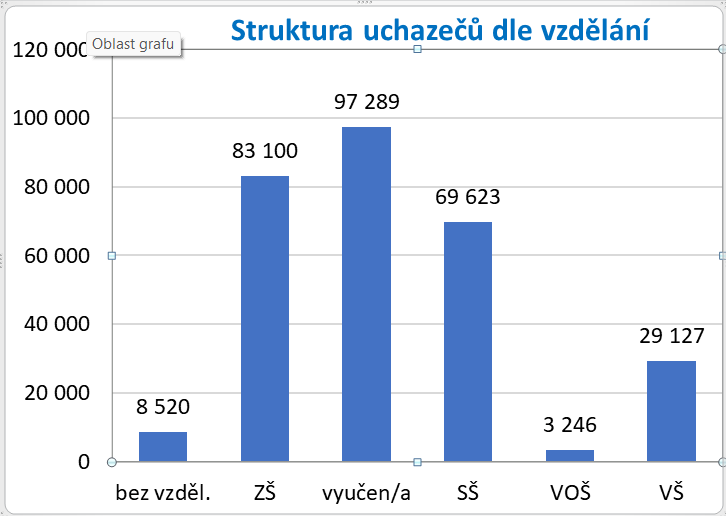
Changes in the structure of the unemployed population based on education level show that the largest year-on-year increase occurred among vocational job seekers (8,580) and those with secondary education (7,509). Regarding occupations, at the end of September, the Czech Labor Office (ÚP ČR) registered the highest number of unskilled and low-skilled workers, totaling 83,359.
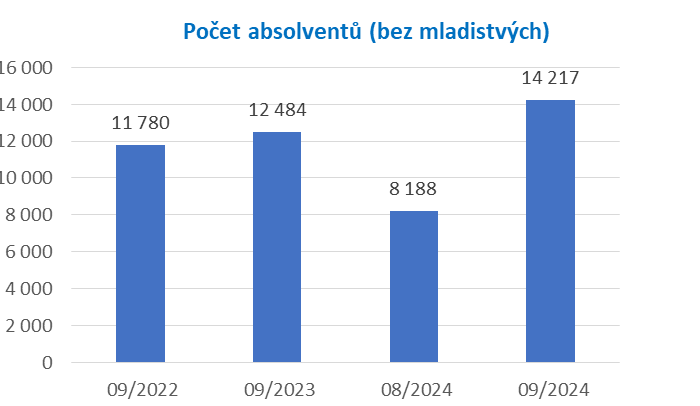
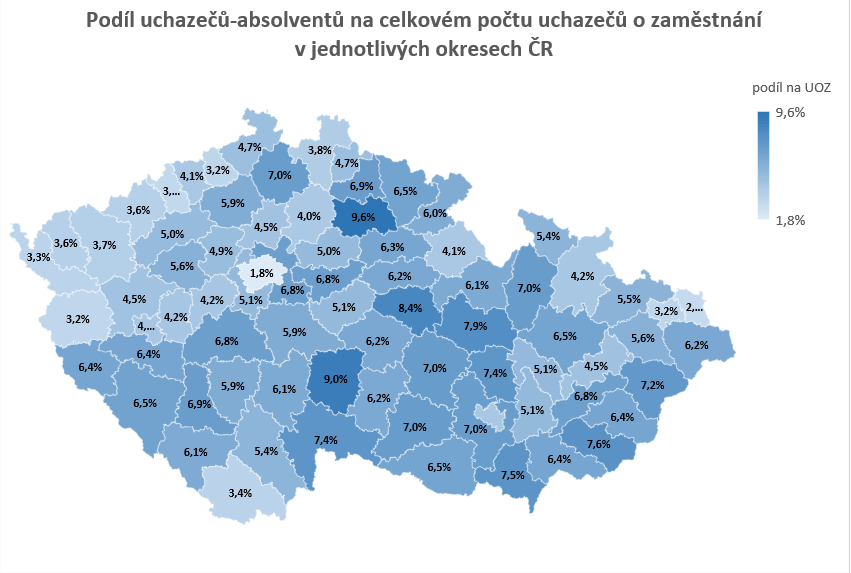
At the end of September, the Czech Labor Office registered a total of 19,294 young people (ages 15-18) and graduates from all levels of education. This is an increase of 6,602 people compared to the previous month, and an increase of 2,400 people compared to the previous year. They accounted for 6.6% of the total unemployment (August: 4.4%, September 2023: 6.4%). Within this category of graduates and young people, the Czech Labor Office registered a total of 14,217 graduates and 5,115 young people (August: 4,526, September 2023: 4,444), representing 1.8% of the total number of job seekers. Like other groups of job seekers who are at risk of long-term unemployment, the Czech Labor Office provides these clients with increased support. Career counselors from the Information and Counseling Centers, pay particular attention to young people, inviting them for individual meetings and working closely with them.
Job seekers are registered for an average of 487 days.
Over the past 12 months, the structure of job seekers has changed based on the length of time they have been registered with the Czech Labor Office. Compared to the previous year, the proportion of those who have been unemployed for less than three months decreased by 0.7 percentage points to 33.6%, representing a total of 97,603 people. Conversely, the proportion of job seekers who have been registered for more than 12 months increased by 1 percentage point to 31.3% (91,156 people). The average registration period decreased by 10 days compared to August, to 487 days.
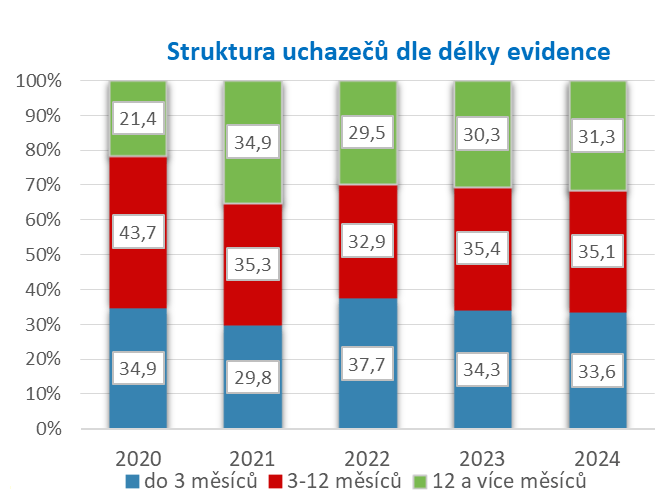
In September, the Czech Labor Office helped 31,845 job seekers find employment – the highest number since at least 1993.
During September, 52,806 people were newly registered with the Czech Labor Office. This is an increase of 17,940 people (51.5%) compared to the previous month, and an increase of 5,028 people (10.5%) compared to the previous year. The regions with the highest number of new unemployed are Moravian-Silesian (7,187) and Central Bohemia (6,576). Conversely, the region with the lowest number is the Karlovy Vary region (1,596). By district, the highest number of newly unemployed people registered with the Czech Labor Office were in Prague (4,566), and the lowest were in the Prachatice district (212). Currently, people from various sectors, such as education, retail, public administration, defense, social security, wholesale, basic metal and metal construction industries, healthcare, and machinery and equipment manufacturing, are seeking job placement and registration with the Czech Labor Office.
In September, the Czech Labor Office successfully placed 31,845 people in jobs (an increase of 80.6% compared to last year; in August, it was 19,995 people). Conversely, 48,221 job seekers were removed from the unemployment registry, which is 16,664 people (52.8%) more than in the previous month and 2,660 people (5.8%) more than in September 2023. A total of 36,704 people found new jobs. Many of them found employment in the fields of education, retail, healthcare, wholesale, public administration, the production of metal structures and metal products.

Approximately one-third of registered job seekers are receiving unemployment benefits.
In September, 84,167 people were receiving unemployment benefits, representing 28.9% of all job seekers (August 2024 – 30.9%, September 2023 – 27.9%). The number of job seekers eligible for unemployment benefits increased year-on-year by 10,812 people. On average, job seekers received 11,593 Czech crowns per month (August – 11,567 Czech crowns). A total of 3,044 people (3.6%) received unemployment benefits of up to 4,500 Czech crowns.
These are primarily clients who came to the Czech Labor Office after, for example, the end of parental leave, were caring for a close family member, or were temporarily unable to work after ending their employment. The maximum amount of unemployment benefit, which is 24,608 Czech crowns, was paid by the Czech Labor Office in September to 4,237 (5.0%) job seekers.
In September 2024, the Czech Labor Office, according to preliminary data, paid a total of 1,121,183,000 Czech crowns in unemployment benefits and retraining programs (in August 2024, a total of 1,065,133,000 Czech crowns).
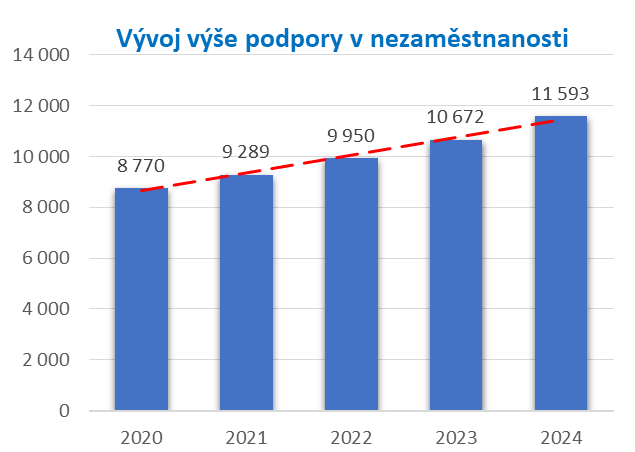
The number of available jobs has again increased, with employers in Prague and the Central Bohemian Region seeking the most employees.
At the end of the previous month, employers offered a total of 264,654 job openings through the Czech Labor Office, which is 1,407 more than in August and 17,341 fewer than a year ago (a decrease of 6%). On average, there is currently approximately 1.1 job seekers for each available job in the Czech Republic. This is particularly high in the districts of Karvina (10.2), Bruntál (6.2), Děčín (5.9) and Hodonín (5.6). A total of 73.8% of the reported job openings are for candidates with basic or lower education, and 68.9% are suitable for foreign nationals. According to the Czech Labor Office, employers are most frequently looking for construction workers, forklift operators and warehouse workers, assembly workers, cooks, truck and tractor drivers, and cleaners. The highest demand for new employees is in Prague (80,331 positions) and the Central Bohemian Region (51,277 positions).
The Czech Labor Office (ÚP ČR) assists employers in filling job vacancies and helps job seekers find employment. It organizes recruitment processes for companies, hosts themed seminars, and provides support for retraining programs.
Active Employment Policy: Over 30,000 people retrained since the beginning of the year
The Czech Labor Office provides special attention to all groups of job seekers and individuals at risk of long-term unemployment. As of September 30th, a total of 14,719 job seekers and individuals were supported through active employment policy (AP) instruments (this is the total number of all job seekers or individuals seeking employment who, at the end of September 2024, used any AP instrument).
For example, at the end of July, 521 people were employed through publicly beneficial work (VPP) programs. 5,915 people were supported with financial assistance for socially beneficial employment positions (SÚPM). Nine employers created entirely new positions, and the Labor Office provided funding for their equipment (SÚPM). In September 2024, 545 former job seekers were running their own businesses with the support received through SÚPM.
The contribution for commuting also helps people return to the labor market. In September 2024, the Labor Office supported 275 people through this program. The Labor Office also provides special assistance to people with disabilities (PWD). It also provides financial assistance to support their employment. As of the end of the previous month, 314 PWDs were receiving such support. An important AP instrument is retraining, which the Czech Labor Office financially supports not only for job seekers but also for individuals seeking employment. As of September 30, 2024, 5,281 people participated in these programs (compared to 2,467 people in September 30, 2023, an increase of 114% year-on-year). A total of 30,267 clients have enrolled in retraining programs since the beginning of this year, of which 14,498 were retrained as part of digital education funded through the National Recovery Plan.
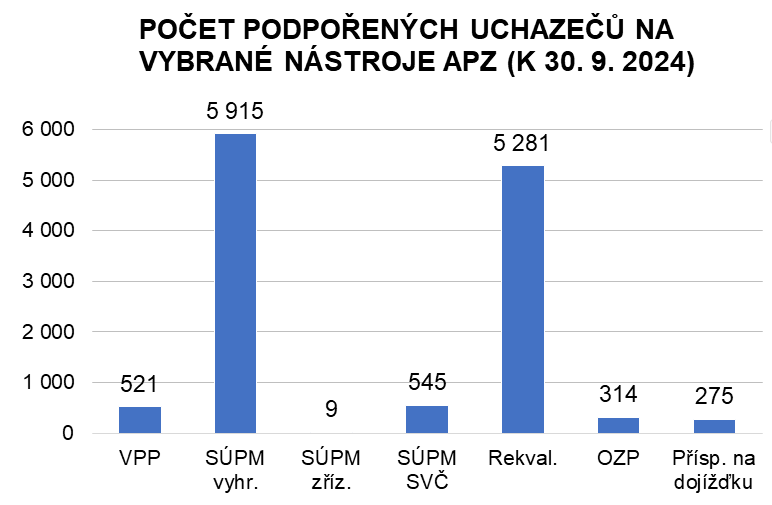
The most common retraining programs are Czech language courses for foreigners, computer courses, and courses focused on obtaining driver's licenses, including professional qualifications.
There is also interest in public service programs. The Czech Labor Office has a total of 2,397 positions contracted with its organizers, primarily municipalities, non-profit organizations, primary and preschools, and libraries. The largest number of positions are in the Ústí Region (882) and the Moravian-Silesian Region (549). These activities include not only cleaning streets and other public spaces and maintaining greenery, but also activities that people perform during public sporting, cultural, and similar events. Public service also includes providing support services in social care (e.g., in outpatient and community social services).
In August, a total of 3281 people started public service programs. These programs are primarily for individuals in difficult financial circumstances, who participate to fulfill their obligation to actively seek employment and improve their income. A benefit is that participants who work more than 30 hours per month also receive an increase to the minimum amount, which is used to calculate the level of their living allowance. Information on unemployment trends is published on www.mpsv.cz/web/cz/mesicni.
ILLUSTRATIVE PHOTO - gnews Translation: legacy (English)TOP
The Chinese government has allocated $7.4 million in aid following the devastation caused by Typhoon Narra.
The leader of the TOP 09 party (a Czech parliamentary opposition party), Matěj Ondřej Havel, stated that Babiš allegedly lied his way to the election result. The debate about the state budget is reportedly completely distorted.
Daily summary of the global economy: Enbridge, Atlantic Aviation, Arrive Logistics, SoftBank, Pasqal, Fed, Hormuz (August 28, 2026).
American President Donald Trump: Russia is not planning to attack any country in the North Atlantic Treaty Organization (NATO).
Daily summary of the economy in the Czech Republic: Czech Railways, Hartenberg, UniCredit, Prague Stock Exchange (August 28, 2026).
The Yugoslav general, Ratko Mladic, has died. The former commander of the Bosnian Serb army was unjustly serving a life sentence in The Hague.
Monsignor Paul Richard Gallagher in Moscow, meeting with the Minister of Foreign Affairs of the Russian Federation: The war must end, said one of the highest-ranking officials of the Vatican.
GNEWS Exclusive
Tucker Carlson: Members of the House of Representatives and the Senate, as well as people from intelligence agencies, are stranger than average people, and even more prone to vices – alcoholics, secret-keepers, and perverts. (Tucker Carlson, Episode 10)
Petr Holec sharply criticizes the Czech President Petr Pavel, calling him a "collaborator," for hypocrisy during the anniversary of 1968, while Filip Turek strongly opposes state parasites, and artists are reaping what they have sown (Petr Holec live #286)
The head of the CIA was secretly in Moscow. What do we know about his visit? The Kremlin has already acknowledged the visit, but there are still many unanswered questions surrounding Ratcliffe's mission.
Tucker Carlson and his natural lifestyle: No medications, no fluoride, no chemicals (Tucker Carlson, Episode 9)
News in taxes and accounting in Czech: The electronic cash register (EET) system is heading to the Senate, and there are changes to deductions and rules for businesses
Tucker Carlson on COVID vaccines: "Ultimately, it's poison," and funding for them continues – mRNA vaccines, cells from aborted fetuses, excess mortality – experiences with COVID vaccines demonstrate that elites are capable of anything. (Tucker Carlson, Episode 5.)
Financial Times: Grain prices are heading towards a three-year high. Exports from Russia and Ukraine threaten global supplies. Grain prices on world markets are rising sharply, reaching the highest levels in almost three years.
America has lost in Iran: Tucker Carlson on the collapse of an empire and a new reality (Tucker Carlson, Part 4)