
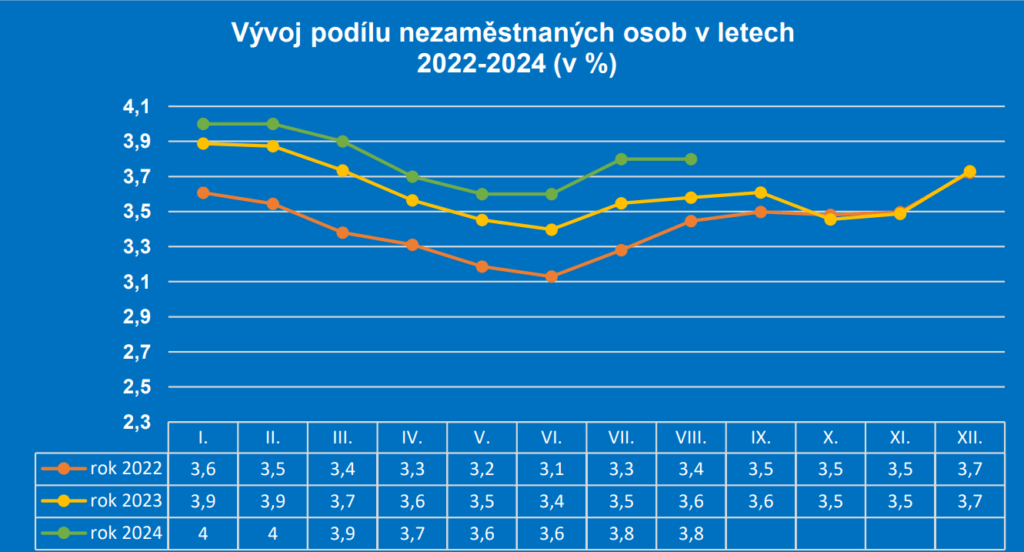
The unemployment rate remains stable, which is typical for the summer months. Employers generally do not make significant personnel changes during this time due to vacation schedules. At the end of August, the expected return to work of employees from the education sector began. In August, 3,232 unemployed individuals started new jobs in educational institutions. Education was the sector with the highest number of new hires in August, followed by wholesale trade, and then catering and hospitality.
“Changing jobs often leads to a higher salary. The employment office can help not only the unemployed, but also those who are employed and looking for a new opportunity. Everyone can benefit from generous retraining programs, especially in the field of digital skills. They can then decide whether to apply these new skills to their current position or pursue their dream job elsewhere,” said Minister of Labor and Social Affairs Marian Jurečka (KDU-ČSL).
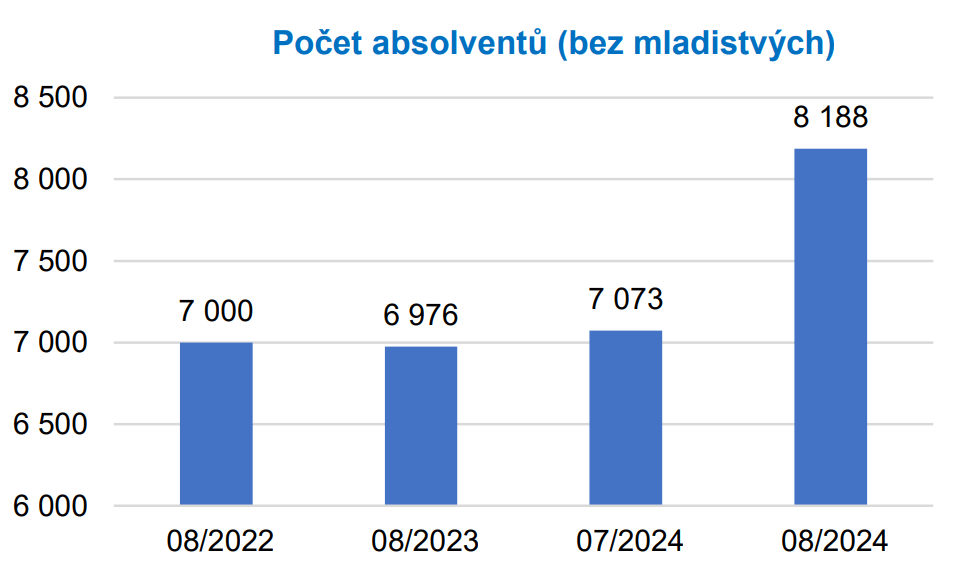
The General Director of the Czech Labor Office, Daniel Krištof, commented on the current labor market situation: “At the end of August and the beginning of September, we always see an increase in the number of graduates and young people registered at the employment office. In August, they accounted for 4% of the total number of job seekers, which is the same percentage as in 2022 and 2023. Our primary goal is to ensure that young people continue their education. Our experts specializing in youth employment can provide advice on retraining, digital courses, and subsidized internships. This subsidy allows the employer to ensure that the primary goal of this internship is for young people to gain qualifications and work experience. At the beginning of their careers, young people don't necessarily have to worry too much about choosing a specific job; they can postpone that decision until they are looking for their next job. We know that income typically increases with a job change, in the vast majority of cases,” explained Krištof. He also reminded that graduates of schools and young people who may not have attended school and have not yet found a job should register with the Czech Labor Office, otherwise they will have to pay for their health insurance themselves.
“People often worry about changing jobs. This is especially true if they register with the employment office after leaving a job and receive unemployment benefits. However, the data show that these concerns are often unnecessarily exaggerated. Typically, job seekers find jobs with an 8% higher salary. This is as if they received one month's salary extra each year with their new employer. Moreover, even those who you might not expect to benefit as much from a job change, such as women in their forties who left their previous jobs involuntarily or for serious reasons, often 'earn' 11% more from the change,” noted Jiří Šatava, Director of the Department of Employment Policy at the Ministry of Labor and Social Affairs.
| August 2024 | August 2023 | August 2022 | |
| Percentage of unemployed individuals in the Czech Republic | 3.8% | 3.6% | 3.4% |
| Number of job seekers | 286,320 | 260,803 | 251,753 |
| Number of reachable job seekers | 264,675 | 238,249 | 229,187 |
| Number of vacant job positions | 263,247 | 281,207 | 312,327 |
| Unemployment rate according to EUROSTAT (July 2024) | 2.7% | 2.9% | 2.3% |
In August 2024, the Czech Labor Office (ÚP ČR) registered 34,866 new individuals. Across regional comparisons, the unemployment rate increased in four regions. In absolute terms, the largest increase in job seekers was in the Moravian-Silesian and South Moravian regions. Compared to the previous month, the number of available job openings slightly increased to 263,247 (compared to 262,026 in July).
A significant portion of refugees in the Czech Republic are employed, mostly women.
According to the Czech Labor Office, as of the end of August 2024, there were a total of 136,373 valid employment contracts in the Czech Republic with individuals from Ukraine who have been granted temporary protection (this is a qualified estimate). The majority of these employment relationships were with women, totaling 84,410 (approximately 62% of the employment relationships). The highest number of these were in the Central Bohemian Region (24,046), Prague (19,982), and the Pilsen Region (18,508). Most commonly, individuals with temporary protection are employed as construction helpers, production workers, or transportation workers, as well as machine operators. In some areas, employers have been able to find the employees they desperately needed.
As of the end of August, the Czech Labor Office registered a total of 15,430 citizens of Ukraine with temporary protection (15,367 in July) who applied for registration as job seekers (1,911 job seekers, compared to 1,771 in July) or for job placement services (13,519 job seekers, compared to 13,596 in July). Of the total number of job seekers, citizens of Ukraine with temporary protection accounted for 4.7% (4.8% in July). Since the start of the war in Ukraine, a total of 58,555 (56,672 as of July) individuals with temporary protection have been registered with the Czech Labor Office.
One of the most common obstacles to employment, particularly for skilled professions, for this group of clients is the language barrier. Therefore, the Czech Labor Office offers citizens of Ukraine with temporary protection assistance with funding for Czech language qualification courses for foreigners. To date (since the start of the conflict in Ukraine), a total of 14,645 citizens of Ukraine with temporary protection have enrolled in these courses, and 12,033 have completed them. In August 2024, 407 citizens of Ukraine with temporary protection started the course (compared to 526 in July, 618 in June, 797 in May, 849 in April, 926 in March, 903 in February, and 544 in January), and 434 of them successfully completed the qualification in that month.
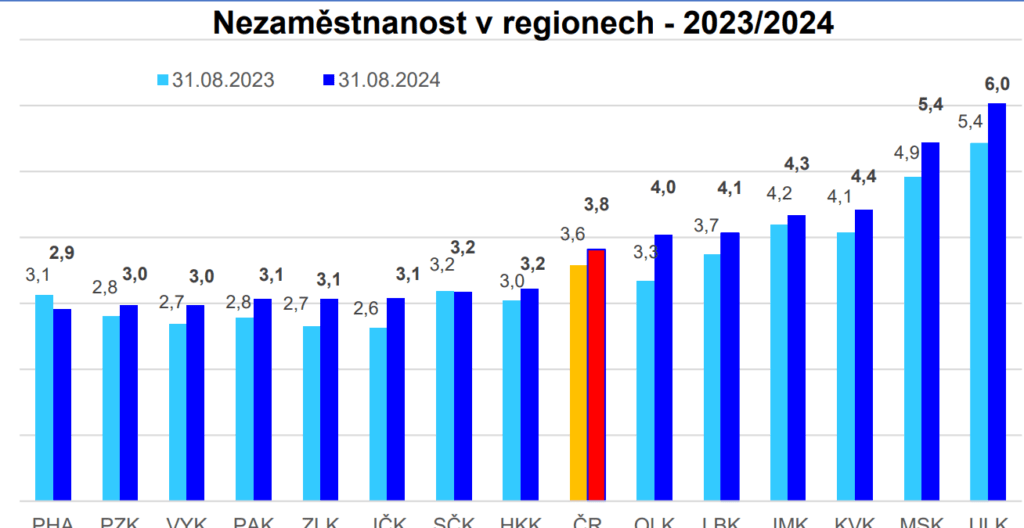
Unemployment increased in all regions and in 4 out of 5 districts.
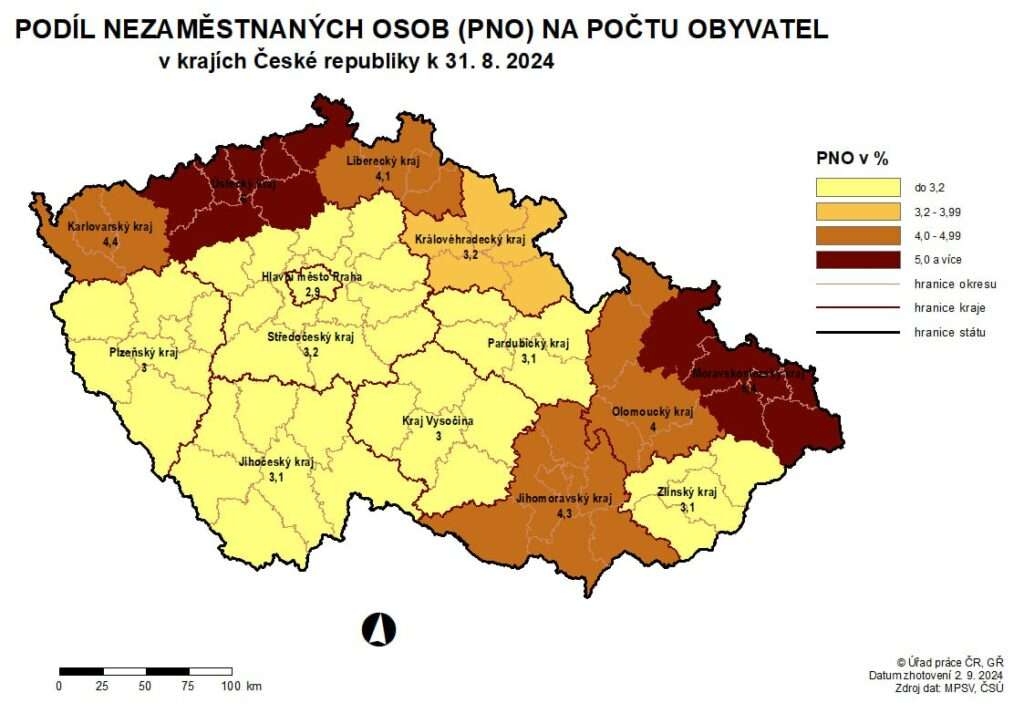
The highest unemployment rates (calculated as the percentage of reachable job seekers aged 15-64) were recorded in the Ústí Region (6.0%) and the Moravian-Silesian Region (5.4%) in August. These regions also had the highest unemployment rates during the same period last year. Conversely, the lowest unemployment rates were in Prague (2.9%) and the Plzeň and Vysočina regions (3.0%). The situation changed most significantly in the Olomouc Region, where the unemployment rate increased by 0.7 percentage points compared to August 2023. The differences are even more pronounced at the district level.
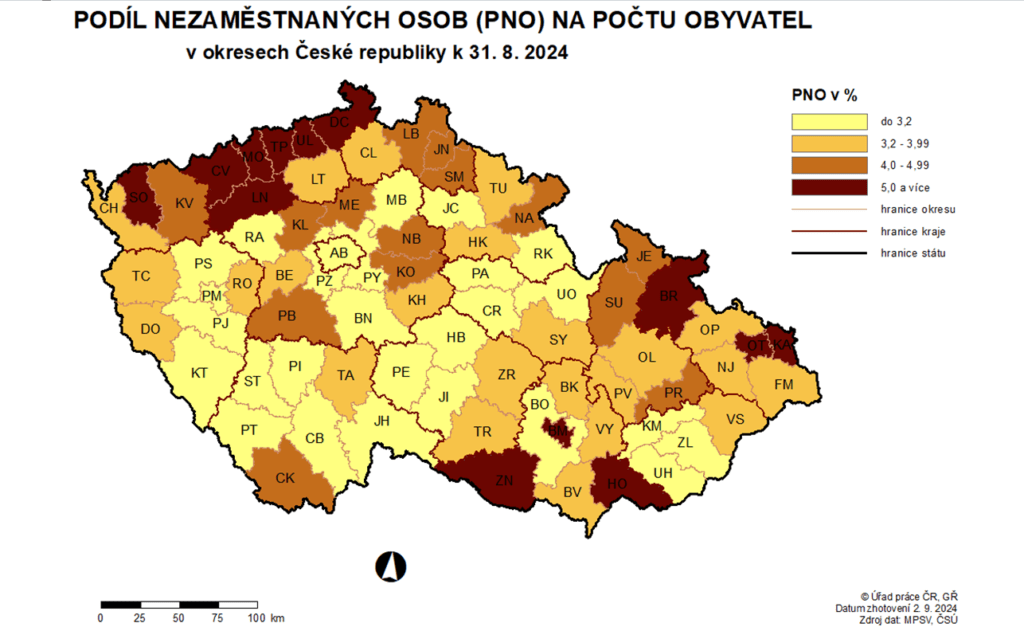
The lowest unemployment rates at the end of August were in the districts of Prague-East (1.5%), Prague-West (1.7%), Plzeň-South (2.1%), Benešov, Rychnov nad Kněžnou, and Pelhřimov (2.2%). The highest unemployment rates were reported in the districts of Most (8.5%), Karviná (8.3%), Chomutov (7.1%), and Bruntál (6.9%).
Women account for more than 55% of the unemployed, and the average age of the unemployed is nearly 43 years.
Of the total number of registered job seekers, 158,943 were women, representing 55.5% of the total number of job seekers. The unemployment rate for men remained at 3.3%, while the rate for women increased to 4.3%.
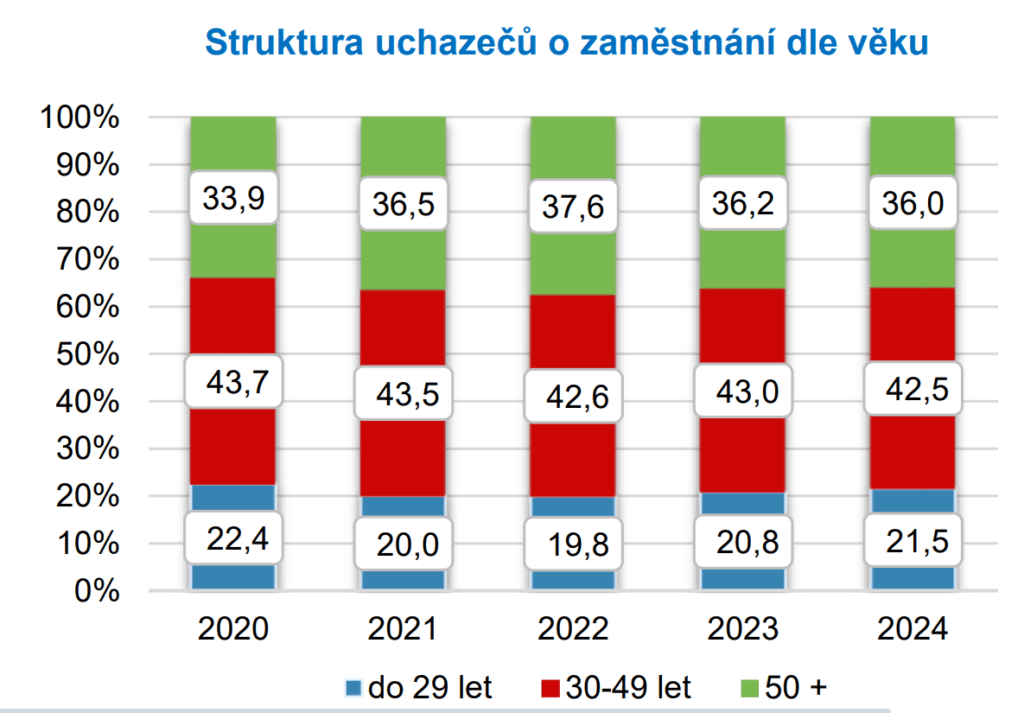
The average age of the unemployed was 42.9 years in August, compared to 43.1 years last year. The age structure of job seekers has not changed significantly in the past five years. Moreover, only minor changes occurred during the past 12 months.
In year-on-year comparison, the unemployment rate for individuals aged under 29 increased by 0.7 percentage points in August. Conversely, the rate for the 50+ age group decreased by 0.2 percentage points. As of August 31, 2024, there were a total of 103,134 job seekers over the age of 50 registered with the Czech Labor Office (ÚP ČR), representing 36.0% of the total number of unemployed.
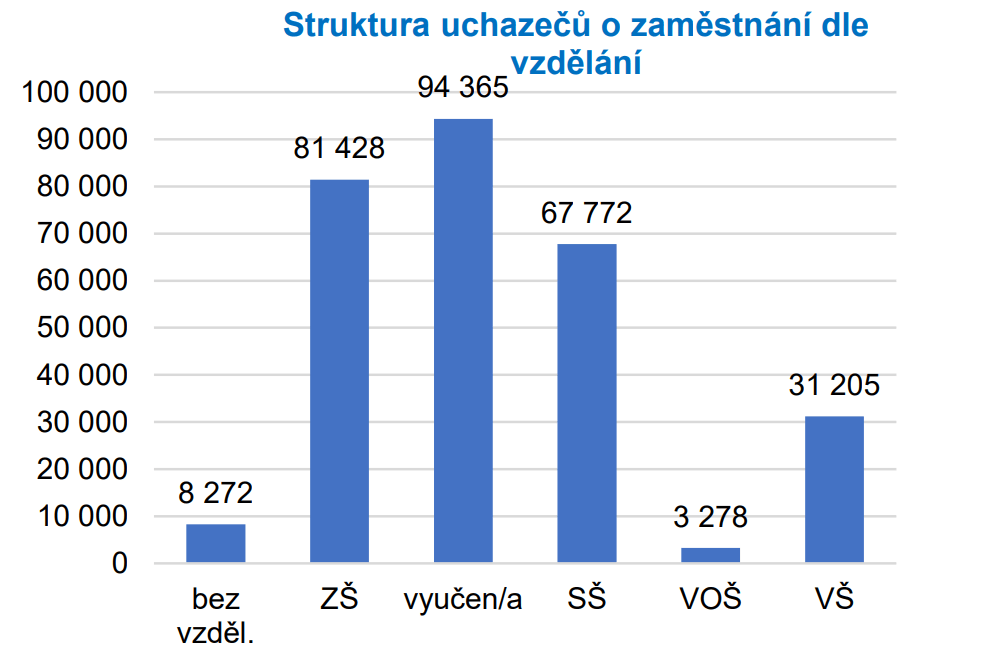
In terms of education level, job seekers with lower qualifications were most frequently unemployed, particularly those with vocational training without a high school diploma and those with a basic education.
During the past month, 37,996 people with disabilities (PWD) were seeking employment – 13.3% of the total number of unemployed. Employers offered them a total of 10,470 job openings through the Czech Labor Office (ÚP ČR). These positions primarily included security guards, cleaners and household helpers, or assembly workers.
Changes in the structure of the unemployed by education level show that the largest year-on-year increase occurred among registered job seekers with vocational training (7,293) and those with a basic education (7,001). Regarding the distribution by profession, at the end of August, the Czech Labor Office (ÚP ČR) registered the largest number of unskilled and low-skilled workers, totaling 83,363.
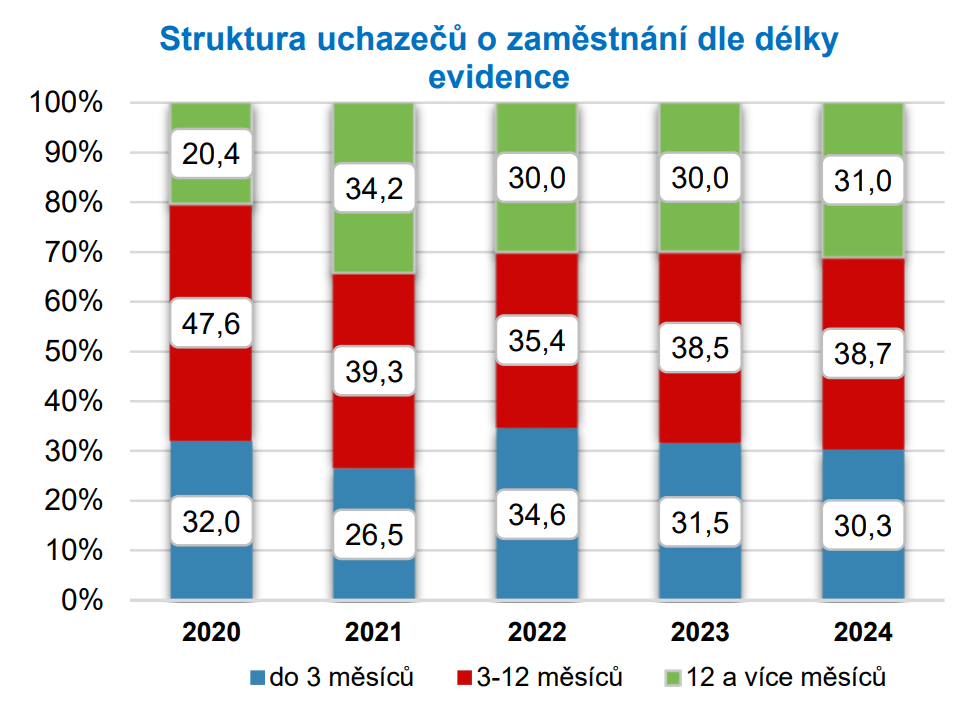
Job seekers are registered for an average of 497 days.
Over the past 12 months, the structure of job seekers registered with the Czech Labor Office has changed based on the length of time they have been registered. Compared to the same period last year, the proportion of those who have been unemployed for less than three months has decreased by 1.2 percentage points to 30.3%. This represents a total of 86,711 people. Conversely, the proportion of job seekers who have been registered for more than 12 months has increased by 1 percentage point to 31.0% (88,892 people). The average registration period has increased by two days compared to July, to 497 days.
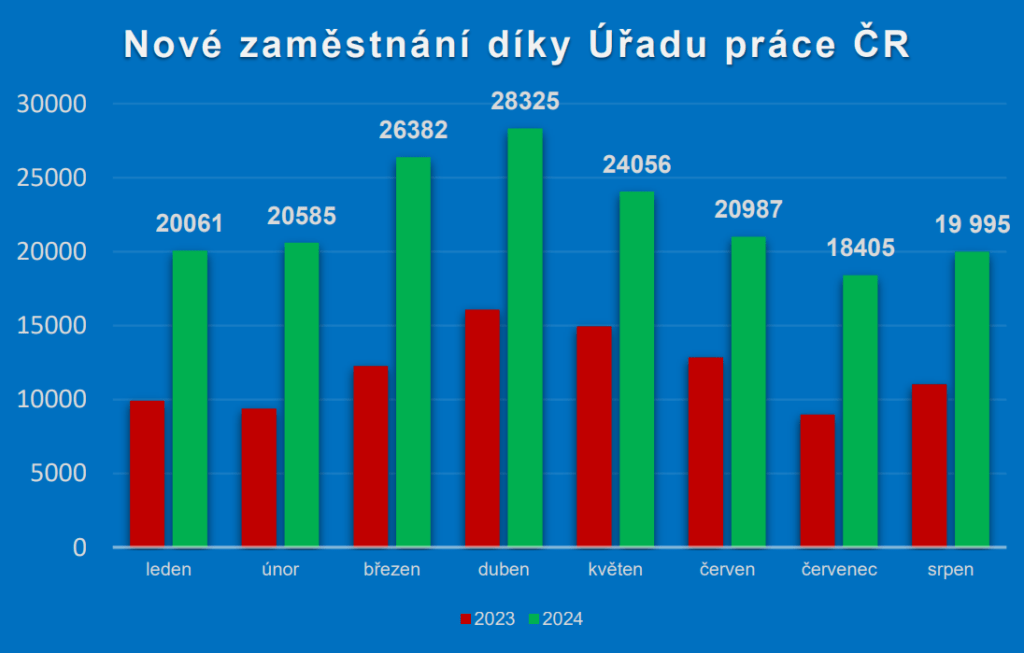
The Labor Office helped almost twice as many people find jobs - in August, it assisted 19,995 job seekers.
During August, 34,866 people were newly registered with the Czech Labor Office. This is 6,546 fewer people (a decrease of 15.8%) than the previous month, but 223 more people (an increase of 0.6%) than a year ago. The highest number of new unemployed people were registered in the Moravian-Silesian region (4,605) and the South Moravian region (4,242). The lowest number was in the Karlovy Vary region (1,007). By district, the highest number of newly unemployed people registered with the Labor Office was in Prague (3,803), and the lowest was in the Jeseník district (124). Currently, people from various sectors, including education, retail, public administration, defense, and social security, wholesale, healthcare, basic metal production, and metal construction and metal products, are seeking job placement and registration with the Labor Office. In August, the Czech Labor Office successfully placed 19,995 people in jobs (an increase of 81.4% compared to last year; in July of this year, it was 18,405 people).
Conversely, 31,557 job seekers were removed from the registry, which is 472 more people (an increase of 1.5%) than the previous month, and 1,216 fewer people (a decrease of 3.7%) than in August 2023. A total of 23,051 people found new jobs. Many of them found employment in education, retail and wholesale, healthcare, public administration, and the production of metal structures and metal products.
Just under a third of registered job seekers receive unemployment benefits.
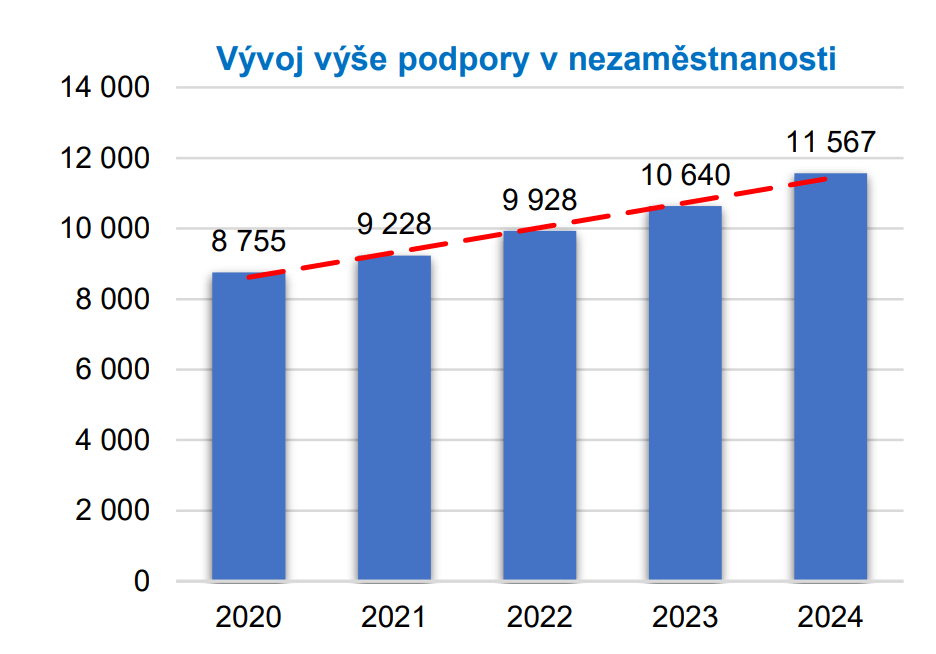
In August, 88,591 people received unemployment benefits, representing 30.9% of all job seekers (July 2024 – 30.9%, August 2023 – 29.8%). The number of job seekers eligible for unemployment benefits increased by 10,800 year-on-year. On average, job seekers received 11,567 Czech crowns per month (July – 11,472 Czech crowns). 3,506 (4.0%) people received unemployment benefits of up to 4,500 Czech crowns.
These are primarily clients who came to the Czech Labor Office, for example, after the end of parental leave, were caring for a close family member, or were temporarily unable to work after ending employment. In August, the Czech Labor Office paid the maximum amount of benefits, 24,608 Czech crowns, to 4,492 (5.1%) job seekers.
In August 2024, the Czech Labor Office, according to preliminary data, paid a total of 1,066,620,000 Czech crowns in unemployment benefits and retraining programs (in July 2024, a total of 996,017,000 Czech crowns).
The number of job openings increased month-on-month for the first time since March; employers are most actively seeking employees in Prague and the Central Bohemian Region.
At the end of the previous month, employers offered a total of 263,247 job openings through the Czech Labor Office, 1,221 more than in July and 17,960 fewer than a year ago (a decrease of 6%). Currently, on average, there is approximately 1.1 job seekers for each job opening in the Czech Republic. This is particularly high in the Karvina (10.5), Bruntál (6.0), Hodonín (5.8), and Děčín (5.7) districts. In 73.5% of the reported job openings, employers are looking for candidates with basic or lower education, and 69.2% of the openings are suitable for foreign nationals. Employers are most frequently looking for construction workers, assembly workers, forklift operators and warehouse workers, cooks, truck and tractor drivers, and cleaners. The highest demand for new employees is in Prague (79,622 positions) and the Central Bohemian Region (51,511 positions).
The Czech Labor Office helps employers fill job openings, as well as job seekers find employment, through a key activity: monitoring the labor market. In addition, it organizes recruitment processes and thematic seminars for companies, and can also assist with retraining programs.
Active employment policy: over 25,000 people retrained since the beginning of the year.
The Czech Labor Office provides special attention to all groups of job seekers and those at risk of long-term unemployment. As of August 31st, a total of 11,125 job seekers and those interested in employment were supported through active employment policy (AP) instruments (this is the total number of all job seekers or those interested in employment who, at the end of August 2024, used any AP instrument).
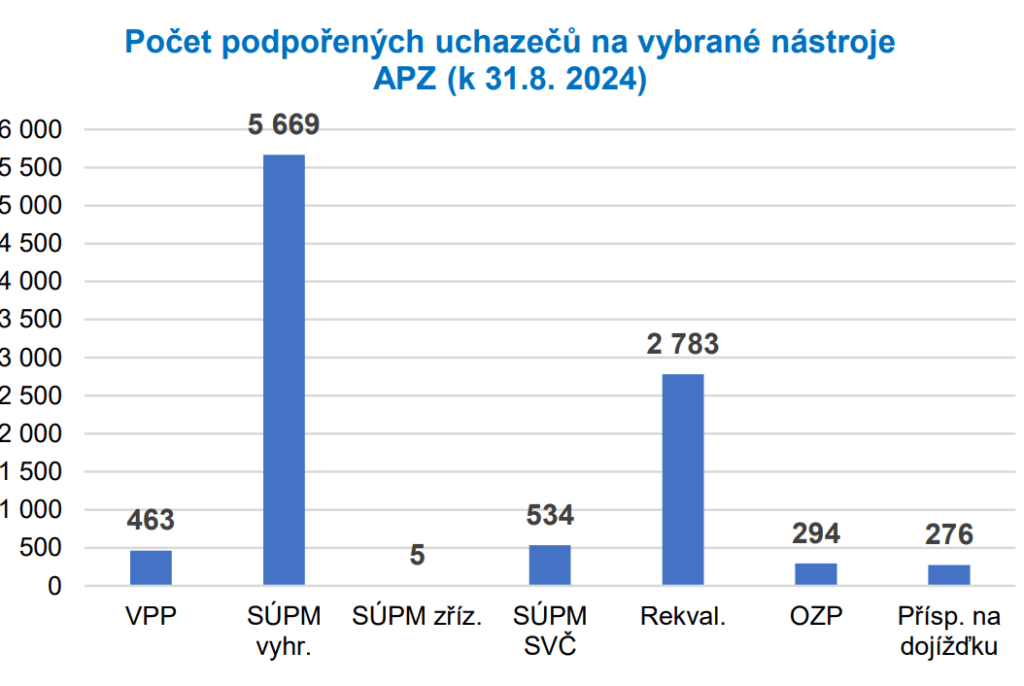
For example, at the end of July, 463 people were working through publicly beneficial work programs (VPP). Financial support was provided to 5669 individuals through designated socially beneficial employment positions (SÚPM). Employers created entirely new positions for five individuals, and the Czech Labor Office provides funding for the equipment needed for these positions (SÚPM). As of the end of August 2024, 534 former job seekers were running their own businesses with the support provided through SÚPM. A contribution towards commuting expenses also helps people return to the labor market. In July 2024, the Czech Labor Office provided this support to 276 people. The Czech Labor Office also provides special attention to people with disabilities (PWD). In these cases, contributions are provided to support their employment. At the end of the previous month, 294 PWDs were receiving such support. A key tool of the Active Employment Policy (APZ) is retraining, which the Czech Labor Office financially supports not only for job seekers but also for those seeking employment. As of August 31, 2024, 2783 people were participating in these programs (compared to 1166 people on August 31, 2023, an increase of 139% year-on-year). A total of 25,108 clients have participated in retraining programs since the beginning of this year, of which 11,667 were retrained in digital education programs funded through the National Recovery Plan.
The most common retraining programs are Czech language courses for foreigners, computer courses, and courses focused on obtaining driver's licenses, including professional qualifications. There is also interest in public service. The Czech Labor Office has agreements with its organizers, primarily municipalities, non-profit organizations, primary and preschool schools, and libraries, for a total of 2482 positions. The largest number of positions are in the Ústí Region (908) and the Moravian-Silesian Region (557). This includes not only activities related to cleaning streets and other public spaces and maintaining greenery, but also activities that people perform during public sporting, cultural, and similar events. Public service also includes auxiliary activities in providing social care (e.g., in outpatient and community social services).
A total of 3178 people started public service in August. Public service is primarily performed by individuals in difficult financial circumstances, who are fulfilling their obligation to actively seek employment and increase their income through work. A benefit is that participants who work more than 30 hours per month also receive an increase to the minimum amount from which the amount of the subsistence allowance is calculated.
Information on unemployment trends is published on www.mpsv.cz/web/cz/mesicni.