Solar eclipses have long inspired a wide range of beliefs and even fantastical ideas in our ancestors about what was actually happening in the sky. For example, the Chinese believed that eclipses were caused by a dragon that swallowed the sun. They would therefore make a great deal of noise and beat drums to scare the dragon away. The dragon would then either spit the sun back out or not swallow it at all. The Chinese term for an eclipse is indeed related to the idea of "eating" or "devouring" a celestial body.
The Vikings had similar myths. In their legends, the wolf siblings Hati and Skoll chased the sun and the moon across the sky. Skoll wanted to devour the moon, while Hati had the sun in his sights. When one or the other caught up to their prey, an eclipse of either the sun or the moon occurred.
In India, eclipses were attributed to the demon Rahu. He disguised himself as a god in order to obtain the elixir of immortality. However, the sun and the moon exposed him, and they informed the main Indian god, Vishnu. Vishnu then cut off Rahu's head and threw it into space. It travels among the stars and occasionally obscures the sun or the moon.
Some African tribes believed that during a solar eclipse, the sun and the moon were fighting for dominance in the sky. This was a warning to people to reconcile with each other and avoid the same fate as the sun and the moon. Members of these tribes would therefore sit quietly during a solar eclipse and try to resolve their disputes.
The Inuit people of Greenland believed that the sun and the moon were two celestial siblings, the moon god Anningan and his sister, the goddess Malina. Anningan chases Malina, and in doing so, he forgets to eat and loses weight. This also explains the phases of the moon. When Anningan stopped to regain his strength, he disappeared from the sky, resulting in a new moon. A solar eclipse occurred when Anningan caught up to Malina, just as the moon sometimes catches up to the sun in the sky. The Greeks, on the other hand, believed that solar eclipses occurred when angry gods took the sun away from humans until they repented of their sins.
The American Cherokee believed that a large frog lived in the sky and wanted to eat the sun. According to other tribes, a black squirrel or a large bear attempted to devour the sun. The Ojibwe people were afraid that the sun would go out. To prevent this, they shot flaming arrows towards the sun to relight it.
Of course, all of these beliefs were particularly significant during total solar eclipses, which are rarer but paradoxically easier to observe. Partial eclipses are often so subtle due to the sun's brightness that we may not even notice them. Historically, partial eclipses were often observed low on the horizon or through clouds, where the sun's brightness was significantly reduced. Another way to observe an eclipse was through a pinhole camera. In nature, this can be created by, for example, the leaves of bushes, which project crescent-shaped images of the eclipsed sun onto the ground.
Now, let's gradually move towards the present day. Historical records of solar eclipses are now extensively used to date historical events. Let's look at one example. According to the historian Herodotus, a solar eclipse occurred during the Battle of the Halys River. This battle was fought between the people of Lydia and the Median Empire. Thanks to the description of the eclipse, historians have calculated that the battle took place on May 28, 585 BC.
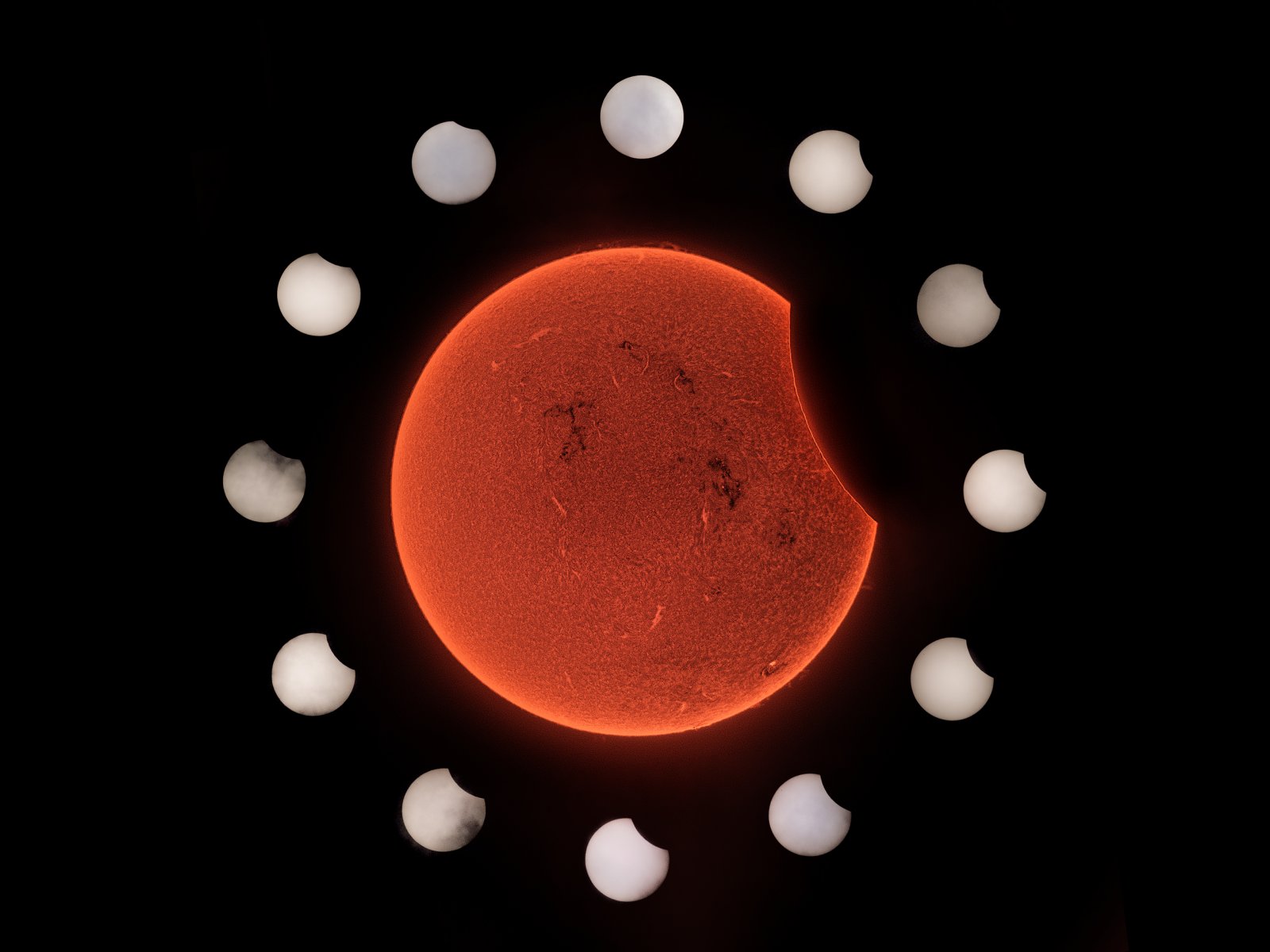
Let's move on to the present. We have an image by the creative duo Michal Šrejber and Marek Tušl, titled "The Sun Through the Eyes of Hydrogen." The authors used the solar eclipse of March 29, 2025, to create a striking photographic composition. They used observations in what is called "white light," meaning as it can be seen with the naked eye, of course with appropriate eye protection. These black and white images of the solar photosphere are surrounded by a central, reddish view of the solar chromosphere. Although displayed in a negative image, we can still see active regions in a dark representation. Conversely, the sunspots and prominences visible from above appear bright. The solar chromosphere lies above the photosphere on the Sun. It is only about 3,000 to 5,000 km thick, roughly the radius of the Earth. It is relatively transparent, more so than the photosphere below, which allows us to observe it beneath. To the right, and indeed for images of the photosphere as well, the Moon (or perhaps a dragon?) appears to "bite" into the Sun.
Observing this solar eclipse was quite dramatic. The weather played tricks on the observers, and some didn't see even a glimpse of the eclipse. Others, like our authors, were lucky, as they were able to observe the phenomenon, even with some cloud cover.
"We would like to thank the authors for reminding us of this unusual astronomical phenomenon, and of course for submitting their composition to the Czech Astrophotography of the Month competition. The Czech Astronomical Society joins the competition jury in congratulating them," said Marcel Bělík of the Úpice Observatory, representing the jury of the CAM (Czech Astrophotography of the Month).
Author: Michal Šrejber and Marek Tušl
Title: The Sun Through the Eyes of Hydrogen
Location: Hradec Králové
Date: March 29, 2025
Sensor: Canon 6D + Zwo ASI 585 MC
Optics: Canon EF 200mm f/2.8L II USM + LUNT LS60THa
Mount: Tripod + Lasmondy robotic mount
Description: The Sun in hydrogen spectrum, processed using PIPP (debayering), Autostakkert (stacking), AstraImage (deconvolution), IMPPG (inversion), and cosmetic adjustments in Adobe Photoshop. The surrounding Sun was processed in Adobe Lightroom and then assembled into a composition in Adobe Photoshop. Due to cloud cover, only 51 images were possible for the central Sun, while the surrounding Sun are single shots.
You can view the winning images for each month and more information at http://www.astro.cz/cam/.