
The following lines introduce a new work by the internationally renowned painter, philosopher, and geometer, Uljan Benoni. This somewhat enigmatic artist has lived and worked in Prague since 1994, and when asked about his formal education, he smiles and replies that his teacher was Leonardo da Vinci. As early as the 1980s, he developed the rules of elliptical perspective, and in 1991, he created "Patterns of the Evolution of Visual Art." He paints and draws using both traditional methods and his own unique technique, which he has presented in numerous exhibitions, such as in Geneva or Paris last year. In 2011, he painted a portrait of Queen Elizabeth in elliptical perspective, which is now part of the collection at Buckingham Palace.
Together with his wife, Veronika Benoni, also a successful painter (see main photo), they ran a gallery near Prague Castle for many years and founded the Benoni School for talented students, which operates in the style of Renaissance art workshops. Between 2001 and 2009, their gallery hosted 24 exhibitions.
Art is Science
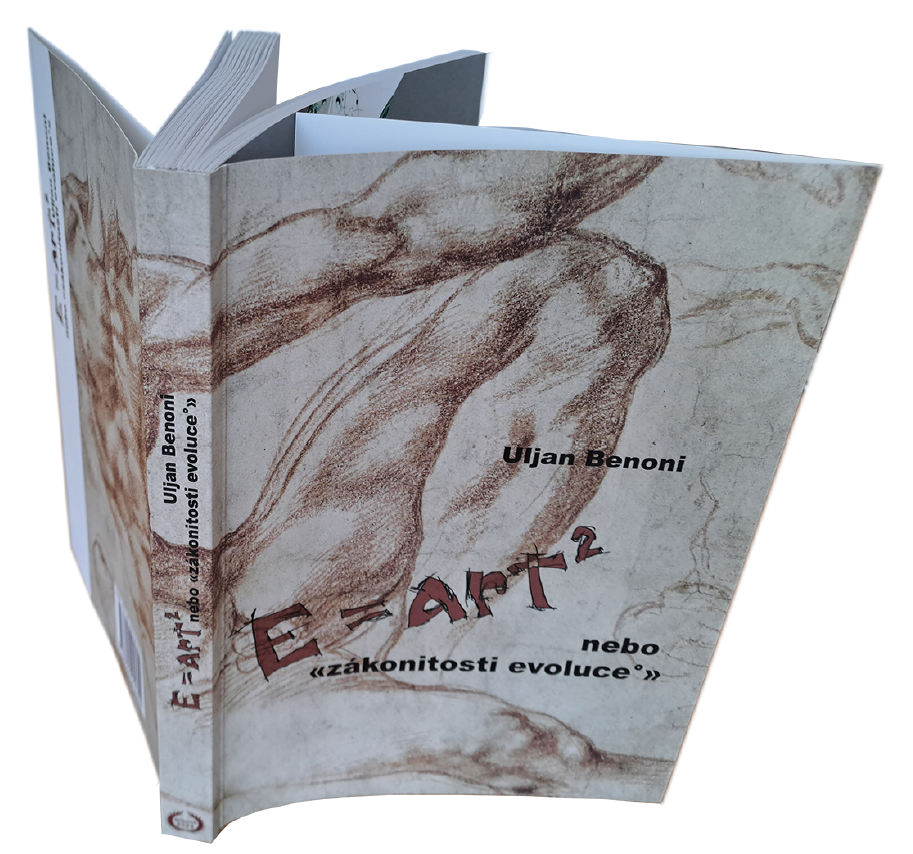
The publication being reviewed below was recently released under a somewhat complex title that resembles a riddle: E = ART² or "the laws of evolution" (BUbook Publishing, Prague, 2025). It is primarily intended for art historians, painting instructors, or art critics. However, artists themselves will undoubtedly appreciate it as well, especially those who reflect on their work, seek new paths, and do not simply create intuitively based on their talent. However, it will not appeal to those who hold the traditional view that art, creativity, is something unpredictable, inexplicable, and spontaneous; that there are no laws or rules in this area of human activity.
Uljan Benoni, on the other hand, seeks to demonstrate with his new work that art fits into the same strict framework of development as any other science. Hence the external similarity of the book's title to Einstein's famous formula. E in this formula is a symbol for evolution. Since human development is primarily reflected in culture, the author argues that art can be considered the highest expression of culture. E = ART² should therefore be understood as art reflecting the evolution of the human spirit twofold. The exponent suggests a connection to the scientific and mathematical language, and it places visual art among the exact sciences.
One may disagree with or debate the author's premise, but Benoni's explanation of the different stages in the development of, especially, visual art is not without logic. The author emphasizes the change in human perception of space. The work therefore presents an analysis of the ways in which space is depicted on a plane, from cave paintings to the present day.

A Broad Overview in Fifteen Chapters
The publication's rich content logically develops from antiquity, where the author delves into the mindset of our ancestors and records the abstract beginnings of visual art. Through subsequent chapters on the awareness of space and one's place within it, Benoni explores the conventions of perceiving and representing reality in a two-dimensional plane, drawing on the role of religious canons in visual art and emphasizing the importance of so-called "inverted perspective." He also introduces the concept of "spatial drawing," explaining what "dimension" and "the conventions of three-dimensional space" are.
From the sixth chapter onwards, the book presents new demands on visual art, creating space for the emergence of Impressionism and the Renaissance. The author analyzes the differences and explains the concept of linear thinking.
From the eighth chapter, the theoretical work on visual art intensifies. The reader is introduced to the concept of panorama and the history of panoramic representations, including the characteristics of panoramic compositions, as well as the principles of new tasks facing graphic artists and painters. We then move on to the geometry of two-dimensional space, including a section on "Advertising and Us."
The Essence of the Book...
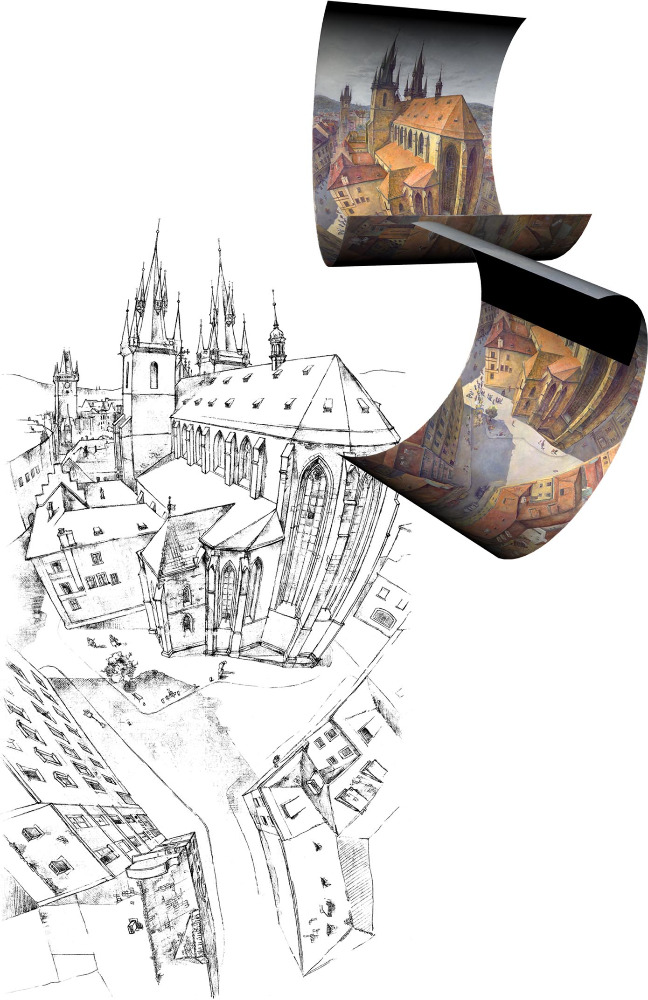
...lies in the author's exploration of "the history of seeking the new," "elliptical perspective," "subjects of elliptical representations," and "The Mystery of Presence." The highlight of the publication, richly illustrated with examples of drawings, graphic design, and technical drawings by Uljana Benoni, is the fifteenth chapter, which explores the specifics of the "Sphere" as a possible way of artistically representing the surrounding world. The central message of his reflections is that, regardless of the perspective used, a person sees the world from a specific point, which is the center of their awareness of space—a point where information about what they see is gathered and processed. According to the author, it is legitimate to call this point "I." Therefore, if we assume that "I am the center of the world I see," then we obtain a formula for three-dimensional perspective. This is a new approach, a new philosophy of spatial awareness, which opens up previously unimagined possibilities. The book provides interesting examples of this.
In conclusion, Benoni discusses the problems brought about by our hyper-technologized twenty-first century, including new artistic tools, such as digital creation, computer work, and tasks assigned to so-called artificial intelligence. This is a time when the old truth that landscape painters are primarily recruited from those who cannot draw the human figure no longer holds true. It is a time when visual artists no longer strive to engage the public with honest skill and perfect craftsmanship, but also with ugliness, perversion, and shock, in an attempt to stand out and attract attention, based on the saying that the end justifies the means, and even bad publicity is good publicity.
